Magazine
pp. 37-38 · Read in the full issue
Fiji, Sixth Star For The
Australasian Federation
By A. M. Quanchi
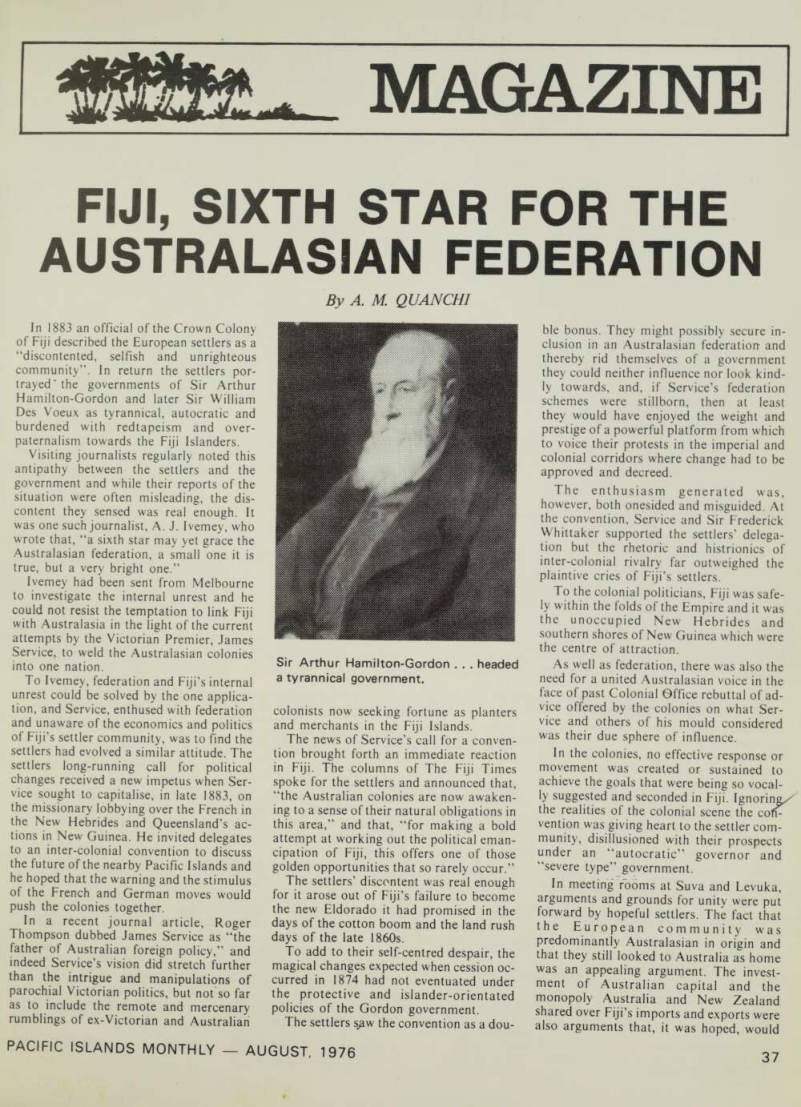
In 1883 an official of the Crown Colony of Fiji described the European settlers as a “discontented, selfish and unrighteous community”. In return the settlers por trayed’the governments of Sir Arthur Hamilton-Gordon and later Sir William Des Voeux as tyrannical, autocratic and burdened with redtapeism and over paternalism towards the Fiji Islanders.
Visiting journalists regularly noted this antipathy between the settlers and the government and while their reports of the situation were often misleading, the dis content they sensed was real enough. It was one such journalist, A. J. Ivemey, who wrote that, “a sixth star may yet grace the Australasian federation, a small one it is true, but a very bright one.”
Ivemey had been sent from Melbourne to investigate the internal unrest and he could not resist the temptation to link Fiji with Australasia in the light of the current attempts by the Victorian Premier, James Service, to weld the Australasian colonies into one nation.
To Ivemey, federation and Fiji’s internal unrest could be solved by the one applica tion, and Service, enthused with federation and unaware of the economics and politics of Fiji’s settler community, was to find the settlers had evolved a similar attitude. The settlers long-running call for political changes received a new impetus when Ser vice sought to capitalise, in late 1883, on the missionary lobbying over the French in the New Hebrides and Queensland’s ac tions in New Guinea. He invited delegates to an inter-colonial convention to discuss the future of the nearby Pacific Islands and he hoped that the warning and the stimulus of the French and German moves would push the colonies together.
In a recent journal article, Roger Thompson dubbed James Service as “the father of Australian foreign policy,” and indeed Service’s vision did stretch further than the intrigue and manipulations of parochial Victorian politics, but not so far as to include the remote and mercenary rumblings of ex-Victorian and Australian
colonists now seeking fortune as planters and merchants in the Fiji Islands.
The news of Service’s call for a conven tion brought forth an immediate reaction in Fiji. The columns of The Fiji Times spoke for the settlers and announced that, “the Australian colonies are now awaken ing to a sense of their natural obligations in this area,” and that, “for making a bold attempt at working out the political eman cipation of Fiji, this offers one of those golden opportunities that so rarely occur.”
The settlers’ discontent was real enough for it arose out of Fiji’s failure to become the new Eldorado it had promised in the days of the cotton boom and the land rush days of the late 1860 s.
To add to their self-centred despair, the magical changes expected when cession oc curred in 1874 had not eventuated under the protective and islander-orientated policies of the Gordon government.
The settlers the convention as a dou
ble bonus. They might possibly secure in clusion in an Australasian federation and thereby rid themselves of a government they could neither influence nor look kind ly towards, and, if Service’s federation schemes were stillborn, then at least they would have enjoyed the weight and prestige of a powerful platform from which to voice their protests in the imperial and colonial corridors where change had to be approved and decreed.
The enthusiasm generated was, however, both onesided and misguided. At the convention, Service and Sir Frederick Whittaker supported the settlers' delega tion but the rhetoric and histrionics of inter-colonial rivalry far outweighed the plaintive cries of Fiji’s settlers.
To the colonial politicians, Fiji was safe ly within the folds of the Empire and it was the unoccupied New Hebrides and southern shores of New Guinea which were the centre of attraction.
As well as federation, there was also the need for a united Australasian voice in the face of past Colonial Office rebuttal of ad vice offered by the colonies on what Ser vice and others of his mould considered was their due sphere of influence.
In the colonies, no effective response or movement was created or sustained to achieve the goals that were being so vocal ly suggested and seconded in Fiji. Ignoring/ the realities of the colonial scene the con vention was giving heart to the settler com munity, disillusioned with their prospects under an “autocratic” governor and “severe type” government.
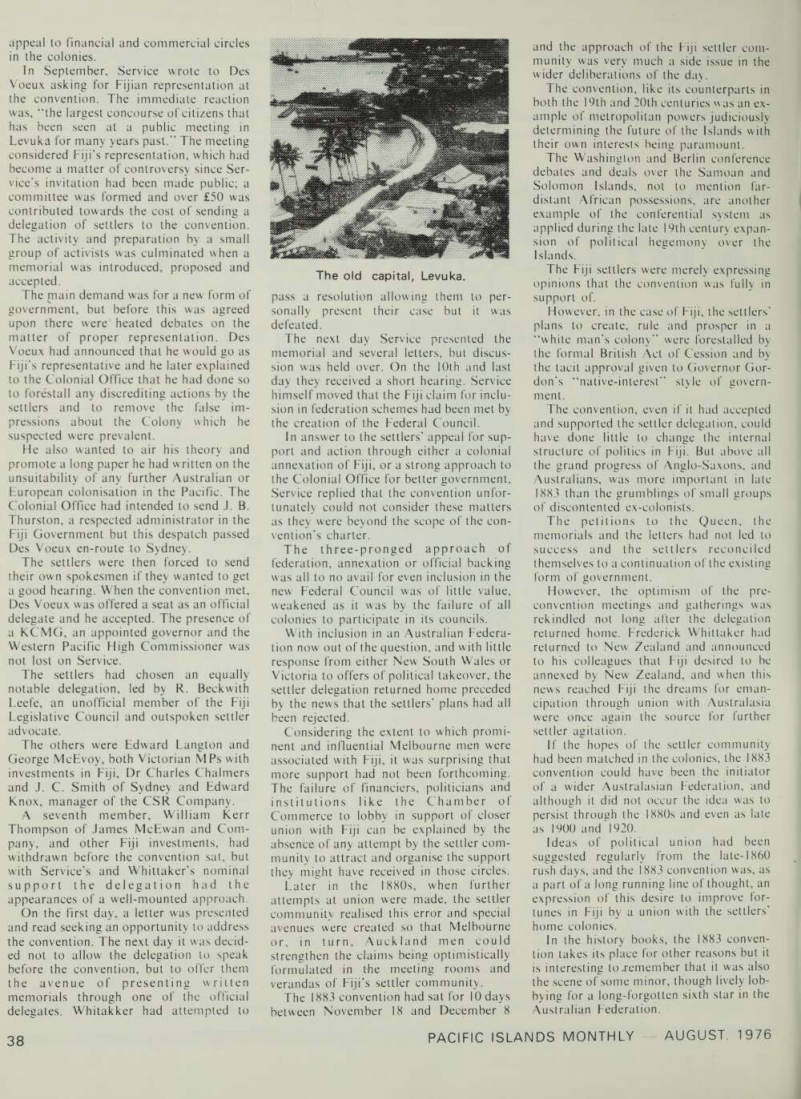
In meeting' rooms at Suva and Levuka, arguments and grounds for unity were put forward by hopeful settlers. The fact that
the European community was
predominantly Australasian in origin and that they still looked to Australia as home was an appealing argument. The invest ment of Australian capital and the monopoly Australia and New Zealand shared over Fiji’s imports and exports were also arguments that, it was hoped, would
Sir Arthur Hamilton-Gordon . . . headed a tyrannical government.
appeal to financial and commercial circles in the colonies.
In September, Service wrote to Des Voeux asking for Fijian representation at the convention. The immediate reaction was, “the largest concourse of citizens that has been seen at a public meeting in Levuka for many years past.” The meeting considered Fiji's representation, which had become a matter of controversy since Ser vice's invitation had been made public; a committee was formed and over £5O was contributed towards the cost of sending a delegation of settlers to the convention.
The activity and preparation by a small group of activists was culminated when a memorial was introduced, proposed and accepted.
The main demand was for a new form of government, but before this was agreed upon there were heated debates on the matter of proper representation. Des Voeux had announced that he would go as Fiji's representative and he later explained to the Colonial Office that he had done so to forestall any discrediting actions by the settlers and to remove the false im pressions about the Colony which he suspected were prevalent.
He also wanted to air his theory and promote a long paper he had written on the unsuitability of any further Australian or European colonisation in the Pacific. The Colonial Office had intended to send J. B.
Thurston, a respected administrator in the Fiji Government but this despatch passed Des Voeux en-route to Sydney.
The settlers were then forced to send their own spokesmen if they wanted to get a good hearing. When the convention met, Des Voeux was offered a seal as an official delegate and he accepted. The presence of a KCMG, an appointed governor and the Western Pacific High Commissioner was not lost on Service.
The settlers had chosen an equally notable delegation, led by R. Beckwith Leefe, an unofficial member of the Fiji Legislative Council and outspoken settler advocate.
The others were Edward Langton and George McEvoy, both Victorian MPs with investments in Fiji, Dr Charles Chalmers and J. C. Smith of Sydney and Edward Knox, manager of the CSR Company.
A seventh member, William Kerr Thompson of James McEwan and Com pany, and other Fiji investments, had withdrawn before the convention sal, but with Service’s and Whittaker's nominal support the delegation had the appearances of a well-mounted approach.
On the first day, a letter was presented and read seeking an opportunity to address the convention. The next day it was decid ed not to allow the delegation to speak before the convention, but to offer them the avenue of presenting written memorials through one of the official delegates. Whitakker had attempted to
pass a resolution allowing them to per sonally present their case but it was defeated.
The next day Service presented the memorial and several letters, but discus sion was held over. On the 10th and last day they received a short hearing. Service himself moved that the Fiji claim for inclu sion in federation schemes had been met by the creation of the Federal Council.
In answer to the settlers' appeal for sup port and action through either a colonial annexation of Fiji, or a strong approach to the Colonial Office for belter government.
Service replied that the convention unfor tunately could not consider these matters as they were beyond the scope of the con vention’s charter.
The three-pronged approach of
federation, annexation or official backing was all to no avail for even inclusion in the new Federal Council was of little value, weakened as it was by the failure of all colonies to participate in its councils.
With inclusion in an Australian Federa tion now out of the question, and with little response from either New South Wales or Victoria to offers of political takeover, the settler delegation returned home preceded by the news that the settlers' plans had all been rejected.
Considering the extent to which promi nent and influential Melbourne men were associated with Fiji, it was surprising that more support had not been forthcoming.
The failure of financiers, politicians and institutions like the Chamber of Commerce to lobby in support of closer union with Fiji can be explained by the absence of an> attempt by the settler com munity to attract and organise the support they might have received in those circles.
Later in the 1880 s, when further attempts at union were made, the settler community realised this error and special avenues were created so that Melbourne or, in turn, Auckland men could strengthen the claims being optimistically formulated in the meeting rooms and verandas of Fiji’s settler community.
The 1883 convention had sal for 10 days between November 18 and December 8
and the approach of the Fiji settler com munity was very much a side issue in the wider deliberations of the day.
The convention, like its counterparts in both the 19th and 20th centuries was an ex ample of metropolitan powers judiciously determining the future of the Islands with their own interests being paramount.
The Washington and Berlin conference debates and deals over the Samoan and Solomon Islands, not to mention far distant African possessions, are another example of the conferential system as applied during the late 19th century expan sion of political hegemony over the Islands.
The Fiji settlers were merely expressing
opinions that the convention was fully in support of.
However, in the case of Fiji, the settlers' plans to create, rule and prosper in a “while man's colony" were forestalled by the formal British Act of Cession and by the tacit approval given to Governor Gor don's “native-interest" style of govern ment.
The convention, even if it had accepted and supported the settler delegation, could have done little to change the internal structure of politics in Fiji. But above all the grand progress of Anglo-Saxons, and Australians, was more important in late 1883 than the grumblings of small groups of discontented ex-colonists.
The petitions to the Queen, the memorials and the letters had not led to success and the settlers reconciled themselves to a continuation oflhe existing form of government.
However, the optimism of the pre convention meetings and gatherings was rekindled not long after the delegation returned home. Frederick Whittaker had returned to New Zealand and announced to his colleagues that Fiji desired to be annexed by New Zealand, and when this news reached Fiji the dreams for eman cipation through union with Australasia were once again the source for further settler agitation.
If the hopes of the settler community had been matched in the colonies, the 1883 convention could have been the initiator of a wider Australasian Federation, and although it did not occur the idea was to persist through the 1880 s and even as late as 1900 and 1920.
Ideas of political union had been suggested regularly from the late-1860 rush days, and the 1883 convention was, as a part of a long running line of thought, an expression of this desire to improve for tunes in Fiji by a union with the settlers' home colonies.
In the history books, the 1883 conven tion takes its place for other reasons but it is interesting to .remember that it was also the scene of some minor, though lively lob bying for a long-forgotten sixth star in the Australian Federation.
The old capital, Levuka.