Bringing The
p. 32 · Read in the full issue
An escape from museum cellars
By W. G. Coppell
It must be one of the sorrows of those whose hearts dwell in the Pacific Islands that all too frequently the infinite variety and great vigour married to beauty of the arts and crafts of the Islands people is un known to the majority of the common peo ple who visit museums and galleries throughout the world.
It is usual to see on display myriads of Etruscan vases, mountains of Ming ware, heaps of Roman coins, crowds of icons and masses of medieval religious paintings.
The output of the indigenous peoples of the Pacific goes largely unacknowledged. Go to the British Museum I doubt that there you will see a single item of significance from the Pacific region. Go to the Museum of Mankind, and there, if you are lucky, you may see a few treasures, set among composite displays. Then the answer is given to you if you can es tablish your credentials as a serious “scholar” you will be given permission to go to the British Museum’s storerooms and there will be laid out before you the very soul of much of the creativity of the Islanders, carvings, tapa, weapons, god figures, masks, fish-hooks they are all there.
The pity of it all is that in the homelands of these artefacts little now remains to show the people the true achievements of their forefathers. Not all museums are guilty of neglecting the Pacific the dis
plays and the meticulous attention of the Dahlem Museum in West Berlin have created a monument of the Islanders' craft. But the disappointments are all too shattering. The collections in Vienna, for instance, are incredibly crude, and the ethnological museums of some of the British museums are equally uninspiring.
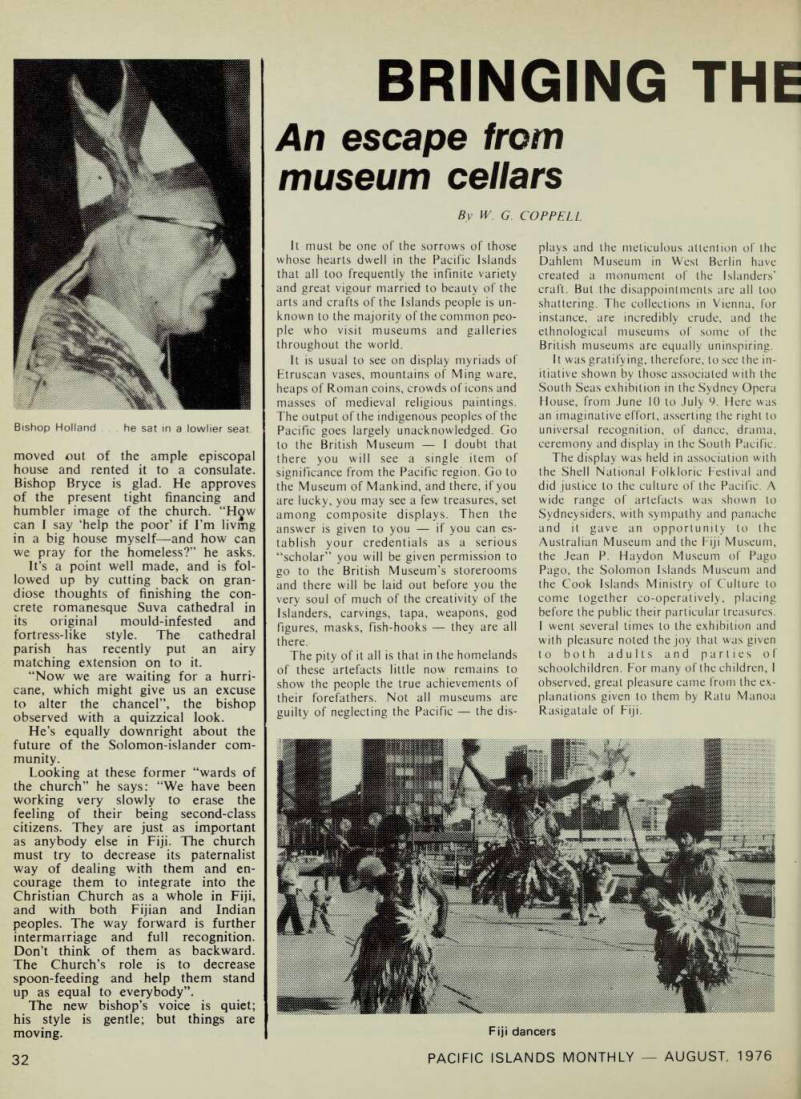
It was gratifying, therefore, to see the in itiative shown by those associated with the South Seas exhibition in the Sydney Opera House, from June 10 to July 9. Here was an imaginative effort, asserting the right to universal recognition, of dance, drama, ceremony and display in the South Pacific.
The display was held in association with the Shell National Folkloric Festival and did justice to the culture of the Pacific. A wide range of artefacts was shown to
Sydneysiders, with sympathy and panache
and it gave an opportunity to the Australian Museum and the Fiji Museum, the Jean P. Haydon Museum of Pago Pago, the Solomon Islands Museum and the Cook Islands Ministry of Culture to
come together co-operatively, placing
before the public their particular treasures.
I went several times to the exhibition and with pleasure noted the joy that was given to both adults and parties of schoolchildren. For many of the children, I observed, great pleasure came from the ex planations given to them by Ralu Manoa Rasigatale of Fiji.
Fiji dancers