Liquid Diocese
pp. 31-32 · Read in the full issue
The Quiet Bishop
With A Large
From JOHN GARRETT in Suva
When a group of Fiji’s church leaders firmly condemned the coun try’s peppery, anti-Indian politician Sakiasi Butadroka for holding views contrary to Christian teaching, they met to hatch their statement in the living room of the new Anglican Bishop in Polynesia, Jabez Bryce.
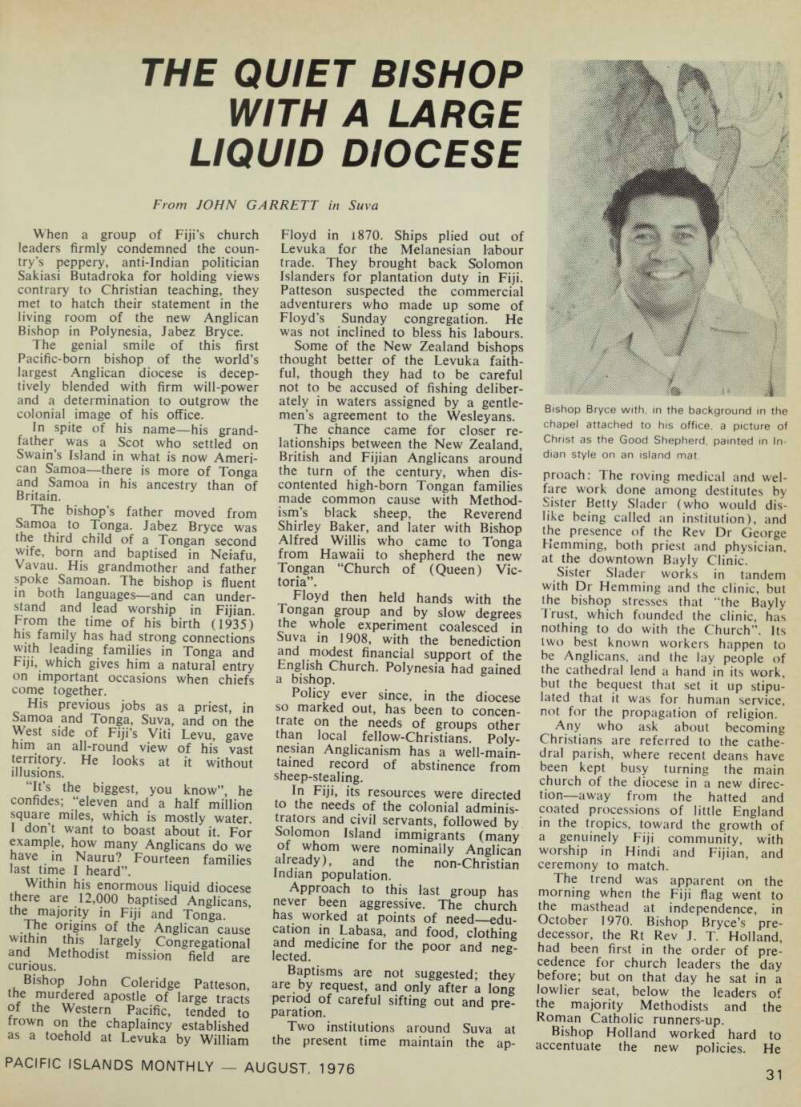
The genial smile of this first Pacific-bom bishop of the world’s largest Anglican diocese is decep tively blended with firm will-power and a determination to outgrow the colonial image of his office.
In spite of his name—his grand father was a Scot who settled on Swain’s Island in what is now Ameri can Samoa—-there is more of Tonga and Samoa in his ancestry than of Britain.
The bishop’s father moved from Samoa to Tonga. Jabez Bryce was the third child of a Tongan second wife, born and baptised in Neiafu, Vavau. His grandmother and father spoke Samoan. The bishop is fluent in both languages—and can under stand and lead worship in Fijian.
From the time of his birth (1935) his family has had strong connections with leading families in Tonga and Fiji, which gives him a natural entry on important occasions when chiefs come together.
His previous jobs as a priest, in Samoa and Tonga, Suva, and on the West side of Fiji’s Viti Levu, gave him an all-round view of his vast territory. He looks at it without illusions.
“It’s the biggest, you know”, he confides; “eleven and a half million square miles, which is mostly water.
I don’t want to boast about it. For example, how many Anglicans do we have in Nauru? Fourteen families last time I heard”.
Within his enormous liquid diocese there are 12,000 baptised Anglicans, the majority in Fiji and Tonga.
The origins of the Anglican cause within this largely Congregational and Methodist mission field are curious.
Bishop John Coleridge Patteson, the murdered apostle of large tracts of the Western Pacific, tended to frown on the chaplaincy established as a toehold at Levuka by William
Floyd in 1870. Ships plied out of Levuka for the Melanesian labour trade. They brought back Solomon Islanders for plantation duty in Fiji, Patteson suspected the commercial adventurers who made up some of Floyd’s Sunday congregation. He was not inclined to bless his labours.
Some of the New Zealand bishops thought better of the Levuka faith ful, though they had to be careful not to be accused of fishing deliber ately in waters assigned by a gentle men’s agreement to the Wesleyans.
The chance came for closer re lationships between the New Zealand, British and Fijian Anglicans around the turn of the century, when dis contented high-born Tongan families made common cause with Method ism’s black sheep, the Reverend Shirley Baker, and later with Bishop Alfred Willis who came to Tonga from Hawaii to shepherd the new Tongan “Church of (Queen) Vic toria”.
Floyd then held hands with the Tongan group and by slow degrees the whole experiment coalesced in Suva in 1908, with the benediction and modest financial support of the English Church. Polynesia had gained a bishop.
Polic y ever since, in the diocese so marked out, has been to concen trate on the needs of groups other than local fellow-Christians. Poly nesian Anglicanism has a well-main tamed record of abstinence from
sheep-stealing.
In Fiji, its resources were directed to the needs of the colonial adminis trators and civil servants, followed bv Solomon Island immigrants (many of whom were nominally Anglican and ,he "on-Chris.ian Indian population.
Appr ° ach ,0 th >s last group has never been aggressive. The church has worked at points of need-edu cation in Labasa, and food, clothing and medicine for the poor and neg lected. g Baptisms are not suggested; they are by request, and only after a long period of careful sifting out and pre paration. p Two institutions around Suva at the present time maintain the ap-
proach: The roving medical and wel fare work done among destitutes by Sister Betty Slader (who would dis like being called an institution), and the presence of the Rev Dr George Hemming, both priest and physician, at the downtown Bayly Clinic.
Sister Slader works in tandem with Dr Hemming and the clinic, but the bishop stresses that “the Bayly Trust, which founded the clinic, has nothing to do with the Church”. Its two best known workers happen to be Anglicans, and the lay people of the cathedral lend a hand in its work, but the bequest that set it up stipu lated that it was for human service, not for the propagation of religion.
Any who ask about becoming Christians are referred to the cathe dral parish, where recent deans have been kept busy turning the main church of the diocese in a new direc tion—away from the hatted and coated processions of little England in the tropics, toward the growth of a genuinely Fiji community, with worship in Hindi and Fijian, and ceremony to match.
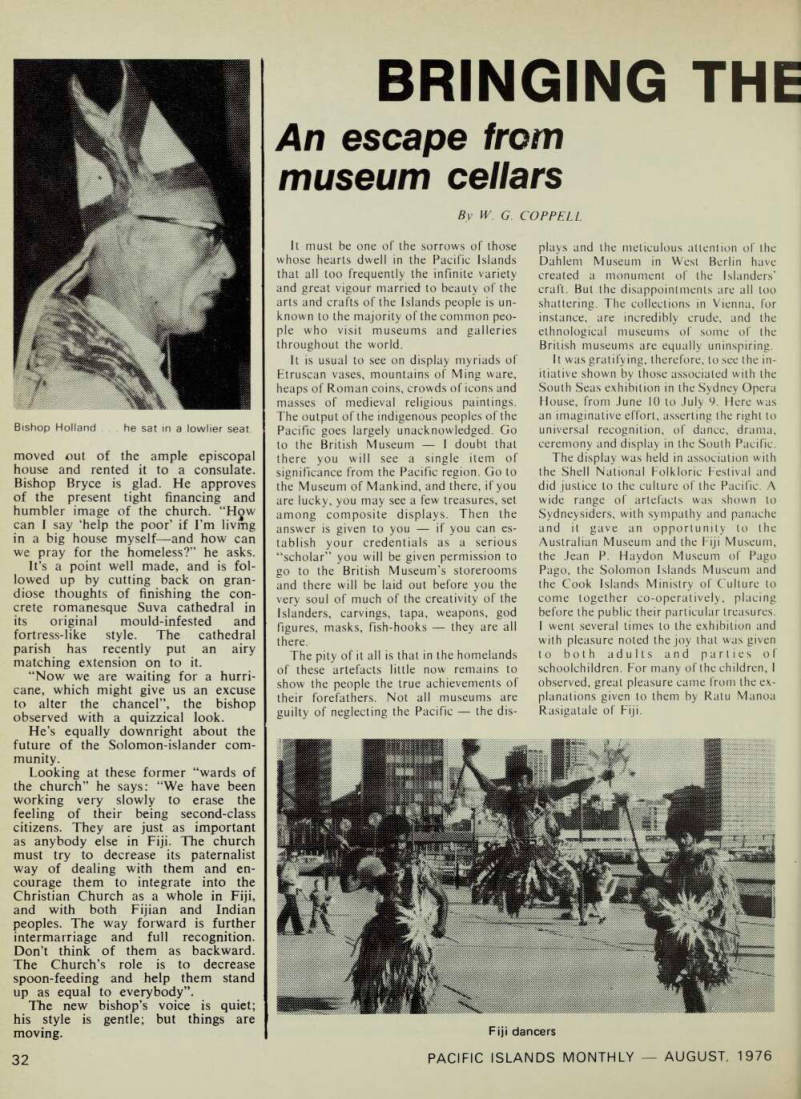
The trend was apparent on the morning when the Fiji flag went to the masthead at independence, in October 1970. Bishop Bryce’s pre decessor, the Rt Rev J. T. Holland, had been first in the order of pre cedence for church leaders the day before; but on that day he sat in a lowlier seat, below the leaders of the majority Methodists and the Roman Catholic runners-up.
Bishop Holland worked hard to accentuate the new policies. He
Bishop Bryce with, in the background in the chapel attached to his office, a picture of Christ as the Good Shepherd, painted in In dian style on an island mat.
moved out of the ample episcopal house and rented it to a consulate.
Bishop Bryce is glad. He approves of the present tight financing and humbler image of the church. “How can I say ‘help the poor’ if I’m livmg in a big house myself—and how can we pray for the homeless?” he asks.
It’s a point well made, and is fol lowed up by cutting back on gran diose thoughts of finishing the con crete romanesque Suva cathedral in its original mould-infested and fortress-like style. The cathedral parish has recently put an airy matching extension on to it.
“Now we are waiting for a hurri cane, which might give us an excuse to alter the chancel”, the bishop observed with a quizzical look.
He’s equally downright about the future of the Solomon-islander com munity.
Looking at these former “wards of the church” he says: “We have been working very slowly to erase the feeling of their being second-class citizens. They are just as important as anybody else in Fiji. The church must try to decrease its paternalist way of dealing with them and en courage them to integrate into the Christian Church as a whole in Fiji, and with both Fijian and Indian peoples. The way forward is further intermarriage and full recognition.
Don’t think of them as backward.
The Church’s role is to decrease spoon-feeding and help them stand up as equal to everybody”.
The new bishop’s voice is quiet; his style is gentle; but things are moving.
Bishop Holland he sat in a lowlier seat