Tbopicalities
pp. 20-24 · Read in the full issue

Upside down
Kon Tiki drift
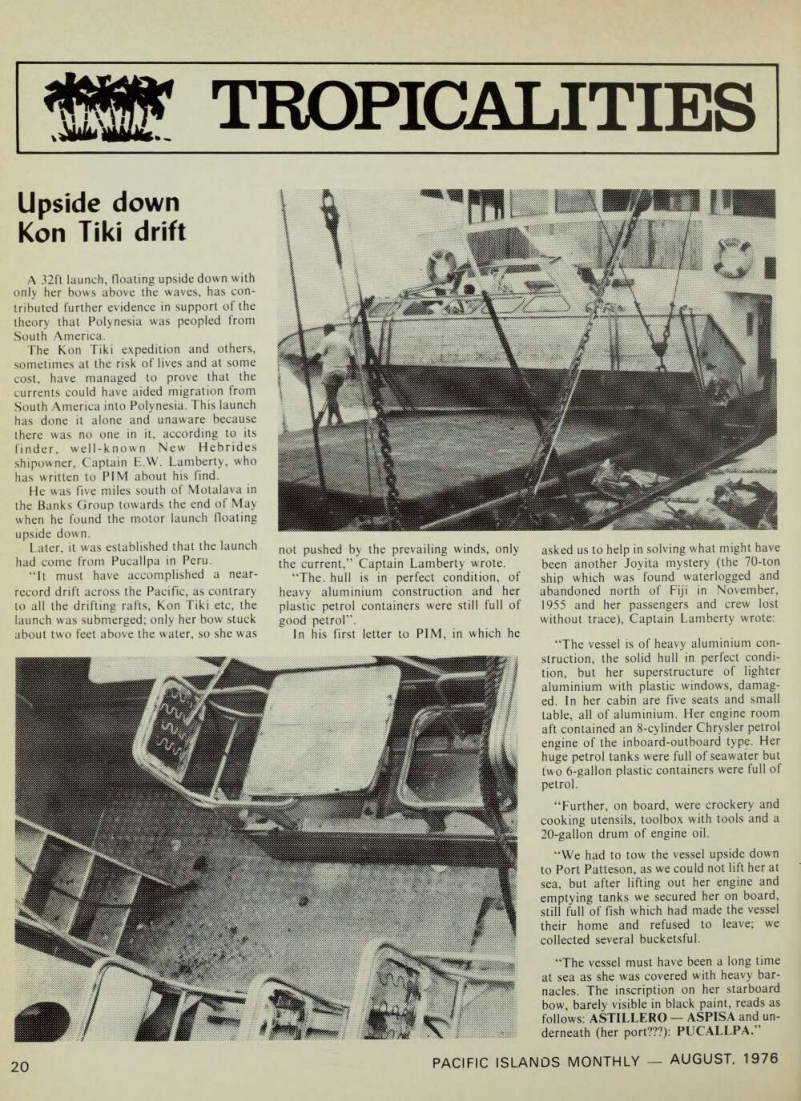
A 32ft launch, floating upside down with only her bows above the waves, has con tributed further evidence in support of the theory that Polynesia was peopled from South America.
The Kon Tiki expedition and others, sometimes at the risk of lives and at some cost, have managed to prove that the currents could have aided migration from South America into Polynesia. This launch has done it alone and unaware because there was no one in it, according to its finder, well-known New Hebrides shipowner. Captain E.W. Lamberty, who has written to PIM about his find.
He was five miles south of Motalava in the Banks Group towards the end of May when he found the motor launch floating
upside down.
Later, it was established that the launch had come from Pucallpa in Peru.
“It must have accomplished a near record drift across the Pacific, as contrary to all the drifting rafts, Kon Tiki etc, the launch was submerged; only her bow stuck about two feet above the water, so she was
not pushed by the prevailing winds, only the current,” Captain Lamberty wrote.
“The. hull is in perfect condition, of heavy aluminium construction and her plastic petrol containers were still full of
good petrol”.
In his first letter to PIM, in which he
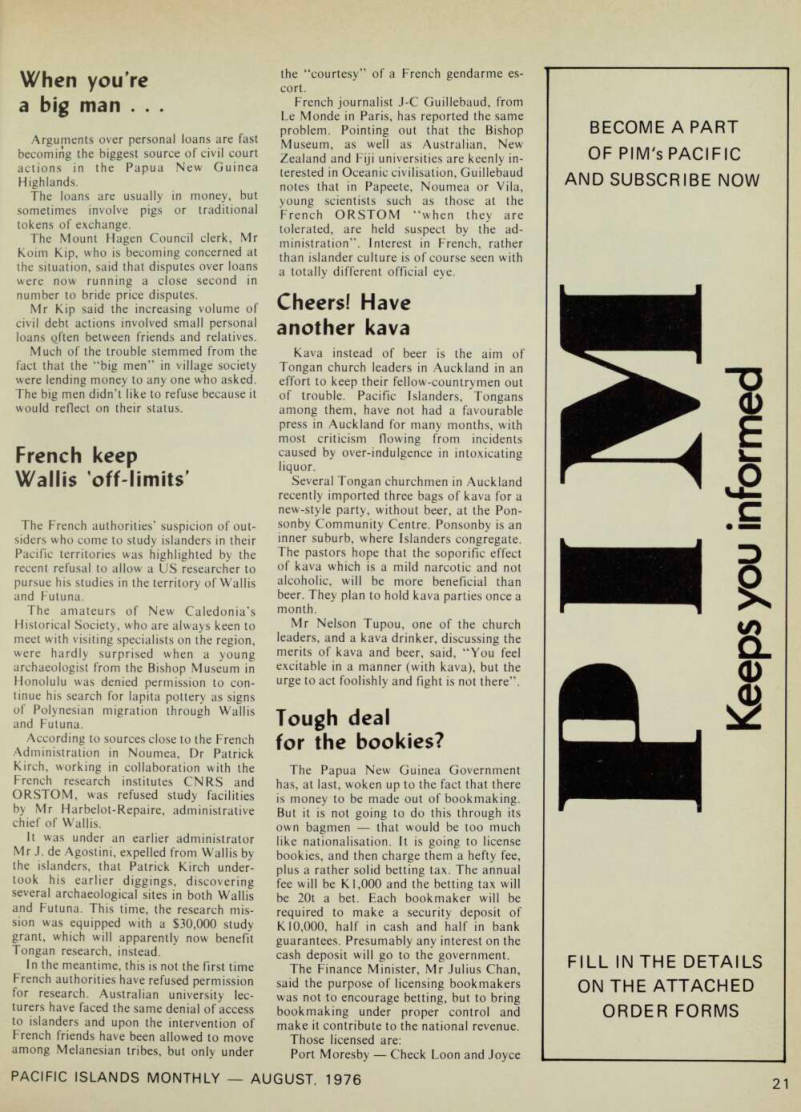
asked us to help in solving what might have been another Joyita mystery (the 70-ton ship which was found waterlogged and abandoned north of Fiji in November, 1955 and her passengers and crew lost without trace), Captain Lamberty wrote: “The vessel is of heavy aluminium con struction, the solid hull in perfect condi tion, but her superstructure of lighter aluminium with plastic windows, damag ed. In her cabin are five seats and small table, all of aluminium. Her engine room
aft contained an 8-cylinder Chrysler petrol
engine of the inboard-outboard type. Her huge petrol tanks were full of seawater but two 6-gallon plastic containers were full of
petrol.
“Further, on board, were crockery and cooking utensils, toolbox with tools and a 20-gallon drum of engine oil.
“We had to tow the vessel upside down to Port Patteson, as we could not lift her at sea, but after lifting out her engine and emptying tanks we secured her on board, still full of fish which had made the vessel their home and refused to leave; we collected several bucketsful.
“The vessel must have been a long time at sea as she was covered with heavy bar nacles. The inscription on her starboard bow, barely visible in black paint, reads as follows; ASTILLERO ASPISA and un derneath (her port???): PUCALLPA.”
When you’re
a big man . . .
Arguments over personal loans are fast becoming the biggest source of civil court actions in the Papua New Guinea
Highlands.
The loans are usually in money, but sometimes involve pigs or traditional tokens of exchange.
The Mount Hagen Council clerk, Mr Koim Kip, who is becoming concerned at the situation, said that disputes over loans were now running a close second in number to bride price disputes.
Mr Kip said the increasing volume of civil debt actions involved small personal loans often between friends and relatives.
Much of the trouble stemmed from the fact that the “big men” in village society were lending money to any one who asked.
The big men didn’t like to refuse because it would reflect on their status.
French keep
Wallis off-limits’
The French authorities’ suspicion of out siders who come to study islanders in their Pacific territories was highlighted by the recent refusal to allow a US researcher to pursue his studies in the territory of Wallis and Futuna.
The amateurs of New Caledonia’s Historical Society, who are always keen to meet with visiting specialists on the region, were hardly surprised when a young archaeologist from the Bishop Museum in Honolulu was denied permission to con tinue his search for lapita pottery as signs of Polynesian migration through Wallis and Futuna.
According to sources close to the French Administration in Noumea, Dr Patrick Kirch, working in collaboration with the French research institutes CNRS and ORSTOM, was refused study facilities by Mr Harbelot-Repaire, administrative chief of Wallis.
It was under an earlier administrator Mr J. de Agostini, expelled from Wallis by the islanders, that Patrick Kirch under took his earlier diggings, discovering several archaeological sites in both Wallis and Futuna. This time, the research mis sion was equipped with a $30,000 study grant, which will apparently now benefit Tongan research, instead.
In the meantime, this is not the first time French authorities have refused permission for research. Australian university lec turers have faced the same denial of access to islanders and upon the intervention of French friends have been allowed to move among Melanesian tribes, but only under
the “courtesy” of a French gendarme es cort.
French journalist J-C Guillebaud, from Le Monde in Paris, has reported the same problem. Pointing out that the Bishop Museum, as well as Australian, New Zealand and Fiji universities are keenly in terested in Oceanic civilisation, Guillebaud notes that in Papeete, Noumea or Vila, young scientists such as those at the French ORSTOM “when they are tolerated, are held suspect by the ad ministration”. Interest in French, rather than islander culture is of course seen with a totally different official eye.
Cheers! Have
another kava
Kava instead of beer is the aim of Tongan church leaders in Auckland in an effort to keep their fellow-countrymen out of trouble. Pacific Islanders, Tongans among them, have not had a favourable press in Auckland for many months, with most criticism flowing from incidents caused by over-indulgence in intoxicating
liquor.
Several Tongan churchmen in Auckland recently imported three bags of kava for a new-style party, without beer, at the Pon sonby Community Centre. Ponsonby is an inner suburb, where Islanders congregate.
The pastors hope that the soporific effect of kava which is a mild narcotic and not alcoholic, will be more beneficial than beer. They plan to hold kava parties once a month.
Mr Nelson Tupou, one of the church leaders, and a kava drinker, discussing the merits of kava and beer, said, “You feel excitable in a manner (with kava), but the urge to act foolishly and fight is not there”.
Tough deal
for the bookies?
The Papua New Guinea Government has, at last, woken up to the fact that there is money to be made out of bookmaking.
But it is not going to do this through its own bagmen that would be too much like nationalisation. It is going to license bookies, and then charge them a hefty fee, plus a rather solid betting tax. The annual fee will be K 1,000 and the betting tax will be 20t a bet. Each bookmaker will be required to make a security deposit of K 10,000, half in cash and half in bank guarantees. Presumably any interest on the cash deposit will go to the government.
The Finance Minister, Mr Julius Chan, said the purpose of licensing bookmakers was not to encourage betting, but to bring bookmaking under proper control and make it contribute to the national revenue.
Those licensed are: Port Moresby Check Loon and Joyce
Seeto; Matthew Ning and Keith Seeto; James Dwyer; PNG Tattersalls Pty Ltd (Albert Chan and Patrick Chan). Rabaul Max Grundy and Alan Tong; Samson Syndicate (Basil Chan, Peter Seeto, Dominic Seeto); TAB‘Syndicate (Alan Seeto, Tong Seeto, Richard Seeto, Terry Seeto); PNG Tattersalls Pty Ltd (Albert Chan, Patrick Chan). Lae Greig and Phylis Baldwin; Better Price Syndicate (T.M. Hilliard, J.C. Hilliard, K.A. Brown, R.K. Gosbell); PNG Tattersalls Pty Ltd (Albert Chan, Patrick Chan).
Kimbe Morris Ling. Wewak Thomas Cole; Robert Leong and Richard Seeto. Madang Michael and Diana Cassell; Thomas Cole. Mt Hagen Keith Levy; Thomas Cole. Goroka John Frame and Brian Lynch. Kieta Stanley Neal, John Davidson.
A tale of
Suva’s dogs
Packs of dogs have often been the bane of life for residents in Fiji. Their noise at night can reach Satanic heights. They represent a threat to the life of family pets and injury to children and adults alike, and they become scavengers supreme.
“I met an old Catholic priest in Suva one day and he told me a tale of dogs, priests and poison in days long past,” writes a PIM man.
“Many years ago a number of priests were housed together in a presbytery in Suva, and among their number was one who wished evil upon all canines. He could not abide them under any circumstances and, above all, their barking and howling aroused in him great rage. Another priest was given to practical joking and took pleasure in taking an evening stroll in the gardens, and at an appropriate moment would let out a banshee howl. All the dogs in Suva would respond to the utter dismay of our anti-dog man.
“These antics played on a particular Fri day evening proved too much for the long suffering priest. The next morning saw him in the shops of Suva. First he called at the butcher’s and bought a large slab of meat; there was a visit to the chemist’s to obtain a generous supply of strychnine.
“The afternoon was spent in preparing a large number of poison-laden pellets, then in the evening he too went for a stroll, not in the garden, but around and about in Suva’s streets.
“My friend told me of the outcome. He was teaching at the Catholic primary school and on Monday morning he took his class for an excursion through Suva. As they moved along he heard the boys ex claim, ‘Oh! look father, there’s a dead dog’, and, ‘Father there’s another’, and ‘Look! look! Father! there’re two more dead dogs!’ ”
He concluded his tale by saying, “You know, I think that priest killed every dog in Suva. In the end we had to send him back to his order in New Zealand for we feared for the dog population of the whole of Fiji.”
Preserving the
islands’ past
Pastor Bwere Eritaia has gone home to the Gilbert Islands to “preach a new gospel.” That’s how he sums up what he learnt at the UNESCO South Pacific workshop on archaeological sites and artefacts.
A dozen Pacific countries were represented at the Auckland workshop, which ranged from how to file information to field days where work was going on.
“They now realise they’re not alone in their problems, or in what they’re trying to do,” says the New Zealand Historic Places
Trust archaeologist, Jim McKinlay.
“They’re all concerned to protect their national heritage and now they know a dozen other people involved in the same work that they can write to with ideas.
Some are working in well-established fields while others have yet to make a start.” Those taking part came from Australia, the Cook Islands, Fiji, the Gilberts, New Caledonia, the New Hebrides, New Zealand, Niue, Papua New Guinea, the Solomons, Tahiti and Tonga.
They’ve learnt that they must set up site and artefact recording programmes to es tablish what they actually have, press for laws to protect their heritage, and inspire others to help with the work, according to
Jim McKinlay.
“Some are doers, others are organisers,” he says. “They have to in volve national and local organisations, at government level and local enthusiasts, cultural societies and school children.”
The stamp
of success
Once upon a time there were a number of Cook Islands traders competing for the business of the territory’s outer islands. For all but one competition was, if not fair, at least above board, for these worthies all had ownership interests in the schooners, which travelled from the main centre to the
other places.
To add to their joys, they also had con tracts to transport the Sovereign’s mail.
The remaining trader, alas, was placed in an invidious position. He had to rely upon his rivals to transport his merchandise, and, with sharp business acumen, they made the best of a good thing. Either he paid at exorbitant freight rates, or he
would be forced to surrender his customers to his opponents.
However, he had several aces up his sleeve. He was a canny Scot, and he knew that the high-value postage stamps of his island home, franked by far-away resident agents-cum postmasters, had a far greater worth upon the philatelic market than in their mint condition.
Out to his loyal customers and possible recruits to his trading network went in structions for solving his dilemma, to the ■ satisfaction of all, except his protagonists.
It was a simple proposition. The ships had to carry HM’s mail; he would post everything his customers requested, sacks of flour, tins of kerosene, cabin biscuits, primus lamps . . . ; he would undercut the other traders, and there was only one stipulation his customers were honour bound to return to him all the postage
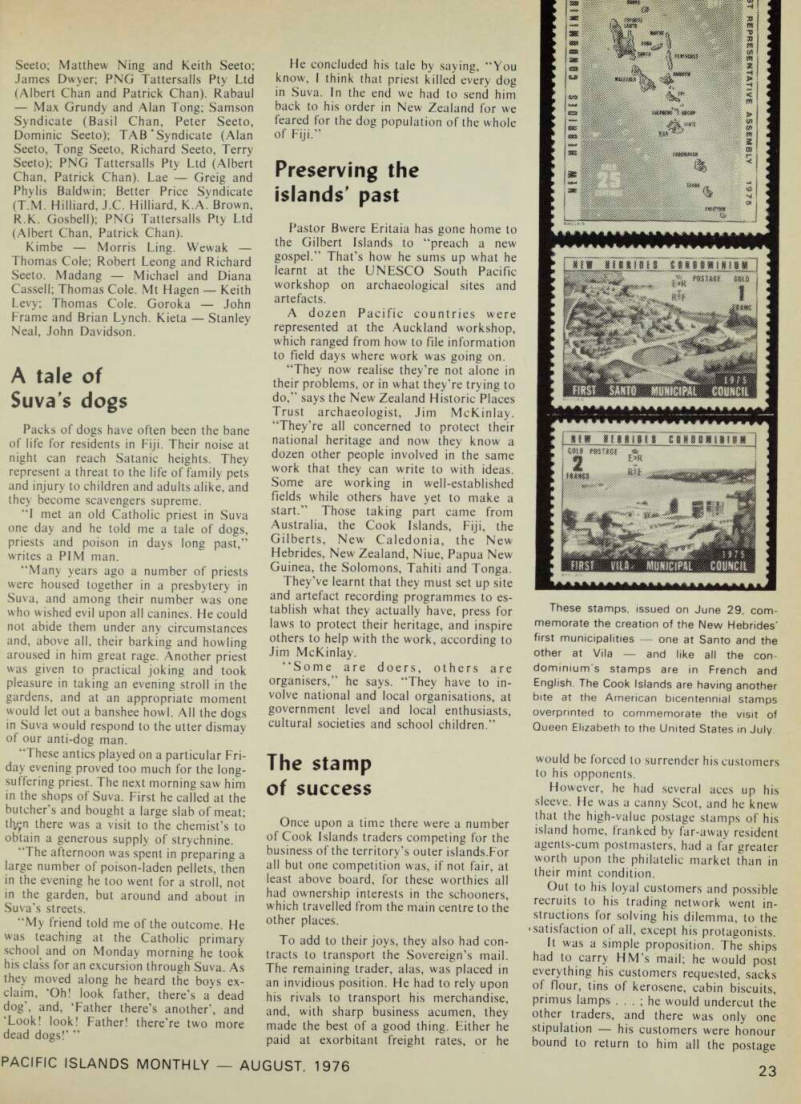
These stamps, issued on June 29, com memorate the creation of the New Hebrides' first municipalities one at Santo and the other at Vila and like all the con dominium's stamps are in French and English. The Cook Islands are having another bite at the American bicentennial stamps overprinted to commemorate the visit of Queen Elizabeth to the United States in July.
stamps on the goods and correspondence which passed between his headquarters and them.
To this enterprising fellow increased profits flowed. The government was pleas ed beyond measure at the unexpected in crease in the sale of postage stamps. The trader’s customers enjoyed having their goods delivered to them at competitive rates with the added security of the protec tion assured to HM’s mails, and the trader-shipowners were left to face the in evitable.
Eventually, the goods of our friend travelled on his colleague-traders’ vessels at the most attractive freight rates.
Farewell To
Jack Hackett
Jack Hackett, Fiji Government public relations officer for around 15 years, died in London towards the end of June while on a visit to his home country. He was 66 and had lived on borrowed time since 1963, when, after several massive heart attacks, Fiji doctors gave him less than 24 hours more in this world. He recovered and con tinued on his cheery, swashbuckling way.
That was typical of Jack, writes his friend for 47 years, John Carter. He didn’t let anything get him down. And this appears in the Tropicalities and not in the Deaths of Islands People section because he would prefer the colourful patches in his career to be part of PI M’s Tropicalities.
He wouldn’t like a formal obituary.
Edward John Fox Hackett was born in Royal Windsor, within sight of Windor Castle which is, perhaps, one reason why Queen Elizabeth sent her good wishes and signed portrait to him while he was in hospital in Lautoka recovering from his “coronaries”. He’d worked almost 24 hours a day for several days preparing the ground for the Royal Visit in February, 1963.
That message thrilled Jack. He was a royalist, but no sycophant. If he thought he was in the right, especially where his position as a journalist was concerned, the status of the person with whom he crossed swords didn’t matter.
I was with him at a meeting of the Fiji Legislative Council when the acting Colonial Secretary top man after the Governor approached and attempted to tell him how to report the council debate, one of the extra jobs Jack did for the radio.
He was working hard he always worked hard and the official’s suggestion would have been impossible to carry out.
“You can pi..off,” said Jack, and an astounded acting Colonial Secretary did just that, and never interfered again.
After World War II Jack became editor-in-chief of a group of weekly papers in Lancashire but he didn’t see it as a desk
job. He liked to be on the street and did many a job normally done by his reporters.
Although born in Windsor, it was Lan cashire that moulded him (and his accent!).
Apart from spending the war in the Royal Navy in which he rose to officer rank. Jack’s whole career was in jour nalism and public relations. He and I were on rival newspapers in Lancashire and later together in the same group. We parted company for a while when war came and after when, in 1953, he went to Malaya as Government Information Of ficer. We met again in Fiji.
He enjoyed that job in Malaya as much as anything else he ever did. The “Emergency” was on, an attempted com munist takeover. Jack didn’t stay at his desk. He hung a revolver round his middle, took pamphlets he had written and a loud hailer and went into the jungle with the ar my. His propaganda methods, together with his own idea of dropping “safe con duct” surrender leaflets from the air, paid off. Many terrorists gave themselves up and the Sultan of Selangor hung a medal on Jack.
He had other honours he never bragged about a commendation from the Direc tor of Operations in Malaya, the Royal Humane Society Parchment for saving a soldier from drowning and the OBE which he was awarded in 1967, a few years before he retired from the Fiji Government ser vice which he entered in 1957. His last few years in Fiji, up to a few months ago, were spent on public relations and publicity for the Pacific Harbour project at Deuba.
Much of his spare time was given to good causes. He helped to run the Fiji Hibiscus Festival in Suva; he was an early chairman of the Fiji Visitors Bureau, vice chairman for 10 years of the Warships Entertainment Committee and also the National Cession Day Committee.
Jack leaves a wife, Lena, son Michael, who is a surgeon in England, and a daughter, Jacqueline, ex-journalist and now a housewife in Canada. He’ll also be missed by Fiji’s Prime Minister, Ratu Sir Kamisese Mara. They had a long and warm association. They played scrabble together.
If Jack could be asked to comment on his own death I think he would say, as he said of anything he did that might be newsworthy, “Gerraway, it was nowt.”
Is It An Old
Soldier's Tale?
Schoolchildren, frightened of punish ment, may have started the rumour that a Japanese soldier is hiding in old wartime tunnels near Rabaul in PNG.
This is the opinion of police who are making a routine check into reported sightings of a “small, emaciated, hairy man” whom children claim is hiding in a maze of tunnels at Ulagunan.
The sightings have brought two Japanese officials to Rabaul to check the possibility that a soldier has been hiding in the area for more than 30 years since the Japanese wartime occupation of Rabaul.
Early evidence that a man was in the caves was given by schoolchildren who showed where someone had been raiding food gardens nearby. But some police and village leaders now believe there is a strong possibility that the children themselves raided the gardens and that the mystery man is a cover-up.
At the same time, however, wide publici ty has caused many people to genuinely believe they have seen the mystery man.
Police have taken several sworn statements from people who say they have seen a mystery man, but all the statements are from schoolchildren with ages ranging from 12 to 15, and police are becoming in creasingly sceptical about the affair.
One of the statements reports, “A bearded man wearing a torn army un iform”, and another tells of “A hairy man, definitely a Japanese man, swimming in the river”.
Meanwhile, a low-key search is being continued by some village people in the Ulagunan area and other volunteers. They have found eating utensils and some ar ticles of clothing in one of the caves which were dug by Japanese forced labour during World War Two and were used as store depots and equipment centres in addition to living quarters.
More than 100,000 Japanese were based at Rabaul at the height of the occupation, and many remained for several months after the war as members of cleaning-up gangs controlled by allied troops.
Japanese Embassy officials, however, are not leaving a stone unturned to find the mystery man, if he exists. They have scattered hundreds of leaflets through forests and villages near Rabaul bearing the appeal, “Soldier, come home. The war ended 30 years ago. There is no longer any danger to your safety. Come out now you can go back to Japan”. The police called the operation, “Operation Dewel”
Pidgin for a devil or phantom, which is less substantial than an old soldier.
Jack Hackett