Solomons
p. 19 · Read in the full issue
Independence
Talks In Nov.
In a surprising about-face the newly-elec ted Solomon Islands Legislative assembly in mid-July, about three weeks after the pre-independence elections, chose 33year-old Mr Peter Kenilorea as the Chief Minister. Favourite for the job was Mr Solomon Mamaloni, who was returned to the assembly with the largest major ity. It was obvious, however, that the elections in which seven ministers lost seats, had deprived him of support.
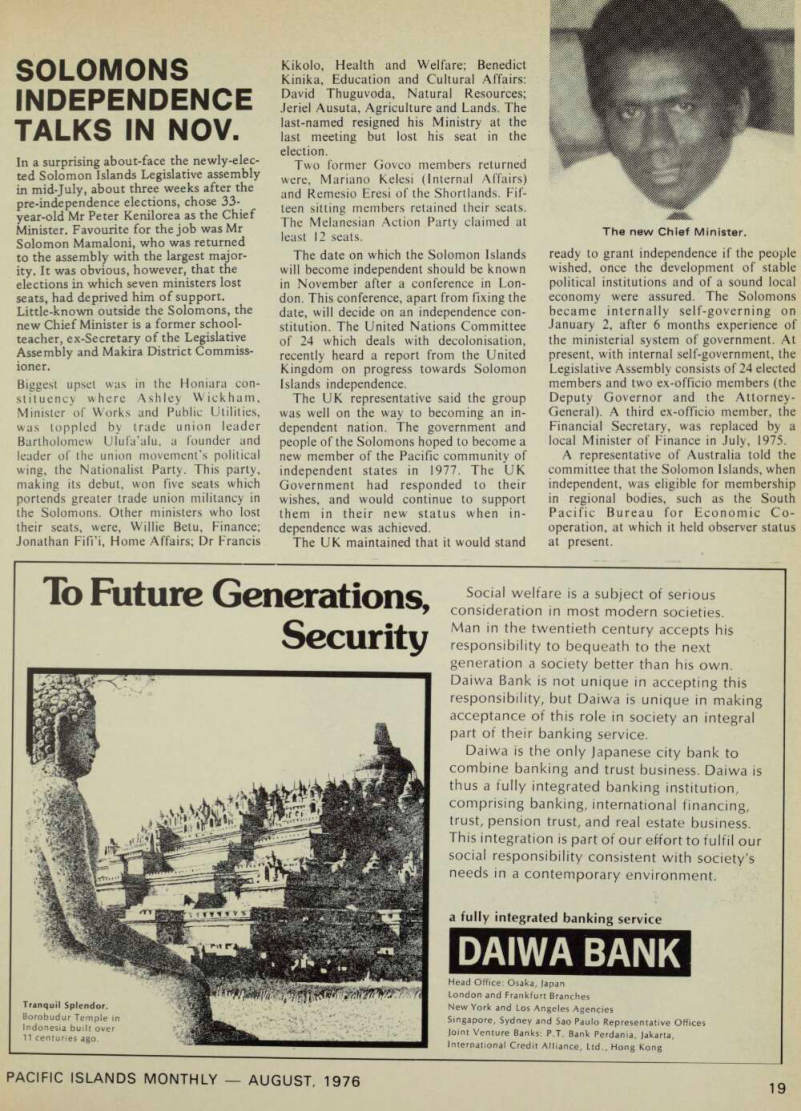
Little-known outside the Solomons, the new Chief Minister is a former school teacher, ex-Secretary of the Legislative Assembly and Makira District Commiss ioner.
Biggest upset was in the Honiara con stituency where Ashley Wickham, Minister of Works and Public Utilities, was toppled by trade union leader Bartholomew Ulufa’alu, a founder and leader of the union movement's political wing, the Nationalist Party. This party, making its debut, won five seats which portends greater trade union militancy in the Solomons. Other ministers who lost their seats, were, Willie Betu, Finance; Jonathan Fifi’i, Home Affairs; Dr Francis
Kikolo, Health and Welfare; Benedict Kinika, Education and Cultural Affairs: David Thuguvoda, Natural Resources; Jeriel Ausuta, Agriculture and Lands. The last-named resigned his Ministry at the last meeting but lost his seat in the election.
Two former Govco members returned were, Mariano Kelesi (Internal Affairs) and Remesio Eresi of the Shortlands. Fif teen sitting members retained their seats.
The Melanesian Action Party claimed at least 12 seats.
The date on which the Solomon Islands will become independent should be known in November after a conference in Lon don. This conference, apart from fixing the date, will decide on an independence con stitution. The United Nations Committee of 24 which deals with decolonisation, recently heard a report from the United Kingdom on progress towards Solomon Islands independence.
The UK representative said the group was well on the way to becoming an in dependent nation. The government and people of the Solomons hoped to become a new member of the Pacific community of independent states in 1977. The UK Government had responded to their wishes, and would continue to support them in their new status when in dependence was achieved.
The UK maintained that it would stand
ready to grant independence if the people wished, once the development of stable political institutions and of a sound local economy were assured. The Solomons became internally self-governing on January 2, after 6 months experience of the ministerial system of government. At present, with internal self-government, the Legislative Assembly consists of 24 elected members and two ex-officio members (the Deputy Governor and the Attorney- General). A third ex-officio member, the Financial Secretary, was replaced by a local Minister of Finance in July, 1975.
A representative of Australia told the committee that the Solomon Islands, when
independent, was eligible for membership
in regional bodies, such as the South Pacific Bureau for Economic Co operation, at which it held observer status at present.
The new Chief Minister,