Double
pp. 10-11 · Read in the full issue
Tahiti’S
Checkmate
From AL PRINCE in Papeete If French Polynesia ever becomes in dependent from France, historians un doubtedly will look back on June 10, 1976, as the day the cord uniting the two for 133 years began to unravel.
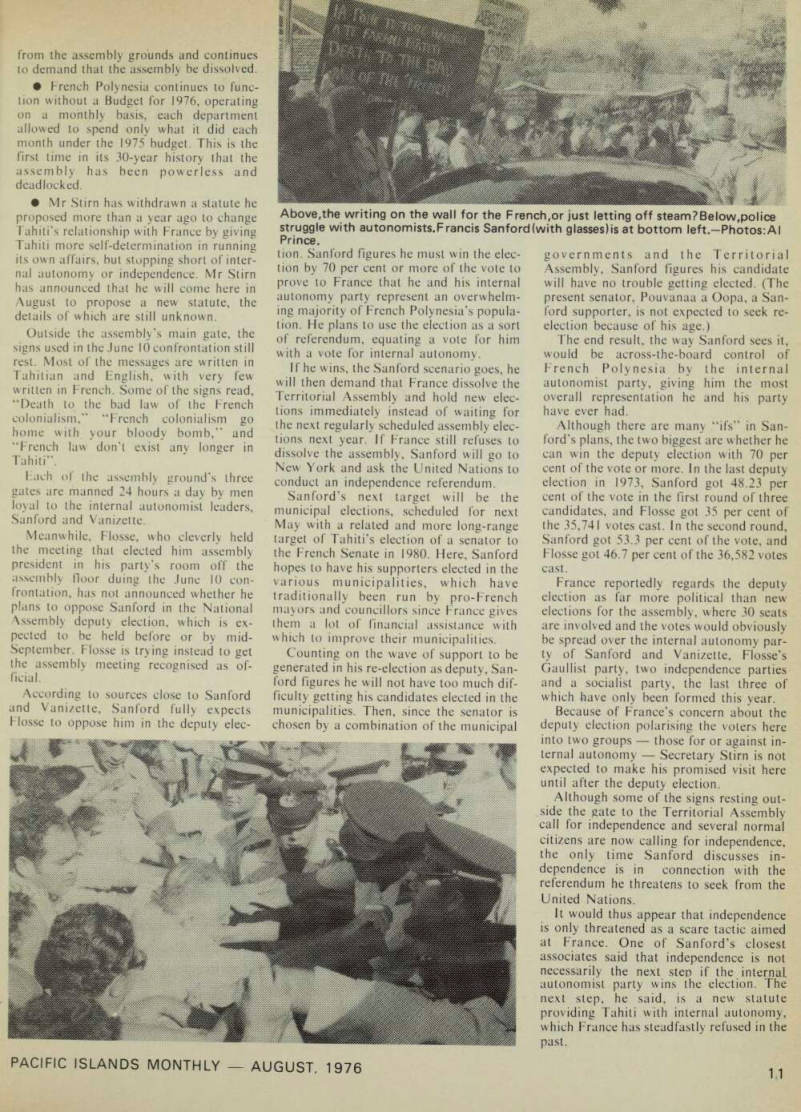
On that historic day, a crowd of 1 200 ( angry, tense and determined people, led by, the internal autonomy political party, formed a human barrier behind a chest high wooden gate, preventing French Polynesia Governor, Charles Schmitt from entering the grounds of the Territorial Assembly, the local governing body.
Chanting “dissolution, dissolution” with upraised arms, the crowd kept Governor Schmitt waiting in his black limousine, surrounded by gendarmes in full riot dress helmets, rifles and tear gas launchers.
Inside the assembly grounds, soldiers, many of them Tahitian, stood by armed with sub-machine guns.
Aside from a few minor scuffles, there was no violence as the tension built up among the crowd, many of whom were carrying anti-French signs and wearing small Tahitian flags stuck to their arms or chests.
Finally, after 50 tense minutes of waiting inside his limousine and after all negotiations had failed, Governor Schmitt left his car, walking a third of a mile back to his office, escorted by aides and several
heavily-armed gendarmes.
Since then, the following has occurred: • The internal autonomist party has occupied the assembly grounds, letting only supporters and journalists inside. • Francis Sanford, Tahiti’s elected deputy in the French National Assembly in Paris, has resigned, but will run for re election within three months, hoping to win by 70 per cent or more of the vote on an internal autonomist ticket. • Gaston Flosse, leader of the pro- French UDR, or Gaullist, party, has been elected president of the assembly by 16 of its members for a one-vote majority. This so-called “new majority” has been official ly recognised by the Governor and Mr Olivier Stirn, the French Secretary of State for Overseas Departments and Territories in Paris. • Frantz Vanizette, assembly president when it last met in November, 1975, has called Flosse’s election illegal, refuses to remove his internal autonomy supporters
from the assembly grounds and continues to demand that the assembly be dissolved. • French Polynesia continues to func tion without a Budget for 1976, operating on a monthly basis, each department allowed to spend only what it did each month under the 1975 budget. This is the first time in its 30-year history that the assembly has been powerless and deadlocked. • Mr Stirn has withdrawn a statute he proposed more than a year ago to change Tahiti’s relationship with France by giving Tahiti more self-determination in running its own affairs, but stopping short of inter nal autonomy or independence. Mr Stirn has announced that he will come here in August to propose a new statute, the details of which are still unknown.
Outside the assembly’s main gate, the signs used in the June 10 confrontation still rest. Most of the messages are written in Tahitian and English, with very few written in French. Some of the signs read, “Death to the bad law of the French colonialism," “French colonialism go home with your bloody bomb,’’ and “French law don’t exist any longer in Tahiti”.
Each of the assembly ground's three gates are manned 24 hours a day by men loyal to the internal autonomist leaders, Sanford and Vanizette.
Meanwhile, Flosse, who cleverly held the meeting that elected him assembly president in his party’s room off the assembly floor duing the June 10 con frontation, has not announced whether he plans to oppose Sanford in the National Assembly deputy election, which is ex pected to be held before or by mid- September. Flosse is trying instead to get the assembly meeting recognised as of ficial.
According to sources close to Sanford and Vanizette, Sanford fully expects Flosse to oppose him in the deputy elec-
lion. Sanford figures he must win the elec tion by 70 per cent or more of the vote to prove to France that he and his internal autonomy party represent an overwhelm ing majority of French Polynesia’s popula tion. He plans to use the election as a sort of referendum, equating a vote for him with a vote for internal autonomy.
If he wins, the Sanford scenario goes, he will then demand that France dissolve the Territorial Assembly and hold new elec tions immediately instead of waiting for the next regularly scheduled assembly elec tions next year. If France still refuses to dissolve the assembly, Sanford will go to New York and ask the United Nations to conduct an independence referendum.
Sanford’s next target will be the municipal elections, scheduled for next May with a related and more long-range target of Tahiti’s election of a senator to the French Senate in 1980. Here, Sanford hopes to have his supporters elected in the various municipalities, which have traditionally been run by pro-French mayors and councillors since France gives them a lot of financial assistance with which to improve their municipalities.
Counting on the wave of support to be generated in his re-election as deputy, San ford figures he will not have too much dif ficulty getting his candidates elected in the municipalities. Then, since the senator is chosen by a combination of the municipal
governments and the Territorial Assembly, Sanford figures his candidate will have no trouble getting elected. (The present senator, Pouvanaa a Oopa, a San ford supporter, is not expected to seek re election because of his age.) The end result, the way Sanford sees it, would be across-the-board control of French Polynesia by the internal autonomist party, giving him the most overall representation he and his party have ever had.
Although there are many “ifs” in San ford’s plans, the two biggest are whether he can win the deputy election with 70 per cent of the vote or more. In the last deputy election in 1973, Sanford got 48.23 per cent of the vote in the first round of three candidates, and Flosse got 35 per cent of the 35,741 votes cast. In the second round, Sanford got 53.3 per cent of the vote, and Flosse got 46.7 per cent of the 36,582 votes cast.
France reportedly regards the deputy election as far more political than new elections for the assembly, where 30 seats are involved and the votes would obviously be spread over the internal autonomy par ty of Sanford and Vanizette, Flosse’s GauHist party, two independence parties and a socialist party, the last three of which have only been formed this year.
Because of France’s concern about the deputy election polarising the voters here into two groups those for or against in ternal autonomy Secretary Stirn is not expected to make his promised visit here until after the deputy election.
Although some of the signs resting out side the gate to the Territorial Assembly call for independence and several normal citizens are now calling for independence, the only time Sanford discusses in dependence is in connection with the referendum he threatens to seek from the United Nations.
It would thus appear that independence is only threatened as a scare tactic aimed at France. One of Sanford’s closest associates said that independence is not necessarily the next step if the internal autonomist party wins the election. The next step, he said, is a new statute providing Tahiti with internal autonomy, which France has steadfastly refused in the past.
Above,the writing on the wall for the French,or just letting off steam?Below,police struggle with autonomists.Francis Sanfordlwith glasses)is at bottom left.—Photos:Al Prince,