Pure Polynesian’ Say Critics
pp. 8-10 · Read in the full issue
Hokule’A Does It But ‘It Wasn’T
From AL PRINCE in Papeete
The Polynesian, twin-hulled sailing canoe, Hokule’a, set sail from Papeete for Hawaii on July I, its sponsors trying desperately to hold its accomplishments intact in the wake of mounting criticism of its 34'/’-day voyage from Hawaii to Tahiti in May.
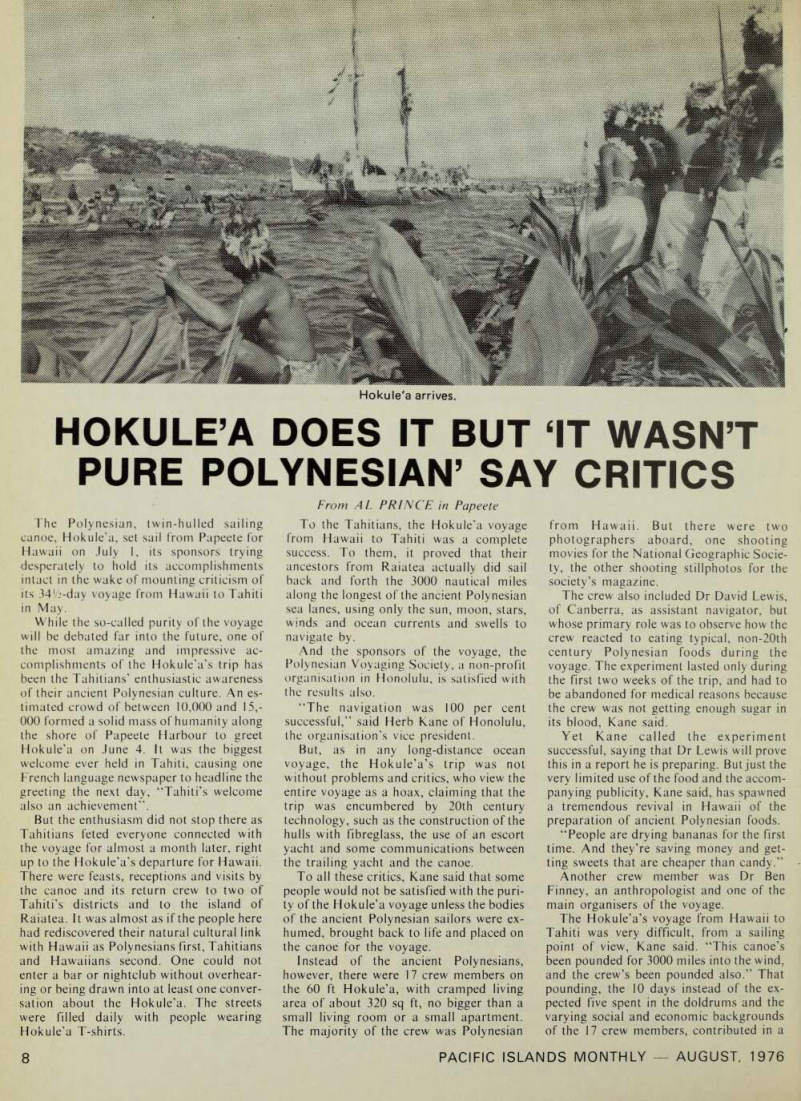
While the so-called purity of the voyage will be debated far into the future, one of the most amazing and impressive ac complishments of the Hokule’a’s trip has been the Tahitians’ enthusiastic awareness of their ancient Polynesian culture. An es timated crowd of between 10,000 and 15,- 000 formed a solid mass of humanity along the shore of Papeete Harbour to greet Hokule’a on June 4. It was the biggest welcome ever held in Tahiti, causing one French language newspaper to headline the greeting the next day, “Tahiti’s welcome also an achievement”.
But the enthusiasm did not stop there as Tahitians feted everyone connected with the voyage for almost a month later, right up to the Hokule’a’s departure for Hawaii.
There were feasts, receptions and visits by the canoe and its return crew to two of Tahiti’s districts and to the island of Raiatea. It was almost as if the people here had rediscovered their natural cultural link with Hawaii as Polynesians first, Tahitians and Hawaiians second. One could not enter a bar or nightclub without overhear ing or being drawn into at least one conver sation about the Hokule’a. The streets were filled daily with people wearing Hokule’a T-shirts.
To the Tahitians, the Hokule’a voyage from Hawaii to Tahiti was a complete success. To them, it proved that their ancestors from Raiatea actually did sail back and forth the 3000 nautical miles along the longest of the ancient Polynesian sea lanes, using only the sun, moon, stars, winds and ocean currents and swells to
navigate by.
And the sponsors of the voyage, the
Polynesian Voyaging Society, a non-profit
organisation in Honolulu, is satisfied with the results also.
“The navigation was 100 per cent successful,” said Herb Kane of Honolulu,
the organisation’s vice president.
But, as in any long-distance ocean voyage, the Hokule’a’s trip was not without problems and critics, who view the entire voyage as a hoax, claiming that the trip was encumbered by 20th century technology, such as the construction of the hulls with fibreglass, the use of an escort yacht and some communications between the trailing yacht and the canoe.
To all these critics, Kane said that some people would not be satisfied with the puri ty of the Hokule’a voyage unless the bodies of the ancient Polynesian sailors were ex humed, brought back to life and placed on the canoe for the voyage.
Instead of the ancient Polynesians, however, there were 17 crew members on the 60 ft Hokule’a, with cramped living area of about 320 sq ft, no bigger than a small living room or a small apartment.
The majority of the crew was Polynesian
from Hawaii. But there were two
photographers aboard, one shooting
movies for the National Geographic Socie ty, the other shooting stillphotos for the society’s magazine.
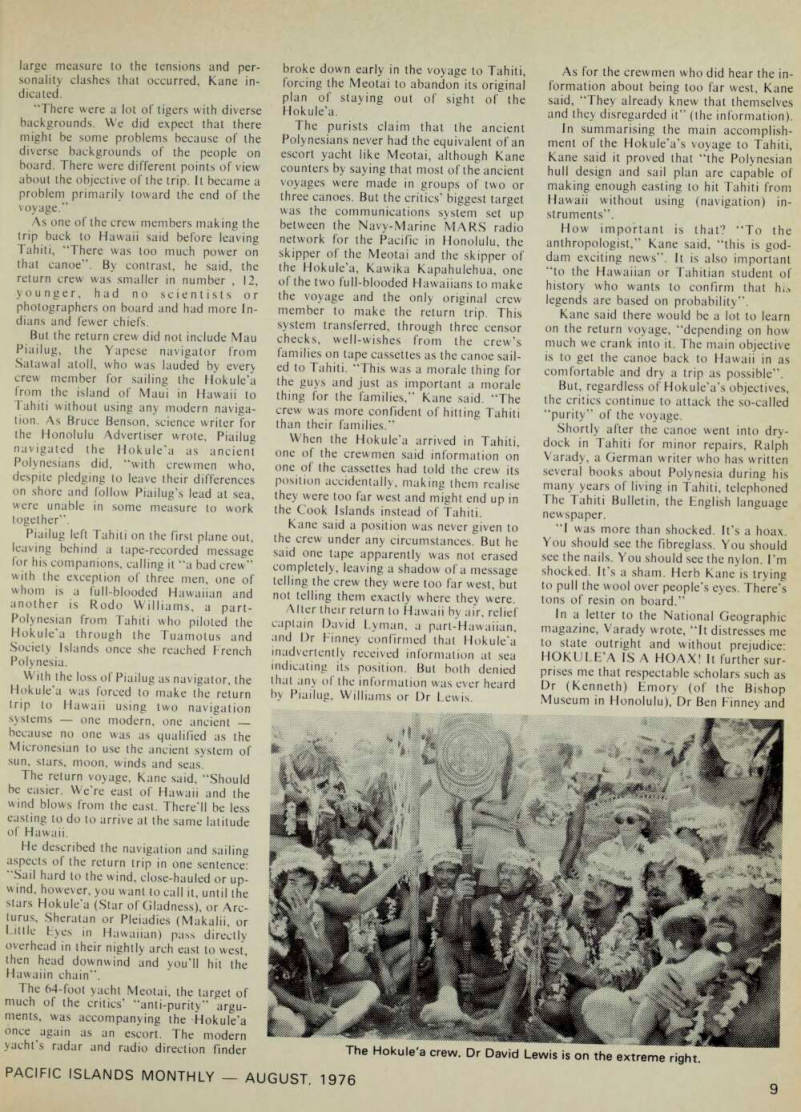
The crew also included Dr David Lewis, of Canberra, as assistant navigator, but whose primary role was to observe how the crew reacted to eating typical, non-20th century Polynesian foods during the voyage. The experiment lasted only during the first two weeks of the trip, and had to be abandoned for medical reasons because the crew was not getting enough sugar in its blood, Kane said.
Yet Kane called the experiment successful, saying that Dr Lewis will prove this in a report he is preparing. But just the very limited use of the food and the accom panying publicity, Kane said, has spawned a tremendous revival in Hawaii of the preparation of ancient Polynesian foods.
“People are drying bananas for the first time. And they’re saving money and get ting sweets that are cheaper than candy.”
Another crew member was Dr Ben Finney, an anthropologist and one of the main organisers of the voyage.
The Hokule’a’s voyage from Hawaii to Tahiti was very difficult, from a sailing point of view, Kane said. “This canoe’s been pounded for 3000 miles into the wind, and the crew’s been pounded also.” That pounding, the 10 days instead of the ex pected five spent in the doldrums and the varying social and economic backgrounds of the 17 crew members, contributed in a
Hokule'sa arrives
large measure to the tensions and per sonality clashes that occurred, Kane in dicated.
“There were a lot of tigers with diverse backgrounds. We did expect that there might be some problems because of the diverse backgrounds of the people on board. There were different points of view about the objective of the trip. It became a problem primarily toward the end of the voyage.”
As one of the crew members making the trip back to Hawaii said before leaving Tahiti, “There was too much power on that canoe”. By contrast, he said, the return crew was smaller in number , 12, younger, had no scientists or photographers on board and had more In dians and fewer chiefs.
But the return crew did not include Mau Piailug, the Yapese navigator from Satawal atoll, who was lauded by every crew member for sailing the Hokule’a from the island of Maui in Hawaii to Tahiti without using any modern naviga tion. As Bruce Benson, science writer for the Honolulu Advertiser wrote, Piailug navigated the Hokule’a as ancient Polynesians did, “with crewmen who, despite pledging to leave their differences on shore and follow Piailug’s lead at sea, were unable in some measure to work together”.
Piailug left Tahiti on the first plane out, leaving behind a tape-recorded message for his companions, calling it “a bad crew” with the exception of three men, one of whom is a full-blooded Hawaiian and another is Rodo Williams, a part- Polynesian from Tahiti who piloted the Hokule’a through the Tuamotus and Society Islands once she reached French
Polynesia.
With the loss of Piailug as navigator, the Hokule’a was forced to make the return trip to Hawaii using two navigation systems one modern, one ancient because no one was as qualified as the Micronesian to use the ancient system of sun, stars, moon, winds and seas.
The return voyage, Kane said, “Should be easier. We’re east of Hawaii and the wind blows from the east. There’ll be less easting to do to arrive at the same latitude of Hawaii.
He described the navigation and sailing aspects of the return trip in one sentence: Sail hard to the wind, close-hauled or up wind, however, you want to call it, until the stars Hokule’a (Star of Gladness), or Arc turus, Sheratan or Pleiadies (Makalii, or Little Eyes in Hawaiian) pass directly overhead in their nightly arch east to west, then head downwind and you’ll hit the Hawaiin chain”.
The 64-foot yacht Meotai, the target of much of the critics’ “anti-purity” argu ments, was accompanying the -Hokule’a once again as an escort. The modern yacht s radar and radio direction finder
broke down early in the voyage to Tahiti, forcing the Meotai to abandon its original plan of staying out of sight of the Hokule’a.
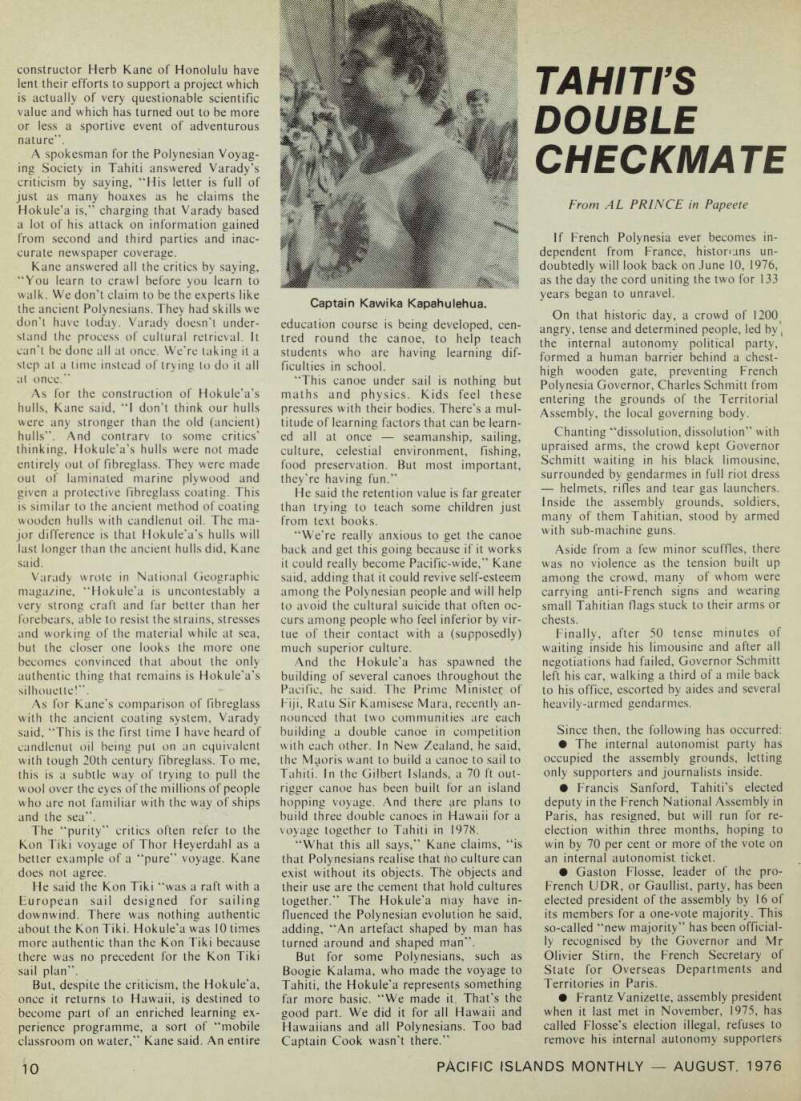
The purists claim that the ancient Polynesians never had the equivalent of an escort yacht like Meotai, although Kane counters by saying that most of the ancient voyages were made in groups of two or three canoes. But the critics’ biggest target was the communications system set up between the Navy-Marine MARS radio network for the Pacific in Honolulu, the skipper of the Meotai and the skipper of the Hokule’a, Kawika Kapahulehua, one of the two full-blooded Hawaiians to make the voyage and the only original crew member to make the return trip. This system transferred, through three censor checks, well-wishes from the crew’s families on tape cassettes as the canoe sail ed to Tahiti. “This was a morale thing for the guys and just as important a morale thing for the families,” Kane said. “The crew was more confident of hitting Tahiti than their families.”
When the Hokule’a arrived in Tahiti, one of the crewmen said information on one of the cassettes had told the crew its position accidentally, making them realise they were too far west and might end up in the Cook Islands instead of Tahiti.
Kane said a position was never given to the crew under any circumstances. But he said one tape apparently was not erased completely, leaving a shadow of a message telling the crew they were too far west, but not telling them exactly where they were.
Alter their return to Hawaii by air, relief captain David Lyman, a parl-Hawaiian, and Dr Finney confirmed that Hokule’a inadvertently received information at sea indicating its position. But both denied that any ol the information was ever heard by Piailug, Williams or Dr Lewis.
As for the crewmen who did hear the in formation about being too far west, Kane said, “They already knew that themselves and they disregarded it” (the information).
In summarising the main accomplish ment of the Hokule’a’s voyage to Tahiti, Kane said it proved that “the Polynesian hull design and sail plan are capable of making enough easting to hit Tahiti from Hawaii without using (navigation) in struments”.
How important is that? “To the anthropologist,” Kane said, “this is god dam exciting news”. It is also important “to the Hawaiian or Tahitian student of history who wants to confirm that his legends are based on probability”.
Kane said there would be a lot to learn on the return voyage, “depending on how much we crank into it. The main objective is to get the canoe back to Hawaii in as comfortable and dry a trip as possible”.
But, regardless of Hokule’a’s objectives, the critics continue to attack the so-called “purity” of the voyage.
Shortly after the canoe went into dry dock in Tahiti for minor repairs, Ralph Varady, a German writer who has written several books about Polynesia during his many years of living in Tahiti, telephoned The Tahiti Bulletin, the English language newspaper.
“I was more than shocked. It’s a hoax.
You should see the fibreglass. You should see the nails. You should see the nylon. I’m shocked. It s a sham. Herb Kane is trying to pull the wool over people’s eyes. There’s tons of resin on board.”
In a letter to the National Geographic magazine, Varady wrote, “It distresses me to state outright and without prejudice- HOKULE’A IS A HOAX! It further sur prises me that respectable scholars such as
Dr (Kenneth) Emory (of the Bishop
Museum in Honolulu), Dr Ben Finney and
The Hokule'a crew. Dr David Lewis is on the extreme right.
constructor Herb Kane of Honolulu have lent their efforts to support a project which is actually of very questionable scientific value and which has turned out to be more or less a sportive event of adventurous nature”.
A spokesman for the Polynesian Voyag ing Society in Tahiti answered Varady’s criticism by saying, “His letter is full of just as many hoaxes as he claims the Hokule’a is,” charging that Varady based a lot of his attack on information gained from second and third parties and inac curate newspaper coverage.
Kane answered all the critics by saying, “You learn to crawl before you learn to walk. We don’t claim to be the experts like the ancient Polynesians. They had skills we don’t have today. Varady doesn’t under stand the process of cultural retrieval. It can’t be done all at once. We’re taking it a step at a lime instead of trying to do it all at once.”
As for the construction of Hokule’a’s hulls, Kane said, “1 don’t think our hulls were any stronger than the old (ancient) hulls”. And contrary to some critics’ thinking, Hokule’a’s hulls were not made entirely out of fibreglass. They were made out of laminated marine plywood and given a protective fibreglass coating. This is similar to the ancient method of coating wooden hulls with candlenut oil. The ma jor difference is that Hokule’a’s hulls will last longer than the ancient hulls did, Kane said.
Varady wrote in National Geographic magazine, “Hokule’a is unconteslably a very strong craft and far better than her forebears, able to resist the strains, stresses and working of the material while at sea, but the closer one looks the more one becomes convinced that about the only authentic thing that remains is Hokule’a’s silhouette!”.
As for Kane's comparison of fibreglass with the ancient coating system, Varady said, “This is the first time I have heard of candlenut oil being pul on an equivalent with tough 20th century fibreglass. To me, this is a subtle way of trying to pull the wool over the eyes of the millions of people who are not familiar with the way of ships and the sea”.
The “purity” critics often refer to the Kon Tiki voyage of Thor Heyerdahl as a better example of a “pure” voyage. Kane does not agree.
He said the Kon Tiki “was a raft with a European sail designed for sailing downwind. There was nothing authentic about the Kon Tiki. Hokule’a was 10 times more authentic than the Kon Tiki because there was no precedent for the Kon Tiki sail plan”.
But, despite the criticism, the Hokule’a, once it returns to Hawaii, is destined to become part of an enriched learning ex perience programme, a sort of “mobile classroom on water,” Kane said. An entire
education course is being developed, cen tred round the canoe, to help teach students who are having learning dif ficulties in school.
“This canoe under sail is nothing but maths and physics. Kids feel these pressures with their bodies. There’s a mul titude of learning factors that can be learn ed all at once seamanship, sailing, culture, celestial environment, fishing, food preservation. But most important, they’re having fun.”
He said the retention value is far greater than trying to teach some children just from text books.
“We’re really anxious to get the canoe back and get this going because if it works it could really become Pacific-wide,” Kane said, adding that it could revive self-esteem among the Polynesian people and will help to avoid the cultural suicide that often oc curs among people who feel inferior by vir tue of their contact with a (supposedly) much superior culture.
And the Hokule’a has spawned the building of several canoes throughout the Pacific, he said. The Prime Minister of Fiji, Rulu Sir Kamisese Mara, recently an nounced that two communities are each building a double canoe in competition with each other. In New Zealand, he said, the Maoris want to build a canoe to sail to Tahiti. In the Gilbert Islands, a 70 ft out rigger canoe has been built for an island hopping voyage. And there are plans to build three double canoes in Hawaii for a voyage together to Tahiti in 1978.
“What this all says,” Kane claims, “is that Polynesians realise that ho culture can exist without its objects. Thfe objects and their use are the cement that hold cultures together.” The Hokule'a may have in fluenced the Polynesian evolution he said, adding, “An artefact shaped by man has turned around and shaped man”.
But for some Polynesians, such as Boogie Kalama, who made the voyage to Tahiti, the Hokule’a represents something far more basic. “We made it That's the good part. We did it for all Hawaii and Hawaiians and all Polynesians. Too bad Captain Cook wasn’t there.”
Captain Kawika Kapahulehua.