Solomons
p. 17 · Read in the full issue
Rent Perk
Off
In The
Solomons
The Solomon Islands government ap pears ready to cut into the privileges of the early crop of local public servants and politicians through their housing rents.
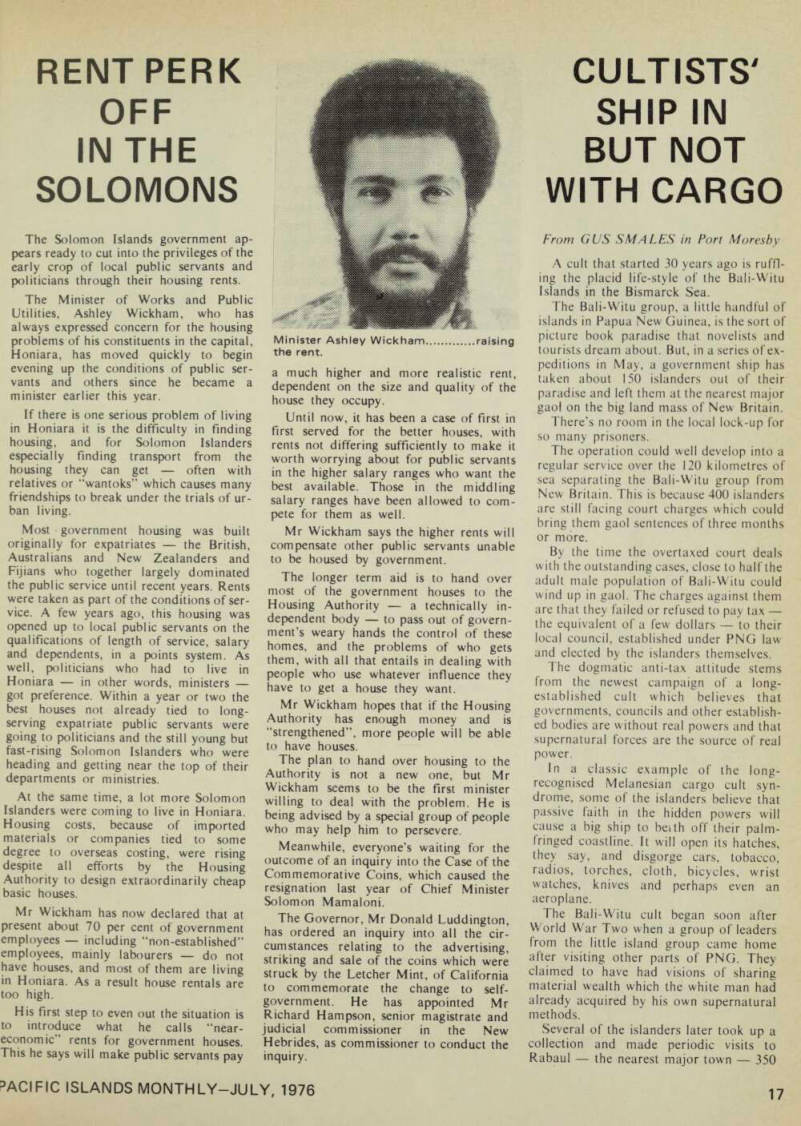
The Minister of Works and Public Utilities, Ashley Wickham, who has always expressed concern for the housing problems of his constituents in the capital, Honiara, has moved quickly to begin evening up the conditions of public ser vants and others since he became a minister earlier this year.
If there is one serious problem of living in Honiara it is the difficulty in finding housing, and for Solomon Islanders especially finding transport from the housing they can get often with relatives or “wantoks” which causes many friendships to break under the trials of ur ban living.
Most government housing was built originally for expatriates the British, Australians and New Zealanders and Fijians who together largely dominated the public service until recent years. Rents were taken as part of the conditions of ser vice. A few years ago, this housing was opened up to local public servants on the qualifications of length of service, salary and dependents, in a points system. As well, politicians who had to live in Honiara in other words, ministers got preference. Within a year or two the best houses not already tied to long serving expatriate public servants were going to politicians and the still young but fast-rising Solomon Islanders who were heading and getting near the top of their departments or ministries.
At the same time, a lot more Solomon Islanders were coming to live in Honiara.
Housing costs, because of imported materials or companies tied to some degree to overseas costing, were rising despite all efforts by the Housing
Authority to design extraordinarily cheap
basic houses.
Mr Wickham has now declared that at present about 70 per cent of government
employees including “non-established”
employees, mainly labourers do not have houses, and most of them are living in Honiara. As a result house rentals are too high.
His first step to even out the situation is to introduce what he calls “near economic” rents for government houses.
This he says will make public servants pay
a much higher and more realistic rent, dependent on the size and quality of the house they occupy.
Until now, it has been a case of first in first served for the better houses, with rents not differing sufficiently to make it worth worrying about for public servants in the higher salary ranges who want the best available. Those in the middling salary ranges have been allowed to com pete for them as well.
Mr Wickham says the higher rents will compensate other public servants unable to be housed by government.
The longer term aid is to hand over most of the government houses to the
Housing Authority a technically in
dependent body to pass out of govern ment’s weary hands the control of these homes, and the problems of who gets them, with all that entails in dealing with people who use whatever influence they have to get a house they want.
Mr Wickham hopes that if the Housing Authority has enough money and is “strengthened”, more people will be able to have houses.
The plan to hand over housing to the Authority is not a new one, but Mr Wickham seems to be the first minister willing to deal with the problem. He is being advised by a special group of people who may help him to persevere.
Meanwhile, everyone’s waiting for the outcome of an inquiry into the Case of the Commemorative Coins, which caused the resignation last year of Chief Minister Solomon Mamaloni.
The Governor, Mr Donald Luddington, has ordered an inquiry into all the cir cumstances relating to the advertising, striking and sale of the coins which were struck by the Letcher Mint, of California to commemorate the change to self government. He has appointed Mr Richard Hampson, senior magistrate and judicial commissioner in the New Hebrides, as commissioner to conduct the
inquiry.
Minister Ashley Wickham... raising the rent.