Tropicalities
pp. 14-16 · Read in the full issue

Pisin em i
winim ol
Pidgin should be the national language in Papua New Guinea, the new Professor of Language at the PNG University, Professor Tom Dutton, believes.
Professor Dutton called the English language an expensive luxury which the country couldn't afford, and claimed that too much school-time was being wasted teaching English to Papua New Guinean children. He was giving his inaugural lec ture after taking up the Chair of Language at the University in Port Moresby.
Pidgin, sometimes called neo- Melanesian, Melanesian Pidgin or Pidgin English, is already one of the most widely used languages in PNG, and is one of three standard languages in the National Parlia ment.
The language uses Melanesian syntax forms, and draws its vocabulary from a wide range of tribal and imported languages, including English.
Professor Dutton advocated a 10-year period to phase out English and bring in the new national language, accompanied by research to establish the language in a formal and acceptable manner.
He said the research should be under taken by a national language committee. It would ensure that necessary changes and ideas needed for the national language were incorporated, not haphazardly, but with proper respect for traditional gram mar, word-building, structure and vocabulary.
And Professor Dutton suggested a “National Language Day” during the changeover years a day every week when every one would have to use only the national language.
Professor Dutton said that under his plan Pidgin would be used in all general conversation, at all levels of formal educa tion (including university), and for all ad ministrative and communication purposes.
English could be learned later only by those who had particular need for it in cer tain types of higher education or other fields.
At present, however, English, and the need to learn it, was a distraction from the main goal of a general education.
Professor Dutton estimated that at pre sent up to half of the school-day was spent in teaching “something about English”.
“Why should everybody be forced to learn English just for the sake of the few
who might need it?” Professor Dutton ask ed.
He believed that an immediate start could be made in the preparation of school textbooks in Pidgin, and said that this was already being done as an individual programme in some primary schools. By teaching in Pidgin, reliance on expensive teachers brought from outside PNG would also be reduced, Professor Dutton said.
He criticised the government for lack of a definite policy on national language, and said that PNG needed a national language more than it needed a national emblem or a national anthem.
Later, Miss Josephine Abaijah, leader of Papua Besena, describing Pidgin as a “mutilated foreign language”, said Motu should be the national language.
She was supported by the Minister for Primary Industry, Mr Sali, who said Pidgin was not spoken by the great grandfathers of the PNG people.
Pisin em i winim ol Pidgin has beaten all others.
High cost
of dying
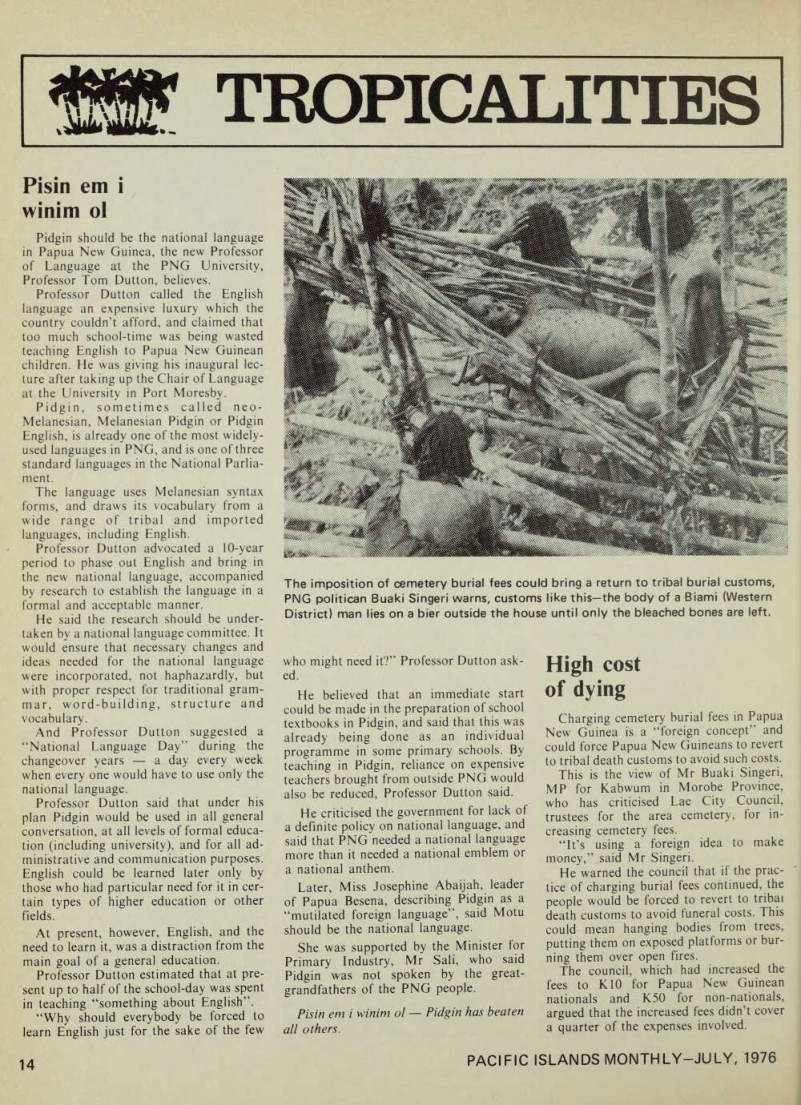
Charging cemetery burial fees in Papua New Guinea is a “foreign concept” and could force Papua New Guineans to revert to tribal death customs to avoid such costs.
This is the view of Mr Buaki Singeri, MP for Kabwum in Morobe Province, who has criticised Lae City Council, trustees for the area cemetery, for in creasing cemetery fees.
“It’s using a foreign idea to make money,” said Mr Singeri.
He warned the council that if the prac tice of charging burial fees continued, the people would be forced to revert to tribal death customs to avoid funeral costs. This could mean hanging bodies from trees, putting them on exposed platforms or bur ning them over open fires.
The council, which had increased the fees to KlO for Papua New Guinean nationals and K5O for non-nationals, argued that the increased fees didn’t cover a quarter of the expenses involved.
The imposition of cemetery burial fees could bring a return to tribal burial customs, PNG politican Buaki Singeri warns, customs like this—the body of a Biami (Western District) man lies on a bier outside the house until only the bleached bones are left.
The unsinkable
Gilbertese
The Gilbertese have done it again. Four of them drifted in a small wooden boat for 80 days before they were picked up by a Japanese fishing ship, Kampira Maru No 5, off the coast of Malaita in the Solomons. The four of them, all men, Emeta, Robati, Mitana and Tekeai, left their home island of Tamana on Decem ber 1 8 to catch fish.
Their story was familiar. Rain hit the area in which they were fishing. When the rain stopped they were out of sight of land. Then they ran out of fuel for their outboard motor.
During their long drift of more than 1,600 kilometres, they survived by cat ching fish and drinking rain and sea water, and eating the few coconuts they took with them. When they were picked up on March 7 they were still out of sight of land, and their boat was water-logged.
They were thin and tired, but in reasonably good condition.
They were taken to Noumea where they were cared for by the South Pacific Com mission, and clothed by the Red Cross.
They flew home by Air Nauru.
Just don’t give up for lost Gilbertese who go missing at sea. Few can emulate them when it comes to surviving a long sea ordeal.
Highlands’
socialising’
Organised “social nights” which are a cloak for sex and illegal drinking are worrying village leaders in the PNG Eastern Highlands.
The leaders claim family life is being destroyed and many young unmarried girls are becoming pregnant.
The spread of “social nights” has become a craze in some areas and there are signs the craze could extend. Even special houses are being built for the ac tivities and have become known as “social night houses”.
They are built in the style of traditional village community houses, often circular in shape. But, according to village leaders, there’s nothing traditional about what goes on inside, and they fear that the strict tribal morality of generations is being un dermined.
Men who no longer accept without question the rule of village elders are run ning the houses to make money.
In some areas, the organisers are holding their “social nights” every night of the week.
The president of the Goroka Council in the Eastern Highlands, Councillor Atau
Waikave, told a recent meeting of the council that he had received complaints from several villages.
The “social night” craze had to be stop ped, he said, before it spread through the entire rural community. The innocent sounding name of “social night” did nothing to indicate the social harm beneath the surface.
Another Goroka councillor, Councillor lyare Noruka, said “burn these houses down go out and put the flames to them. If you won’t do it, just tell me .where these houses are and I’ll go out and burn them down myself’.
High jinks
from the Hicom
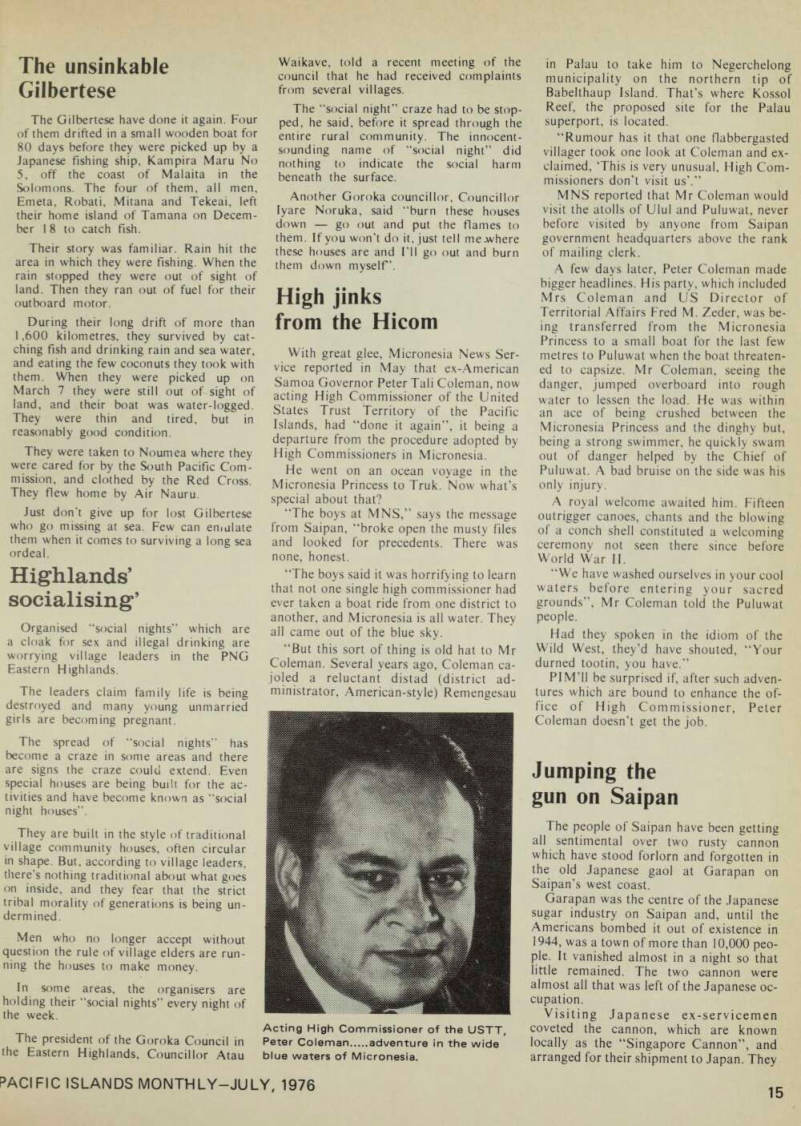
With great glee, Micronesia News Ser vice reported in May that ex-American Samoa Governor Peter Tali Coleman, now acting High Commissioner of the United States Trust Territory of the Pacific Islands, had “done it again”, it being a
departure from the procedure adopted by
High Commissioners in Micronesia.
He went on an ocean voyage in the Micronesia Princess to Truk. Now what’s special about that?
“The boys at MNS,” says the message from Saipan, “broke open the musty files and looked for precedents. There was none, honest.
“The boys said it was horrifying to learn that not one single high commissioner had ever taken a boat ride from one district to another, and Micronesia is all water. They all came out of the blue sky.
“But this sort of thing is old hat to Mr Coleman. Several years ago, Coleman ca joled a reluctant distad (district ad ministrator, American-style) Remengesau
in Palau to take him to Negerchelong municipality on the northern tip of Babelthaup Island. That’s where Kossol Reef, the proposed site for the Palau superport, is located.
“Rumour has it that one flabbergasted villager took one look at Coleman and ex claimed, This is very unusual, High Com missioners don’t visit us’.”
MNS reported that Mr Coleman would visit the atolls of Ulul and Puluwat, never before visited by anyone from Saipan government headquarters above the rank of mailing clerk.
A few days later, Peter Coleman made bigger headlines. His party, which included Mrs Coleman and US Director of Territorial Affairs Fred M. Zeder, was be ing transferred from the Micronesia Princess to a small boat for the last few metres to Puluwat when the boat threaten ed to capsize. Mr Coleman, seeing the danger, jumped overboard into rough water to lessen the load. He was within an ace of being crushed between the Micronesia Princess and the dinghy but, being a strong swimmer, he quickly swam out of danger helped by the Chief of Puluwat. A bad bruise on the side was his
only injury.
A royal welcome awaited him. Fifteen outrigger canoes, chants and the blowing of a conch shell constituted a welcoming ceremony not seen there since before World War 11.
“We have washed ourselves in your cool waters before entering your sacred grounds”, Mr Coleman told the Puluwat
people.
Had they spoken in the idiom of the Wild West, they’d have shouted, “Your durned tootin, you have.”
PlM’ll be surprised if, after such adven tures which are bound to enhance the of fice of High Commissioner, Peter Coleman doesn’t get the job.
Jumping the
gun on Saipan
The people of Saipan have been getting all sentimental over two rusty cannon which have stood forlorn and forgotten in the old Japanese gaol at Garapan on Saipan’s west coast.
Garapan was the centre of the Japanese sugar industry on Saipan and, until the Americans bombed it out of existence in 1944, was a town of more than 10,000 peo ple. It vanished almost in a night so that little remained. The two cannon were almost all that was left of the Japanese oc cupation.
Visiting Japanese ex-servicemen
coveted the cannon, which are known locally as the “Singapore Cannon”, and arranged for their shipment to Japan. They
Acting High Commissioner of the USTT, Peter Coleman... adventure in the wide blue waters of Micronesia.
were hoisted aboard a Japanese-bound ship, which was almost ready to sail from
Saipan’s quaintly-named Charley Dock
when someone realised that they loved the old guns after all. The police were called and they off-loaded the cannon.
The Deputy District Administrator, Dan E. Akimoto, issued a temporary order preventing anyone from jumping the gun.
He was almost lyrical in his restraining order, saying, according to Guam’s Pacific Daily News, that the cannon “have great intrinsic value due to their rarity and their place in history of the Mariana Islands”.
Now the Marianas’ District Attorney is looking for a law, since one doesn’t exist, to ban the export of war relics and artifacts from the Marianas.
How’s this
for re-cycling
A chewing gum industry with a local touch has been suggested for Papua New Guinea when you’ve chewed out the sweetness you trade-in what’s left.
The suggestion comes from a group of researchers and potential beekeepers in volved in a new attempt to get beekeeping established in the PNG Highlands. They
have suggested selling honey-soaked
beeswax as a local chewing gum. Honey is almost unknown among the Highlands people.
Because the beeswax base is in com paratively short supply, the suggestion is that the chewed-out material could even ually be sold back to the industry.
“Chew it all day if you like, but then put it into a bottle and sell it back to us,” they suggest.
The Department of Primary Industry is behind the beekeeping promotion, but commented that it had “no formal recommendations” on the chewing gum idea.
Fiji's civil service
almost localised
Fiji’s localisation of the public service is almost complete, but the goal of complete localisation is practically unattainable, ac cording to a Fiji Public Service Commis sion report. By the middle of 1975 there were only 15 permanent and pensionable expatriate civil' servants in the 17,735strong public service. The PSC concedes that Fiji still needs, and is likely to need for many years, the services of recruits from overseas, especially in some professional and technical categories.
At the middle of 1975, there were 513 non-Fiji citizens in the public service. Two hundred were from Britain (132 on con tract), 155 from the US, 95 from NZ, 50 from India, 30 from Australia, six from Canada and 17 of “other nationalities”. Of the total of 513 non-Fiji citizens, 135 were volunteers and 69 were from aid organisations.