Magazine
pp. 48-51 · Read in the full issue

Islands Where Pagan Gods
Fell To A Modern ‘Miracle’
In the April PIM, Denis Fisk wrote about the change threatening the lives of the in habitants of Rennell and Bellona Islands in the Solomon Islands. Here, he tries to explain more about who these people are.
The only way to get ashore on the coral limestone atolls of Rennell and Bellona is the usually hazardous landing from a dinghy which makes a dash through or over the reefs, catching waves with the aid of the 9hp Seagull outboard motors which are übiquitous in the Solomon Islands.
What you land on varies, but you always have to be nimble, not weighted down with luggage. Be sure to have footwear you can quickly kick off if you fall into the sea, and be able to swim.
These landings are one of the reasons why Rennell and Bellona have remained remote.
Another is an accident of history. In 1927, the great Pacific geologist, G.A.V.
Stanley, who died in October, 1965 in Port Moresby General Hospital, took an ex pedition to Rennell to investigate the
possibility of phosphate deposits.
“It was found that the percentage of phosphate material in the limestone over the country explored was too low to be of the slightest commercial importance”, says an account at the time.
It was not until the 1950 s that it was discovered.
Had Stanley looked as well on Bellona, Rennell’s much smaller sister atoll, he might have found the commercially im portant deposits of phosphate, the ex ploitation of which is now a hotly-debated subject.
Big ships will be able to get close to Rennell to carry off the alumina from the smelter. I found how deep the water is right up to a rock shelf which is the end of a steep road coming down bauxite cliffs.
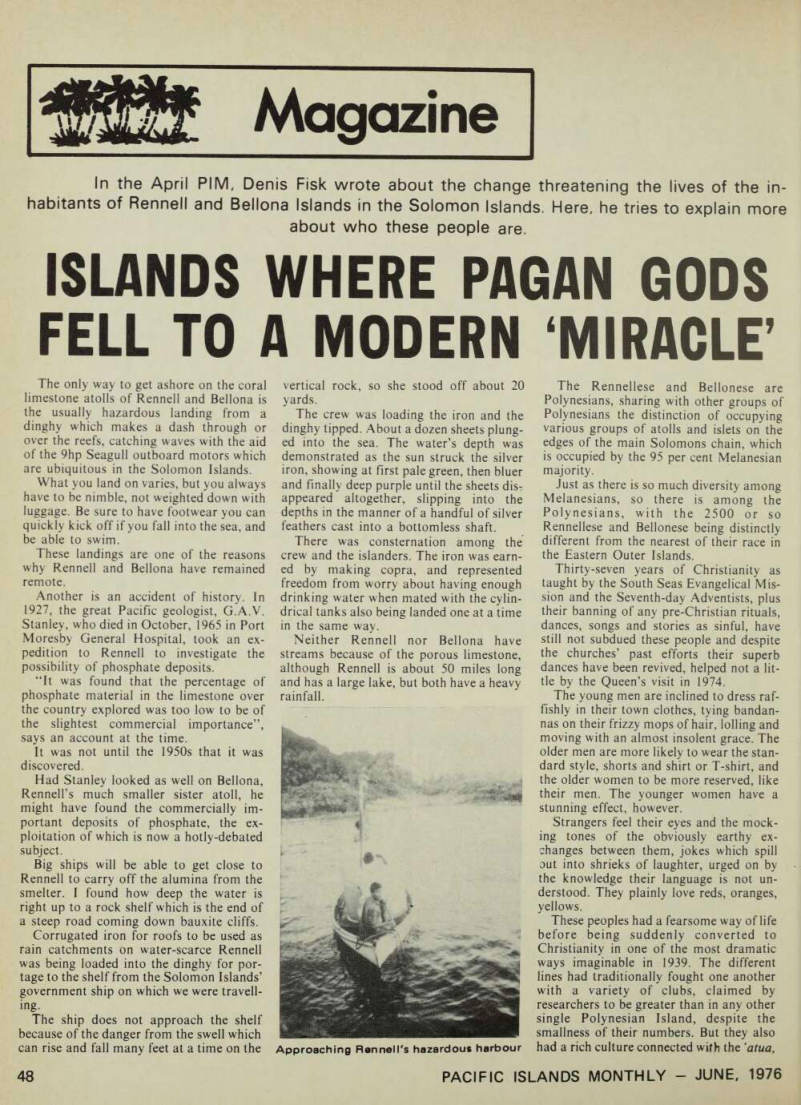
Corrugated iron for roofs to be used as rain catchments on water-scarce Rennell was being loaded into the dinghy for por tage to the shelf from the Solomon Islands’ government ship on which we were travell ing.
The ship does not approach the shelf because of the danger from the swell which can rise and fall many feet at a time on the
vertical rock, so she stood off about 20 yards.
The crew was loading the iron and the dinghy tipped. About a dozen sheets plung ed into the sea. The water’s depth was demonstrated as the sun struck the silver iron, showing at first pale green, then bluer and finally deep purple until the sheets dis appeared altogether, slipping into the depths in the manner of a handful of silver feathers cast into a bottomless shaft.
There was consternation among the crew and the islanders. The iron was earn ed by making copra, and represented freedom from worry about having enough drinking water when mated with the cylin drical tanks also being landed one at a time in the same way.
Neither Rennell nor Bellona have streams because of the porous limestone, although Rennell is about 50 miles long and has a large lake, but both have a heavy rainfall.
The Rennellese and Bellonese are Polynesians, sharing with other groups of Polynesians the distinction of occupying various groups of atolls and islets on the edges of the main Solomons chain, which is occupied by the 95 per cent Melanesian
majority.
Just as there is so much diversity among Melanesians, so there is among the Polynesians, with the 2500 or so Rennellese and Bellonese being distinctly different from the nearest of their race in the Eastern Outer Islands.
Thirty-seven years of Christianity as taught by the South Seas Evangelical Mis sion and the Seventh-day Adventists, plus their banning of any pre-Christian rituals, dances, songs and stories as sinful, have still not subdued these people and despite the churches’ past efforts their superb dances have been revived, helped not a lit tle by the Queen’s visit in 1974.
The young men are inclined to dress raf fishly in their town clothes, tying bandan nas on their frizzy mops of hair, lolling and moving with an almost insolent grace. The older men are more likely to wear the stan dard style, shorts and shirt or T-shirt, and the older women to be more reserved, like their men. The younger women have a stunning effect, however.
Strangers feel their eyes and the mock ing tones of the obviously earthy ex changes between them, jokes which spill out into shrieks of laughter, urged on by the knowledge their language is not un derstood. They plainly love reds, oranges, yellows.
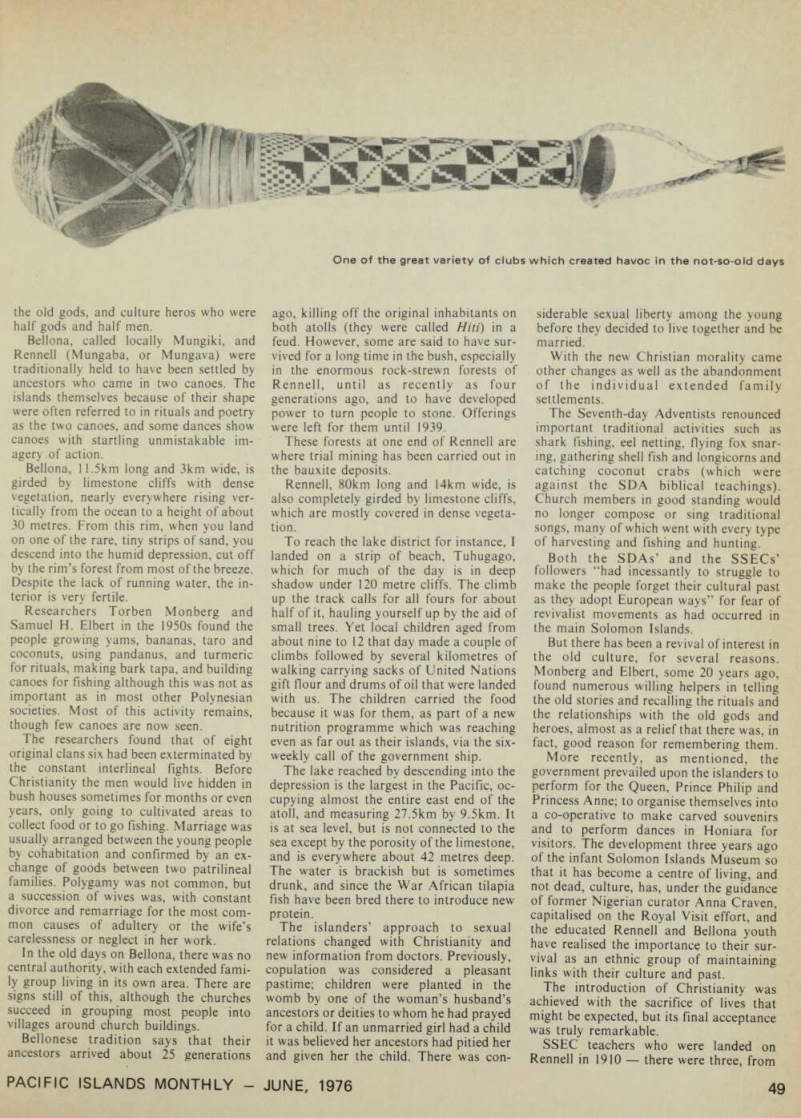
These peoples had a fearsome way of life before being suddenly converted to Christianity in one of the most dramatic ways imaginable in 1939. The different lines had traditionally fought one another with a variety of clubs, claimed by researchers to be greater than in any other single Polynesian Island, despite the smallness of their numbers. But they also had a rich culture connected with the ‘atua.
Approaching Rennell's hazardous harbour
the old gods, and culture heros who were half gods and half men.
Bellona, called locally Mungiki, and Rennell (Mungaba, or Mungava) were traditionally held to have been settled by ancestors who came in two canoes. The islands themselves because of their shape were often referred to in rituals and poetry as the two canoes, and some dances show canoes with startling unmistakable im agery of action.
Bellona, 11.5 km long and 3km wide, is girded by limestone cliffs with dense vegetation, nearly everywhere rising ver tically from the ocean to a height of about 30 metres. From this rim, when you land on one of the rare, tiny strips of sand, you descend into the humid depression, cut off by the rim’s forest from most of the breeze.
Despite the lack of running water, the in terior is very fertile.
Researchers Torben Monberg and Samuel H. Elbert in the 1950 s found the people growing yams, bananas, taro and coconuts, using pandanus, and turmeric for rituals, making bark tapa, and building canoes for fishing although this was not as important as in most other Polynesian societies. Most of this activity remains, though few canoes are now seen.
The researchers found that of eight original clans six had been exterminated by the constant interlineal fights. Before Christianity the men would live hidden in bush houses sometimes for months or even years, only going to cultivated areas to collect food or to go fishing. Marriage was usually arranged between the young people by cohabitation and confirmed by an ex change of goods between two patrilineal families. Polygamy was not common, but a succession of wives was, with constant divorce and remarriage for the most com mon causes of adultery or the wife’s carelessness or neglect in her work.
In the old days on Bellona, there was no central authority, with each extended fami ly group living in its own area. There are signs still of this, although the churches succeed in grouping most people into
villages around church buildings.
Bellonese tradition says that their ancestors arrived about 25 generations
ago, killing off the original inhabitants on both atolls (they were called Hiti) in a feud. However, some are said to have sur vived for a long time in the bush, especially in the enormous rock-strewn forests of Rennell, until as recently as four generations ago, and to have developed power to turn people to stone. Offerings were left for them until 1939.
These forests at one end of Rennell are where trial mining has been carried out in the bauxite deposits.
Rennell, 80km long and 14km wide, is also completely girded by limestone cliffs, which are mostly covered in dense vegeta tion.
To reach the lake district for instance, I landed on a strip of beach, Tuhugago, which for much of the day is in deep shadow under 120 metre cliffs. The climb up the track calls for all fours for about half of it, hauling yourself up by the aid of small trees. Yet local children aged from about nine to 12 that day made a couple of climbs followed by several kilometres of walking carrying sacks of United Nations gift flour and drums of oil that were landed with us. The children carried the food because it was for them, as part of a new nutrition programme which was reaching even as far out as their islands, via the six weekly call of the government ship.
The lake reached by descending into the depression is the largest in the Pacific, oc cupying almost the entire east end of the atoll, and measuring 27.5 km by 9.5 km. It is at sea level, but is not connected to the sea except by the porosity of the limestone, and is everywhere about 42 metres deep.
The water is brackish but is sometimes drunk, and since the War African tilapia fish have been bred there to introduce new protein.
The islanders’ approach to sexual relations changed with Christianity and new information from doctors. Previously, copulation was considered a pleasant pastime; children were planted in the womb by one of the woman’s husband’s ancestors or deities to whom he had prayed for a child. If an unmarried girl had a child it was believed her ancestors had pitied her and given her the child. There was con
siderable sexual liberty among the young before they decided to live together and be married.
With the new Christian morality came other changes as well as the abandonment of the individual extended family settlements.
The Seventh-day Adventists renounced important traditional activities such as shark fishing, eel netting, flying fox snar ing, gathering shell fish and longicorns and catching coconut crabs (which were against the SDA biblical teachings).
Church members in good standing would no longer compose or sing traditional songs, many of which went with every type
of harvesting and fishing and hunting.
Both the SDAs’ and the SSECs’ followers “had incessantly to struggle to make the people forget their cultural past as they adopt European ways” for fear of revivalist movements as had occurred in the main Solomon Islands.
But there has been a revival of interest in the old culture, for several reasons.
Monberg and Elbert, some 20 years ago,
found numerous willing helpers in telling
the old stories and recalling the rituals and the relationships with the old gods and heroes, almost as a relief that there was, in fact, good reason for remembering them.
More recently, as mentioned, the government prevailed upon the islanders to perform for the Queen, Prince Philip and Princess Anne; to organise themselves into a co-operative to make carved souvenirs and to perform dances in Honiara for visitors. The development three years ago of the infant Solomon Islands Museum so that it has become a centre of living, and not dead, culture, has, under the guidance of former Nigerian curator Anna Craven, capitalised on the Royal Visit effort, and the educated Rennell and Bellona youth have realised the importance to their sur vival as an ethnic group of maintaining links with their culture and past.
The introduction of Christianity was achieved with the sacrifice of lives that might be expected, but its final acceptance was truly remarkable.
SSEC teachers who were landed on Rennell in 1910 there were three, from
One of the great variety of clubs which created havoc in the not-so-old days
the New Hebrides, and San Christoval and Malaita in the Solomons were killed very soon at the order of high chief Tipaika after he was told these foreigners were go ing to rule. Northcote Deck, the mis sionary who had left them, returned for the bones of one, Thomas, but Rennell was then left alone until 1934, when an SDA ship visited, and the following year left four people. The SSEC and the Church of England also trained local people by tak ing them away to bible schools.
In October, 1938, there occurred what has since been called the “Niupani madness”.
One full account was given by Moa, a man from Hutuna on Rennell who died of tuberculosis in 1963.
He told of how the two old gods who were the centre of Rennell/Bellona religion were brought by an ancestor, Kaitu’u, from the land from whence he sailed his canoe, called ’Ubea. The gods’ earthly form was two stones. He searched Rennell for a suitable place for them to stay but ended up placing them on Bellona at Gabenga where the gods Guatupu'a and her brother/husband Gau’eteaki then resided.
When the chiefs heard the news of Christ, some believed it while others feared retaliation by their gods, and at one stage most people fell in with chief Taupongi who proposed that all be worshipped, but debate continued until October, 1938, when a big meeting was called at Niupani on Rennell.
A priest/chief Tegheta divided people, some to pray to the Christian God and the rest to their old gods. Brothers and sisters were allowed to marry among the many marriages that then took place as mediums said the gathering had to get ready to go to heaven. God was going to set fire to the earth. They said goodbye to their old gods, then went into a large house.
Those who could not find a sleeping shelf inside hung from the cross beams or tied themselves to the roof or the outside, while Tegheta stood and asked God to take the house to heaven.
After some hours of waiting in vain, then preparing food, burning their proper ty, singing “till our mouths were weary”, and still nothing happened, the people were confused.
One man was beaten and killed, the first of many who would be beaten that night.
The large house was broken into bits and put into a pile with dogs and chickens and cats which were all killed. People with sores were separated and lay down to wait to be killed. One group plotted to kill Tegheta and he was set upon with a mighty battle cry as were the mediums. Some died, some lived through the beatings, and others fled into the bush.
In the morning, men and women ig nored the taboo that they should not bathe together. There were more beatings, but
Moa recalled that all those who, apparently, were severely injured or killed, in fact lived. Tegheta, killed the previous night, was said to have been revived by a man “in whom there was an angel” by breathing into his nostrils, eyes, ears and mouth.
Later, at another settlement where they regathered, the high chief Taupongi stood among them with a picture of Jesus, ... i • i j * ■ i i ■ i holding it on his head with his back to , 4 . , . them. The people were astonished to see .. ■ X . , the mouth m the picture move as though ,■ K 5 speaKmg.
The people then divided up to go to worship at the three Christian churches, having finally accepted the new religion.
In November, Moa said, it was agreed to carry the news to other settlements, ineluding Bellona where Moa and his group landed in two canoes to find a fight going on. He conciliated in the fight, and the 400 people involved agreed to listen to him.
Those who did not agree to become Christian were told he intended to destroy the two old gods.
It was extremely rare to go anywhere near them, even to pay homage, and the Bellonese were afraid.
Finally, with two local leaders Moa went to the gods and they prayed together to God, and the two leaders ran away because they were still afraid.
“After praying I broke the stone gods to bits with my axe”, Moa said. The two leaders were very angry when he told them, and said he would die but when he did not, they began doubting. One of the leaders who objected to a hymn being sung became
ill, and despite his people praying to their gods he died. As they prepared to wrap his body Moa suggested that they pray to God, which they did, and Moa picked up the man’s hand and he came to life again.
At this they decided to stop fighting and become Christians, and everyone who was sick was healed by their prayers. a .u . • ney built a church, and three months a r fpr or . in „ t R _n rtr , o . , alter going to Bellona Moa went home to D« n aii th.,, u a . . C Rennell. All that had occurred at Niupani mif j_ w;ri tn . . r ... F w as put down to punishment for their not accepting the Christian God.
Today, the Rennell and Bellona people are bein g drawn more into the mainstream °f Solomon Islands life. They are enthusiastic travellers and use any excuse t 0 v *sß Honiara, and know more about what affects their future. In some ways tbe y bave resisted change, willingly or otherwise, as when the local government council established for them by the govern ment went bankrupt for lack of ability to collect taxes, but this now seems to have been f' xed under a new local government scheme. They have created confusion for government and mining representatives wbo bave tr ' e d to pin them down to com pensation schemes and mining agreements, Since their fighting days they have been one more difficult peoples to fit into B overnment scheme of things, Their desire, and penchant for survival as a cohesive group had much going for it. in the past. But the desire of some to be rich is also strong. Whether the two can live together remains to be seen.
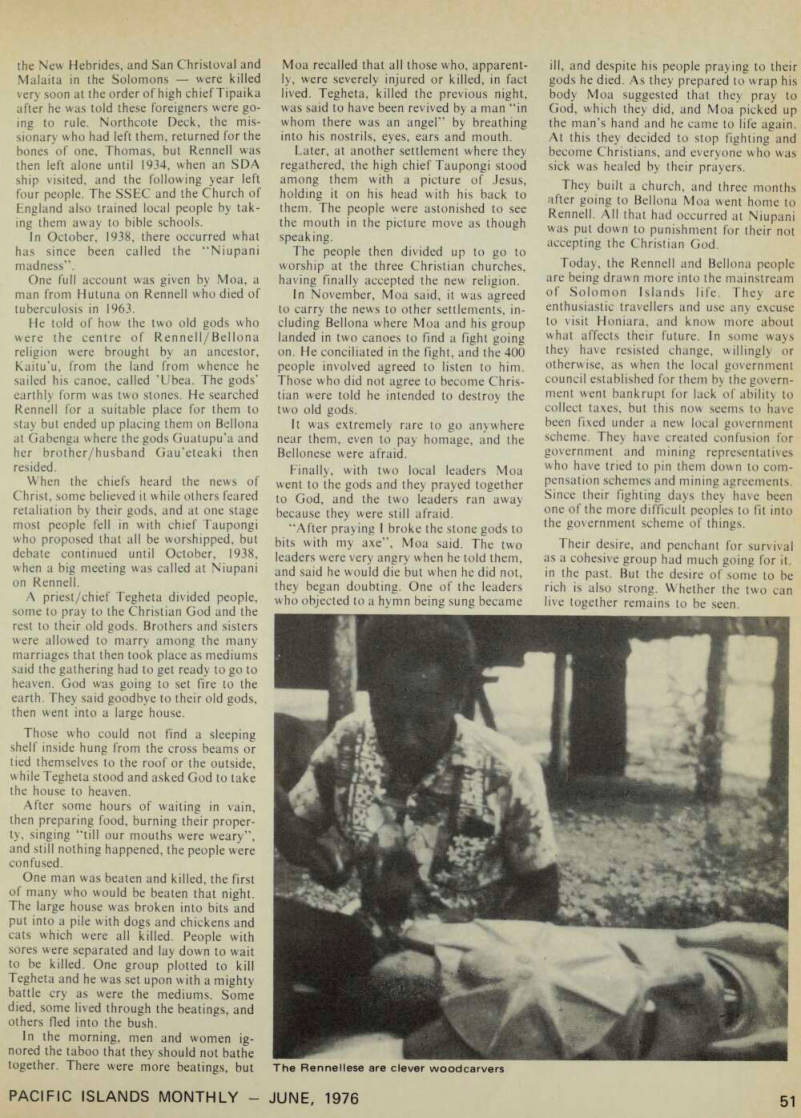
The Rennellese are clever woodcarvers