The Solomons Has A New Image
pp. 46-47 · Read in the full issue
For A Younger Generation
By TOSHIRO UEDA, Director of Mitsui Mining & Smelting Co. (SI) Ltd.
In the past few years the relationship between the Solomon Islands and Japan lias gone from strength to strength.
Japanese cars are well in the majority in Honiara streets and Japanese radio sets in practically every home. Apart from these healthy signs of international trade, the big Japanese industries are also taking an in creasingly important role in the Solomon
Islands’ development plans.
The Solomons, particularly Guadalcanal, are familiar names to one generation of Japanese people as the scene of heavy fighting and bloodshed during 1942 and 1943. In the minds of the younger generation and industrialists, however, the names conjure up a very different image.
Not only are the Solomon Islands famous as a ‘tropical island paradise’ but they also possess abundant natural resources. The government and Japanese officials have greatly improved their liaison in recent years with reciprocal visits and talks.
Some Japanese companies are keenly interested in planning a Japanese/Solomon Islands Cultural Association, to encourage cultural relations between the two countries. A few Japanese firms are already active in the fishing and logging industries, but the in dustry with the most economic potential, of course, would have its basis in the natural resources in the ground.
Many mining people have dreamed of a second ‘Bougainville’ copper strike in the Solomons, a reasonable assumption, as the islands are in the same geographical line but thus far, all efforts to find a huge, porphyry copper deposit like the one in Bougainville have been in vain. There is known to be nickel, gold, limestone and phosphate, but none has proved to be
economically workable.
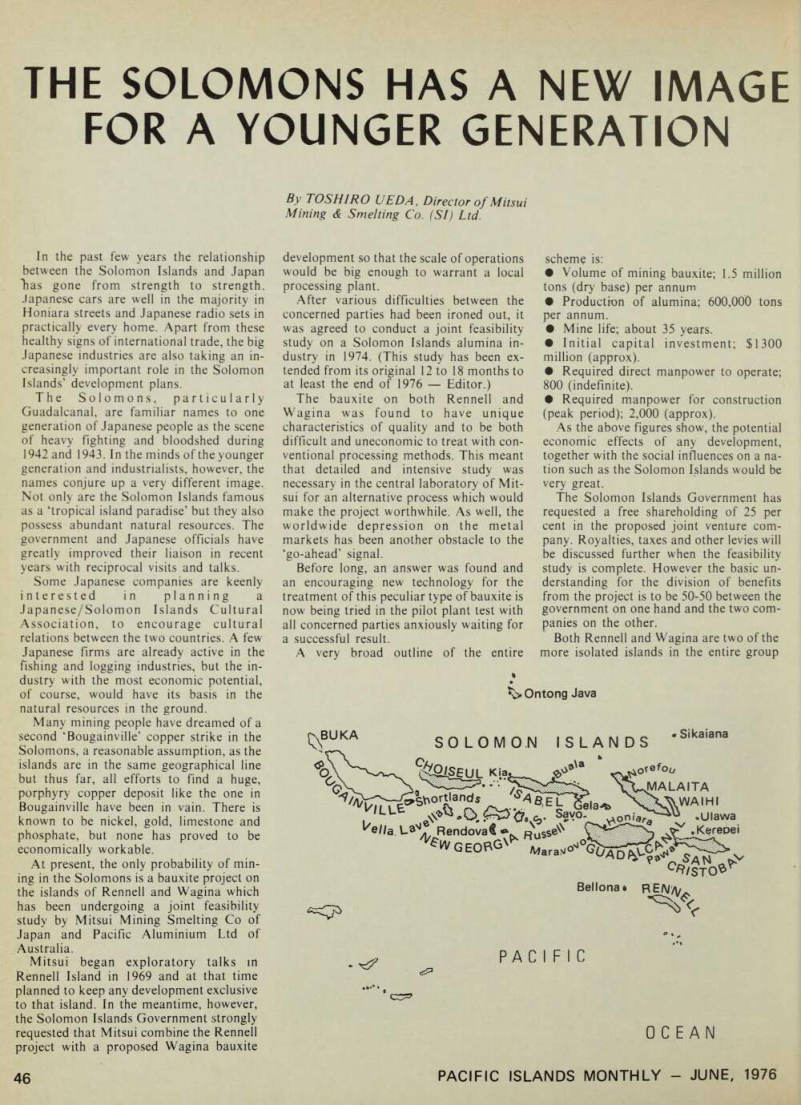
At present, the only probability of min ing in the Solomons is a bauxite project on the islands of Rennell and Wagina which has been undergoing a joint feasibility study by Mitsui Mining Smelting Co of Japan and Pacific Aluminium Ltd of Australia.
Mitsui began exploratory talks in Rennell Island in 1969 and at that time planned to keep any development exclusive to that island. In the meantime, however, the Solomon Islands Government strongly requested that Mitsui combine the Rennell project with a proposed Wagina bauxite
development so that the scale of operations would be big enough to warrant a local
processing plant.
After various difficulties between the concerned parties had been ironed out, it was agreed to conduct a joint feasibility study on a Solomon Islands alumina industry in 1974. (This study has been extended from its original 12 to 18 months to at least the end of 1976 Editor.) The bauxite on both Rennell and Wagina was found to have unique characteristics of quality and to be both difficult and uneconomic to treat with conventional processing methods. This meant that detailed and intensive study was necessary in the central laboratory of Mitsui for an alternative process which would make the project worthwhile. As well, the worldwide depression on the metal markets has been another obstacle to the
‘go-ahead’ signal.
Before long, an answer was found and an encouraging new technology for the treatment of this peculiar type of bauxite is now being tried in the pilot plant test with all concerned parties anxiously waiting for a successful result.
A very broad outline of the entire
scheme is: • Volume of mining bauxite; 1.5 million tons (dry base) per annum • Production of alumina; 600,000 tons per annum, • Mine life; about 35 years, • Initial capital investment; $l3OO million (approx). • Required direct manpower to operate;
800 (indefinite).
• Required manpower for construction (peak period); 2,000 (approx), As the above figures show, the potential economic effects of any development, together with the social influences on a na tion such as the Solomon Islands would be very great.
The Solomon Islands Government has requested a free shareholding of 25 per cent in the proposed joint venture corn pany. Royalties, taxes and other levies will be discussed further when the feasibility study is complete. However the basic un derstanding for the division of benefits from the project is to be 50-50 between the government on one hand and the two com panics on the other, Both Rennell and Wagina are two of the more isolated islands in the entire group
and the new joint venture company will need to invest tremendous capital for in frastructure such as a port, roads, public utilities etc especially on Rennell where it is proposed to establish the processing plant. An entire new town of over 5,000 people will have to be established with all the necessary industry, commerce, civil service and public facilities necessary for its administration.
Particular care will be taken by all con cerned in the scheme in preserving the natural environment as far as humanly and economically possible. Both companies and the government are determined there will be no repetition of Nauru or Ocean Island.
The situation is, in fact, quite different from those islands in that the whole area for the mining and processing of the baux ite is less than 10 per cent of the whole of Rennell Island.
The Solomon Islands Government plans to establish a national park in a substan tially large area of East Rennell for the preservation of certain birds which are found nowhere else. Rennell also attracts and interests many scholars of archaeology and ethnology as a very early Polynesian settlement.
Many important discoveries have been found during their surveys and as recently as September 1975, pigs’ teeth and other artifacts were unearthed which are being
Mitsubishi Looks For Coal
Mitsubishi Development Pty Ltd, an Australian subsidiary of the giant corporation, Mitsubishi, of Japan, is interested in coal and other mineral exploration in the Gulf Province of Papua New Guinea. The exploration area covers 4,600 square miles at the headwaters of the Vailala River, near Ihu, next to a CRA prospect.
Both sites are in the area of the Purari coal beds, first discovered early this century.
Brown coal found there has been low-grade. Mitsubishi may spend up to K 100,000 in ex ploration. Emphasis in the first stage is on coal, shales and clay. There will also be ex ploration for a variety of minerals.
Mitsubishi has had considerable experience in coal. In Australia, it is involved with Utah.
studied by the Kaio University team in Japan. Professor T. Monburg, the well known ethnologist, has studied in Rennell for many years and any developments there will be in full co-operation with these scholastic investigations into the ecology, archaeology and anthropology of Rennell.
Rennellese people are enthusiastic about the proposed developments and have cooperated with the survey work already done by Mitsui. They can expect permanent employment and a comfortable income from land compensation.
The people have been consulted on every aspect since the project was first considered, as without their cooperation the entire scheme would be impossible.
Mitsui’s survey work thus far has
already created a certain amount of im patience for the scheme to start, Mr Trevor Clark, the Deputy Governor, who recently visited Rennell, advised the people that a plan of this magnitude re
quires a patient waiting period. The
government and both companies must carefully consider the long term future of the island as well as the immediate benefits that may ensue and have every intention of doing so.
There are many problems and dif ficulties yet to be solved before the scheme can be realised but none is impossible and it is firmly believed that as they are solved one by one, an entirely new economic in dustry for the Solomon Islands will be the result.