The US army’s ghetto-islet
pp. 27-29 · Read in the full issue
in Micronesia
From MIKE MALONE on Saipan
From a distance, Kwajalein looks like any other atoll in the Marshall Islands flat, coral-and-sand islands that spread out like a huge necklace around a vast lagoon.
But in reality, Kwajalein is unlike any other island group in the entire Pacific. In addition to being the biggest atoll in the Pacific, it is the United States Army’s “secret” missile testing centre.
Kwajalein, the security-tight main island, is “American,” and has cost US taxpayers more than $7OO million in defence appropriations. Rocket ex perts and technicians live in modern, air-conditioned housing, surrounded by sprinkled lawns, golf course, sidewalks, schools, and marinas, much like any suburban community in southern California.
Kwajalein, in fact, observes California time (remaining one day behind). This is done to synchronise experiments with incoming rockets launched from Vandenburg, Califor nia, which are routinely shot across the International Date Line into Kwajalein’s wide lagoon.
The landowners of Kwajalein, the Marshallese, signed a 99-year lease for the 745-acre island to the United States Government in 1964 under the threat of exercising its power of “emi nent domain.” A United Nations trusteeship agreement gave the United States such authority in 1947.
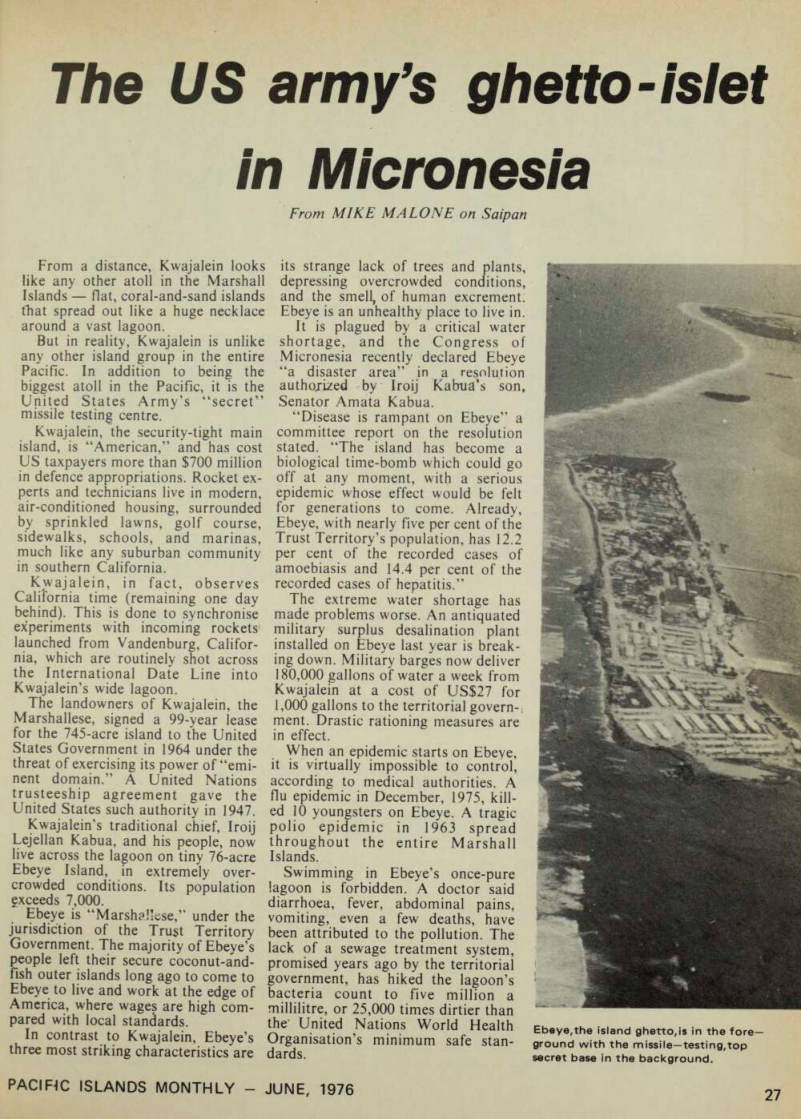
Kwajalein’s traditional chief, Iroij Lejellan Kabua, and his people, now live across the lagoon on tiny 76-acre Ebeye Island, in extremely over crowded conditions. Its population exceeds 7,000.
Ebeye is “Marshallese,” under the jurisdiction of the Trust Territory Government. The majority of Ebeye’s people left their secure coconut-and fish outer islands long ago to come to Ebeye to live and work at the edge of America, where wages are high com pared with local standards.
In contrast to Kwajalein, Ebeye’s three most striking characteristics are
its strange lack of trees and plants, depressing overcrowded conditions, and the smell, of human excrement.
Ebeye is an unhealthy place to live in.
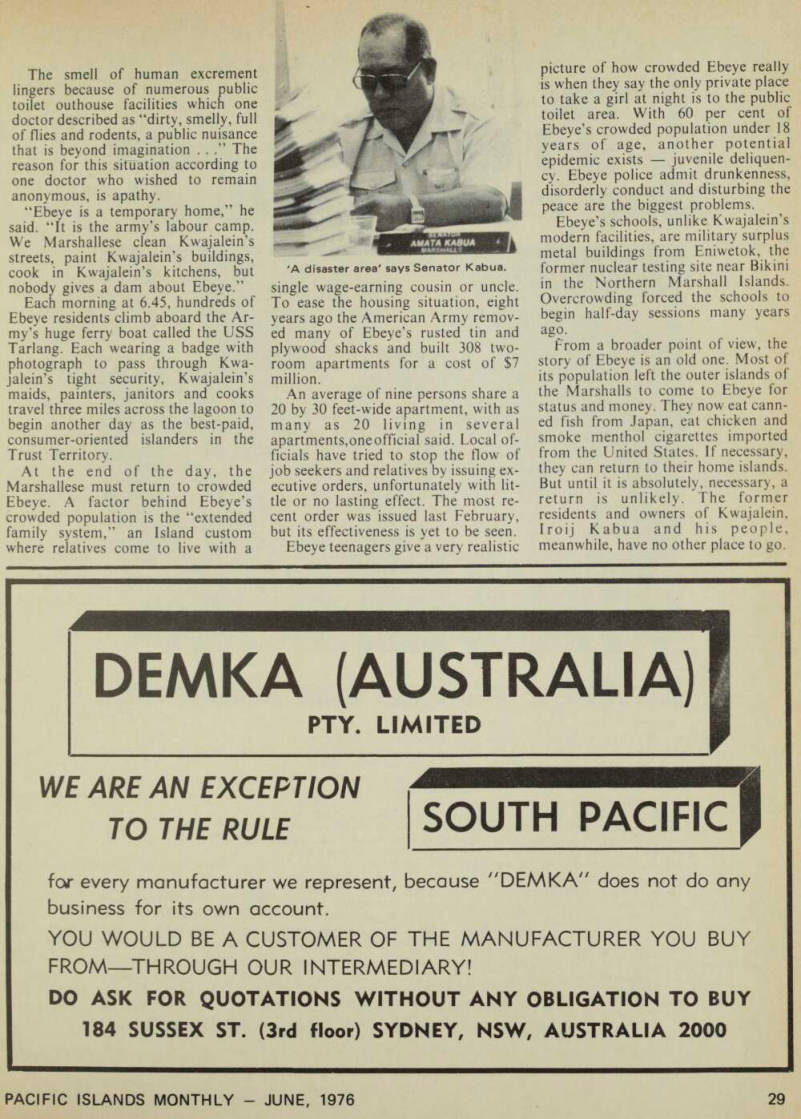
It is plagued by a critical water shortage, and the Congress of Micronesia recently declared Ebeye “a disaster area” in a resolution authorized by Iroij Kabua’s son.
Senator Amata Kabua.
“Disease is rampant on Ebeye” a committee report on the resolution stated. “The island has become a biological time-bomb which could go off at any moment, with a serious epidemic whose effect would be felt for generations to come. Already, Ebeye, with nearly five per cent of the Trust Territory’s population, has 12.2 per cent of the recorded cases of amoebiasis and 14.4 per cent of the recorded cases of hepatitis.”
The extreme water shortage has made problems worse. An antiquated military surplus desalination plant installed on Ebeye last year is break ing down. Military barges now deliver 180.000 gallons of water a week from Kwajalein at a cost of US$27 for 1.000 gallons to the territorial govern ment. Drastic rationing measures are in effect.
When an epidemic starts on Ebeye, it is virtually impossible to control, according to medical authorities. A flu epidemic in December, 1975, kill ed 10 youngsters on Ebeye. A tragic polio epidemic in 1963 spread throughout the entire Marshall Islands.
Swimming in Ebeye’s once-pure lagoon is forbidden. A doctor said diarrhoea, fever, abdominal pains, vomiting, even a few deaths, have been attributed to the pollution. The lack of a sewage treatment system, promised years ago by the territorial government, has hiked the lagoon’s bacteria count to five million a millilitre, or 25,000 times dirtier than the' United Nations World Health Organisation’s minimum safe stan dards.
Ebeye,the island ghetto, is in the fore ground with the missile—testing,top secret base in the background.
The smell of human excrement lingers because of numerous public toilet outhouse facilities which one doctor described as “dirty, smelly, full of flies and rodents, a public nuisance that is beyond imagination . . .” The reason for this situation according to one doctor who wished to remain anonymous, is apathy.
“Ebeye is a temporary home,” he said. “It is the army’s labour camp.
We Marshallese clean Kwajalein’s streets, paint Kwajalein’s buildings, cook in Kwajalein’s kitchens, but nobody gives a dam about Ebeye.”
Each morning at 6.45, hundreds of Ebeye residents climb aboard the Ar my’s huge ferry boat called the USS Tarlang. Each wearing a badge with photograph to pass through Kwa jalein’s tight security, Kwajalein’s maids, painters, janitors and cooks travel three miles across the lagoon to begin another day as the best-paid, consumer-oriented islanders in the Trust Territory.
At the end of the day, the Marshallese must return to crowded Ebeye. A factor behind Ebeye’s crowded population is the “extended family system,” an Island custom where relatives come to live with a
single wage-earning cousin or uncle.
To ease the housing situation, eight years ago the American Army remov ed many of Ebeye’s rusted tin and plywood shacks and built 308 two room apartments for a cost of $7 million.
An average of nine persons share a 20 by 30 feet-wide apartment, with as many as 20 living in several apartments,one official said. Local of ficials have tried to stop the flow of job seekers and relatives by issuing ex ecutive orders, unfortunately with lit tle or no lasting effect. The most re cent order was issued last February, but its effectiveness is yet to be seen.
Ebeye teenagers give a very realistic
picture of how crowded Ebeye really is when they say the only private place to take a girl at night is to the public toilet area. With 60 per cent of Ebeye’s crowded population under 18 years of age, another potential epidemic exists juvenile deliquen cy. Ebeye police admit drunkenness, disorderly conduct and disturbing the peace are the biggest problems.
Ebeye’s schools, unlike Kwajalein’s modern facilities, are military surplus metal buildings from Eniwetok, the former nuclear testing site near Bikini in the Northern Marshall Islands.
Overcrowding forced the schools to begin half-day sessions many years ago.
From a broader point of view, the story of Ebeye is an old one. Most of its population left the outer islands of the Marshalls to come to Ebeye for status and money. They now eat cann ed fish from Japan, eat chicken and smoke menthol cigarettes imported from the United States. If necessary, they can return to their home islands.
But until it is absolutely, necessary, a return is unlikely. The former residents and owners of Kwajalein, Iroij Kabua and his people, meanwhile, have no other place to go.
'A disaster area' says Senator Kabua.