Fiji mumbo-jumbo?
p. 25 · Read in the full issue
A fatal curse or just Fiji mumbo-jumbo?
From VIJENDRA KUMAR in Suva D AINMAKERS, yes, but have you heard of rainstoppers? In Fiji, where the annual rainfall is 100 plus in ches, rainmakers are expendable but there is always a demand for rainstoppers if they can be per suaded to use their magic.
The rainstoppers come from the Wainoro tribe in Viti Levu’s Naitasiri Province and invoke their powers only on rare occasions when it is particular ly important to stop the rain. The an cient rite, webbed in mysticism and oc cultism, is known only to a few sages.
Those who might scoff at their powers should find it interesting to read what happened when the tribe was recently called upon to stop the rain so that an important Fijian festival might proceed unhindered.
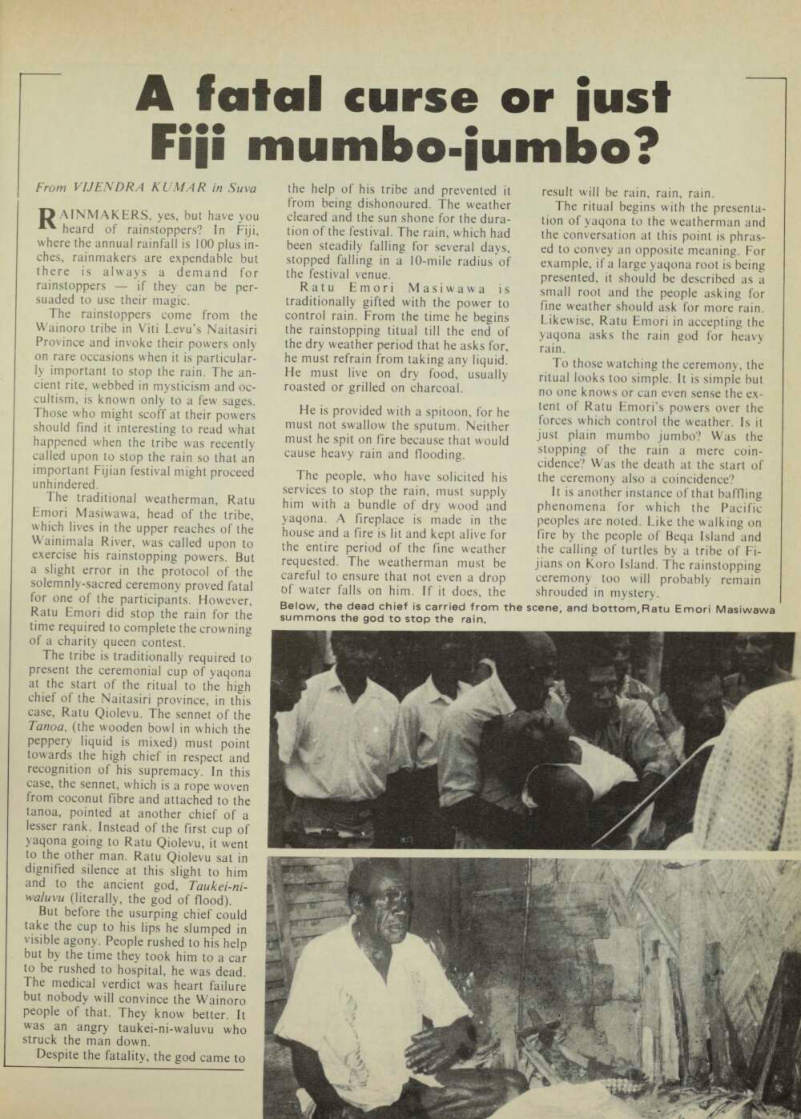
The traditional weatherman, Ratu Emori Masiwawa, head of the tribe, which lives in the upper reaches of the Wainimala River, was called upon to exercise his rainstopping powers. But a slight error in the protocol of the solemnly-sacred ceremony proved fatal for one of the participants. However, Ratu Emori did stop the rain for the time required to complete the crowning of a charity queen contest.
The tribe is traditionally required to present the ceremonial cup of yaqona at the start of the ritual to the high chief of the Naitasiri province, in this case, Ratu Qiolevu. The sennet of the Tanoa, (the wooden bowl in which the peppery liquid is mixed) must point towards the high chief in respect and recognition of his supremacy. In this case, the sennet, which is a rope woven from coconut fibre and attached to the tanoa, pointed at another chief of a lesser rank. Instead of the first cup of yaqona going to Ratu Qiolevu, it went to the other man. Ratu Qiolevu sat in dignified silence at this slight to him and to the ancient god, Taukei-ni waluvu (literally, the god of flood).
But before the usurping chief could take the cup to his lips he slumped in visible agony. People rushed to his help but by the time they took him to a car to be rushed to hospital, he was dead.
The medical verdict was heart failure but nobody will convince the Wainoro people of that. They know better. It was an angry taukei-ni-waluvu who struck the man down.
Despite the fatality, the god came to
the help of his tribe and prevented it from being dishonoured. The weather cleared and the sun shone for the dura tion of the festival. The rain, which had been steadily falling for several days, stopped falling in a 10-mile radius of the festival venue.
Ratu Emori Masiwawa is traditionally gifted with the power to control rain. From the time he begins the rainstopping titual till the end of the dry weather period that he asks for, he must refrain from taking any liquid.
He must live on dry food, usually roasted or grilled on charcoal.
He is provided with a spitoon, for he must not swallow the sputum. Neither must he spit on fire because that would cause heavy rain and flooding.
The people, who have solicited his services to stop the rain, must supply him with a bundle of dry wood and yaqona. A fireplace is made in the house and a fire is lit and kept alive for the entire period of the fine weather requested. The weatherman must be careful to ensure that not even a drop of water falls on him. If it does, the
result will be rain, rain, rain.
The ritual begins with the presenta tion of yaqona to the weatherman and the conversation at this point is phras ed to convey an opposite meaning. For example, if a large yaqona root is being presented, it should be described as a small root and the people asking for fine weather should ask for more rain.
Likewise, Ratu Emori in accepting the yaqona asks the rain god for heavy rain.
To those watching the ceremony, the ritual looks too simple. It is simple but no one knows or can even sense the ex tent of Ratu Emori's powers over the forces which control the weather. Is it just plain mumbo jumbo? Was the stopping of the rain a mere coin cidence? Was the death at the start of the ceremony also a coincidence?
It is another instance of that baffling phenomena for which the Pacific peoples are noted. Like the walking on fire by the people of Beqa Island and the calling of turtles by a tribe of Fi jians on Koro Island. The rainstopping ceremony too will probably remain shrouded in mystery.
Below, the dead chief is carried from the scene, and bottom,Ratu Emori Masiwawa summons the god to stop the rain.