Freedom
p. 12 · Read in the full issue
TO
Perish
From Felise Va’A In Apia
The saga of dying newspapers con tinues in the Samoas with the demise of two weeklies in Western Samoa, and a weekly and a monthly in American Samoa during the first four months of 1976.
Beginning with the American Samoan newspapers, Transpac, publisher of the popular Samoan Sun, ordered a halt to publication early March. About the same time. Sherry O’Sullivan, the ebullient editor/pub lisher of the controversial but en tertaining Underground Monthly an nounced that her magazine would cease publication with the April issue.
In Western Samoa, financial dif ficulties forced the closure of the popular Apia Weekly and the Samoana Herald. The Apia Weekly had been going for about a year, the Samoana Herald for a little over two years. The life of the Samoana Herald was shortened considerably by the fact that it lost a libel suit brought against it by the management of the Hideaway Hotel. The court ordered the newspaper to pay a fine of about $l,OOO for printed remarks in a letter to the editor relating to the quality of meat served at the hotel.
Whether the court will succeed in collecting the money is another issue as
the editor has said “the newspaper does not have that money.”
The Samoa Sun, one of the fastest growing newspapers in the Samoas, died after only a year and several months existence at the peak of its career. This fact has surprised many people especially as the halt to publication was sudden and unan nounced.
On surface, the Sun contained a lot of advertisements, averaging eight pages weekly, at a cost of US$lOO a page. Its circulation was fast ap proaching the 3,000 mark, close enough to that of the Samoa News to make it uncomfortable for the News, but deeper down, the newspaper was beset by personnel and financial problems. The newspaper revenue was inadequate to offset the rising costs of production. These costs were largely the result of high salaries (by local standards, at least) paid to employees.
But it was the resignation or the prof fered resignation of two key personnel which finally forced the decision to close.
As for the Underground Monthly, many factors led to the decision to close it. The courageous Miss O’Sullivan had for many months been complaining of inadequate revenues necessary to support her publication, and she had been considering the possibility of migrating to an uninhabited island, to live there by herself. She was also thinking of writing a book about her experiences in American Samoa. But all that was to end sooner than expected.
She was in the habit of combing the local bars in search of hard-core news and gossip. At the Bamboo Room, her regular haunt, she had met a regular drinking companion, a palagi. Late at night, as the unsuspecting editor was leaving the bar, she was viciously at tacked by a crowd of Samoan women.
In her words, published in her last issue: “My hair was all hacked off and passed down a surrealistic ‘bucket brigade’ of Samoans, an earring was torn out and an attempt to either blind me or disfigure my face was narrowly aborted. I was able to count five Samoans and was aware of many, many more milling about... ap parently enjoying the situation. When I cried for help. . .they laughed at me.”
After her fear and fiery temper had worn off, Miss O’Sullivan finally lear ned another fact about Samoan life. To make a pass at a married man or to be seen socialising with a married man in “questionable circumstances” could result in an unsuspected attack on the “offender” and frequently mutilation
of the body (usually an ear cut off).
Men are more tolerant but more brutal once they have discovered “the
true relationship.”
For the sensitive editor, the attack by the Samoans she had grown to love after two years was definitely the last straw.
She was constantly hustled by government representatives who resen ted her outspoken criticism of politicians and public servants. For many months, they had been trying to deport her to her homeland in Canada. However, she managed to fight off all sorts of government on slaughts, but the attack on her meant that she had lost the one thing that had given her strength in all her tribulations: her faith in the Samoan people. She felt it was indeed time to pack up her things and leave. She has already left but her name is legendary, for the struggle she fought. The struggle to make the government more honest, more humane, more
progressive.
The fact that the government dilly dallied in the prosecution of her case did not help her. She was told that she should not press charges against her assailants as it might jeopardise her life. Then, after she reported this in a television interview, the government relented but she was told that if she came back to attend the trial, she would have to bear the expenses her self. End of the case for Miss O’Sullivan.
Now in American Samoa, there is only the Samoa News, which has sud denly taken a pro-government stance.
In Western Samoa, the Samoa Times still rules supreme but is seriously being challenged by the South Seas Star, and the Tapuitea, printed and owned by the Lamepa Press.
Despite the setbacks to journalism in the Samoas, there is comfort in the Samoan proverb; “A hero falls, but another takes his place.”
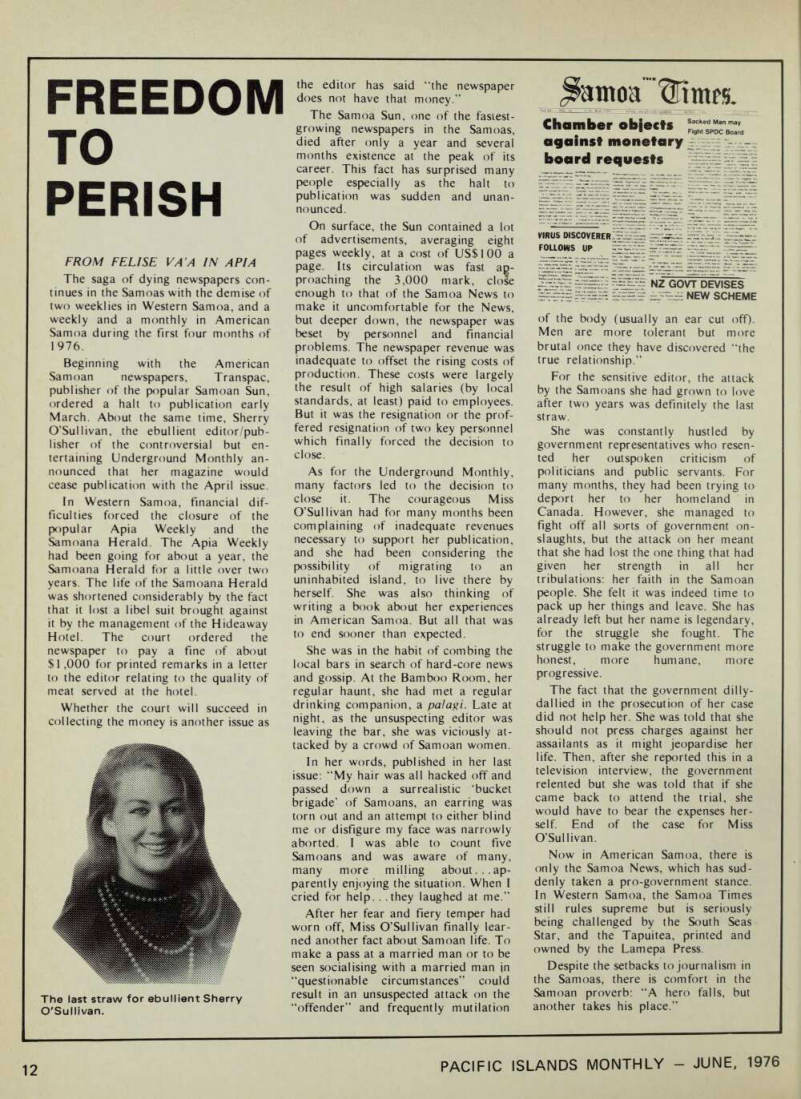
The last straw for ebullient Sherry O'Sullivan.