Grass skirts - so it
p. 11 · Read in the full issue
must be Friday
From GUS SMALES in Port Moresby
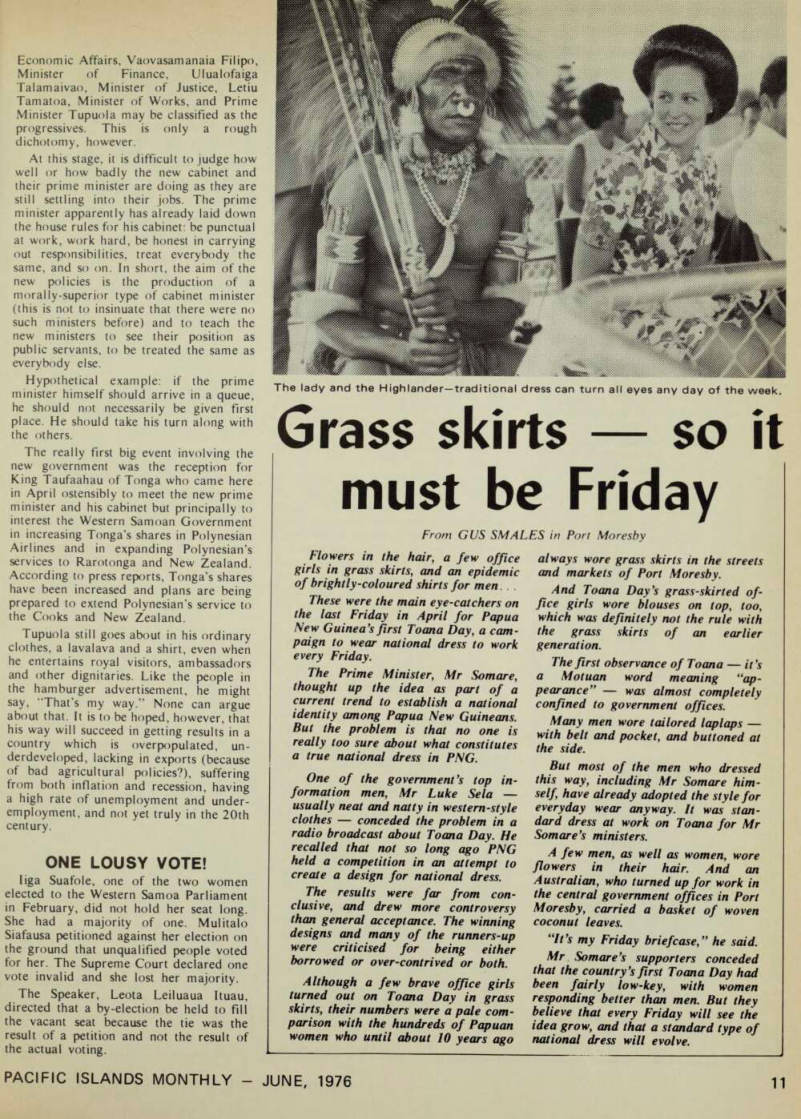
Flowers in the hair, a few office girls in grass skirts, and an epidemic of brightly-coloured shirts for men These were the main eye-catchers on the last Friday in April for Papua New Guinea’s first Toana Day, a campaign to wear national dress to work €V€ 'ru the Prime Minister, Mr So mare, thought up the idea as part of a current trend to establish a national
bT‘!LZriZff.ZthZ
, problem is that no one is really too sure about what constitutes a true national dress in PNG.
One of the government’s top information men, Mr Luke Sela usually neat and natty in western-style clothes conceded the problem in a radio broadcast about Toana Day. He Md‘o d r‘n h mn ,v' “• he ti competition 10 create a design for national dress.
The results were far from conelusive, and drew more controversy than general acceptance. The winning
d ::rcZidTeT f :i“tsrsz
borrowed or over-contrived or both Although a few brave office girls turned out on Toana Day in grass skirts, their numbers were a pale comparison with the hundreds of Papuan women who until about 10 years ago
always wore grass skirts in the streets and markets of Port Moresby Toana of fice girls wore blouses on top, too, which was definitely not the rule with the grass skirts of an earlier generation.
The first observance of Toana it’s a Motuan word meaning “op pear once” was almost completely confined to government offices Guineans. Many men wore tailored laptops with M , pocke , md at t he side F n , , out most of the men who dressed this way, including Mr Somare him self have already adopted the style for everyday wear anyway. It was stan dard dress at work on Toana for Mr Somare’s ministers.
T PNG 4 « *■*// women, wore at ,‘T P ‘ fl° wers « '*«> hair. And an Australian, who turned up for work in the central government offices in Port Moresby, carried a basket of woven coconut leaves.
T FridaybrUfcase ’’ he
Mr Somare s supporters conceded that the country’s first Toana Day had been fairly low-key, with women responding better than men. But they believe that every Friday will see the idea grow, and that a standard type of national dress will evolve.
The lady and the Highlander—traditional dress can turn all eyes any day of the week.