power-a Fijian
pp. 48-49 · Read in the full issue
The presentation nf power-a Fijian analyses the Fijian
Books
Leadership in Fiji is the posthumously published work of the first Fijian an thropologist, the late Rusiate Nayacakalou. It is in large part a critique of the Fijian Administration, the bureaucracy established by the British colonial rulers to preserve village society and to discourage individualism.
An earlier draft of the book was originally circulated among Fijian officials and the author was subsequently invited to redesign the administration to make it more responsive to popular demands.
Rusiate Nayacakalou gained his BA and MA degrees in New Zealand. He then studied for his doctorate at the London School of Economics under the guidance of the distinguished anthropologist Raymond Firth. In 1965 Dr Nayacakalou was appointed as a lecturer in an
thropology at the University of Sydney.
Four years later he resigned to become manager of the Native Land Trust Board, the authority that supervises the use of over 80% of Fiji’s land. His duties in cluded evaluating the proposal of this would-be foreign investor as against that at a time when there was a vocal political
opposition in Fiji.
Inevitably, his decisions drew the fire of the radical press, a fate that would have befallen any occupant of the post at that peak period in the development of the tourist resorts.
The stresses of the job contributed to the decline of Rusiate’s health and his death in 1972 at the age of 44.
In his book, published with the editorial assistance of Professor Ron Crocombe, Dr Nayacakalou first makes us sensitive to the subtleties and flexibilities of the
traditional society.
He brings new insights into the actual
operation of kinship ideology in relation
to the practical contingencies of local organisation, and into the wide play that is given to pragmatism and rivalry in the selection of leaders: “Although the prin ciples underlying the structure of chief tainship are clear and unmistakable there are subtle ambiguities in their application which can be manipulated to ad vantage. . .the essential flexibility of the institution may be viewed as the shock absorber by which the ability of ex ceptional men can be turned to advantage within the system.”
In the longest and most enjoyable chap
ter, “Traditional Leadership in the Modern Village”, we are given a lively ac count of leadership in action based on the author’s observations in several villages that had been subjected in varying degrees to the forces of social and economic change.
Susequent chapters deal with the operation of the Fijian Administration and the Methodist Church as authorities in the village, and with trade unions and other organisations that have developed as arenas of leadership in the towns.
Dr Nayacakalou’s main interest is in the disjunction between authority and public opinion that inevitably resulted from the establishment of the Fijian Administration as an instrument of colonial rule.
Bureaucratisation generated dissatisfac tions “verging on distrust of the chiefly system as a <vhole”.
In the traditional system, by contrast,
authority was responsive to popular sen
timents “chiefs and the people are one”, the chief being simply “the focus for the unity of the group he leads”.
The administration gave a small in digenous elite control over a large, predominantly subsistence rural population. The Fijian Affairs Board discouraged people from living in the towns or becoming independent farmers.
Children were educated in farming and the norms of village life and taught to revere traditional and official authority.
One manual instructed teachers that “the general rule for commoners is that they
should make themselves as inconspicuous as possible in the presence of the chief’
At least, for a time, the administration employed constables to police migration and persuade people in Suva to return to their villages. Special courts punished violators of the regulations right up until the late 19605.
The millenarian movement of Apolosi Nawai gained its strength from popular discontents with the bureaucracy as it was in the first three decades of the century.
Apolosi aimed to win for Fijians the economic and political advantages en
joyed by Europeans.
He began by encouraging people to disobey the officials, with sufficient success to induce the government to exile him on three occasions.
But popular resentment against the ad ministration as a coercive authority was
partly eclipsed by popular identification
with it as a source of political solidarity and a symbol of racial prestige once op position to Indians began to gain strength, especially in the 1960 s when Indian political demands made Fijians fearful for the security of their lands.
Dr Nayacakalou emphasises that the Fijians came to regard the bureaucracy with ambivalence: “On the one hand they placed their trust in it as the system which kept them united against the world of In dians, Europeans, and others. On the other it did not give them the freedom they needed to pursue their in clinations..its effect was always “to stifle individual initiative”.
While, as individuals, Fijians were often deeply frustrated by the paternalism of the officials and the conservatism of policy, the institution never became a popular target for attack in contests for leadership that raised the question of preserving Fijian political power in the country as a whole.
In parliamentary elections the progressiveness or otherwise of Fijian leadership has been subordinated to the question; Who can best secure racial
unity?
Inter-racial antagonism helped the men who headed the Fijian Administration to retain their political position after the franchise was extended to Fijians in 1963 their power base shifted from in stitutions associated with administration to
popular ideology.
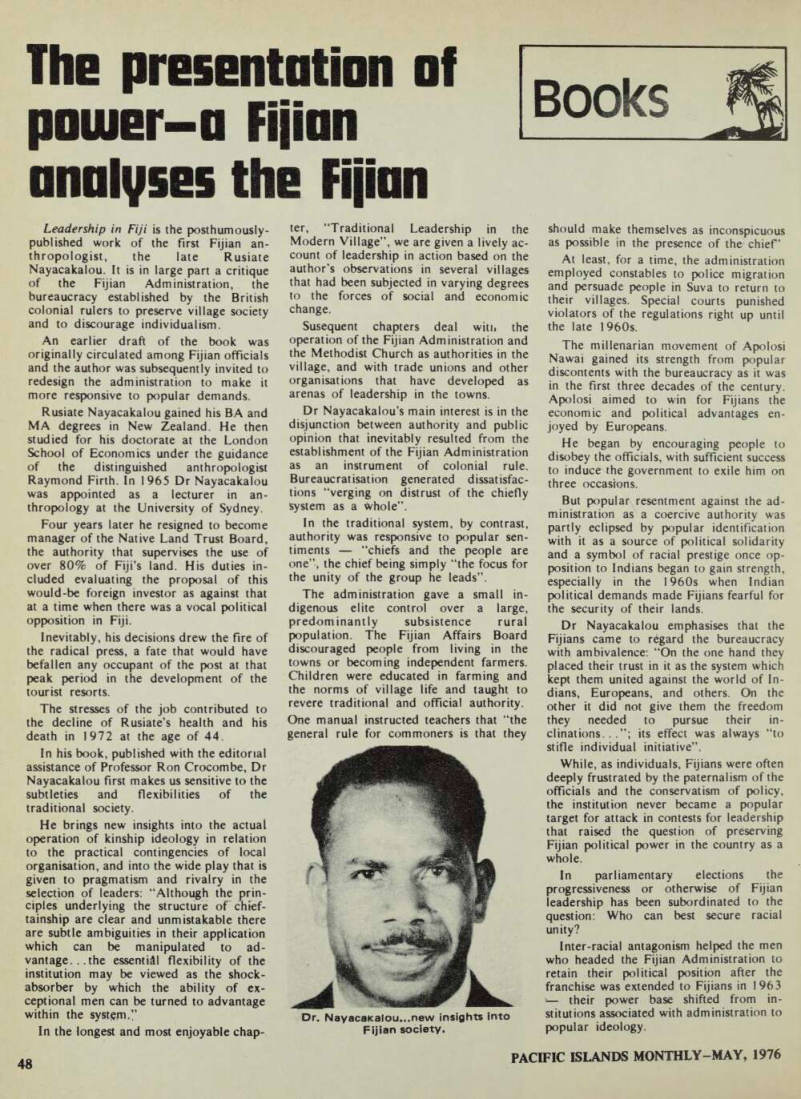
Dr. NayacaKalou...new insights into Fijian society.
This brings me to my criticism of the book. It makes little attempt to relate the operation of Fijian Administration to the interests and conflicts of particular sec tions of society, especially in inter-racial relations.
The institution created a social and political elite whose members acquired a vested interest in its preservation. As heads of the administration, chiefs and com moners alike were reluctant to promote social and economic change partly from fear that it would undermine their position by weakening official power and diver sifying the interests of the people.
Dr Nayacakalou dismisses with a derisive exclamation mark the suggestion by some of his informants that con servative ideals were preached by the chiefs to keep themselves in a privileged position. But there is more than a grain of truth in this notion and to acknowledge that would be to introduce a rather dif ferent perspective to the study.
Europeans, both officials and businessmen, wished to support a strong conservative Fijian leadership that would restrain social changes that might strengthen opposition to industrial management and demands for political reforms, and give Fijians reasons to oc casionally unite with Indians as some did in the big strikes of 1959-60, events that are largely ignored in the book.
Europeans also sought allies among the Fijian leaders to strengthen their position against Indian leaders who were calling for the reduction of European political
privileges.
Hence, we find Europeans generally en dorsing the institutions in which con servative Fijian leaders built their positions, and Fijians being brought up to revere as sacred the alliance of their leaders with the Europeans.
The conservatism of Fijian Ad ministration was validated by an ideology that stressed the moral integrity and loyalty of the Fijians and attributed these virtues to the traditional society as this was said to be preserved through the colonial institutions.
One of the first things I noted when doing research in Fiji in the late 19605, initially under Dr Nayacakalou’s super
vision, was how Europeans were generally
inclined to contrast these reputed virtues with alleged demerits of the Indians: In
dians were often depicted as calculating,
materialistic, and exploiting.
In truth, the Europeans were defen sively exaggerating the very qualities that made the Indians their rivals in com merce, professions, and politics, and
lauding the Fijians for being gracefully
-ontented with their humble positions in he economy as subsistence villagers or iocile wage-workers disinclined to question the status quo.
One of the ironic twists in Fijian history is that the very impediments the Fijian Administration placed in the way of economic development helped to create anxieties that then made the institution popular as a framework and symbol of racial unity, and encouraging Fijians to be more concerned with maintaining political power than with reducing the economic
inequalities.
Aside from guaranteeing control of land and increasing career opportunities in the civil service, the preservation of power has had an intrinsic value for Fijians, enhan cing their sense of honour in the wider society rather than providing a lever for gaining real economic advantages. Indeed it has provided a safe setting for the con tinuation of foreign hegemony in major in dustries.
My point is that an examination of the Fijian Administration ought to give some attention to the influence of political in terests, some of which I have indicated, and also to political consequences that bear on the situations of interest groups
today.
But perhaps to effect liberal changes in Fijian government Dr Nayacakalou found it necessary to take the diplomatic path of
locating his peoples’ “problems” simply in
the form of their institutions rather than in the interests, conflicts, and alliances of particular groups and strata.
There is a story in Fiji, perhaps
apocryphal, that Apolosi Nawai blessed the family of Rusiate Nayacakalou and assured his father of his son’s future fame.
Rusiate’s boyhood village, Draubuta, was indeed one of the main centres of Apolosi’s commercial ventures, and his father was one of Apolosi’s most devoted hosts there. Unlike his legendary patron, Rusiate was able to stimulate change from within the system itself, realising the popular hope that an educated commoner would one day persuade the chiefly establishment to relax its grip on the people.
Yet, though Fijians now elect their leaders at both local and national levels, they have come little closer to achieving effective power in their economy than in the days when Apolosi organised his Viti Kabani (Fiji Company). Robert Norton
(Leadership In Fiji By Rusiate
Nayacakalou. Published by Oxford University Press, Melbourne. Cloth $l4. paper $6.50.)