Forever Norfolk
pp. 45-47 · Read in the full issue
A Corner Of A
Foreign Field Which Is
a ™£ te 'i‘ r . histor '® 1 ’ and archaeologist is unlikely to find any connections with Norfolk Island in the nreserved inmh/nfn Q “ eensthe N. ile galley of Egypt, where to browse through the incredibly well preserved tombs of Queen Hapshetsut, King Tuthankamen, Ramses VI and Amenophis 11, and to examine ocietiTs of ove 000 P eS ° f is to bring home the fact that The spiritually-onented problems** perhaps make Australia's periodic “constitutional crises, much less little Norfolk s worries, pale indeed into insignificance.
A number of military officers who were S°. au™f Admin,strators of Norfolk island had connections with the fighting and adventures on Gallipoli. Of the eight
Sffit
buf 'two e ( MV W Mu?p7y a Ud 1 Mr 9 Jusuce C E eight, Herbert and Sellheim, died on Norfolk Island and are buried there Of the six soldiers, four had a connection with
Gallipoli.
Colonel Edwin Thomas Leane, CBE, VD, served as Administrator from July 1 924 to October 1 926. He does not seem to have actually served at Gallipoli but was in the large supporting base in Cairo on the staff of the then Colonel Sellheim.
E.T. Leane is not to be confused with Brigadier R.L. Leane, CB, CMG, DSO, MC, (of Leane’s Trench fame) who landed early in the Gallipoli campaign and surfighting generals. ° f AUStral ' a * The adm inistrati °n of E.T. Leane on rfolk, however, ended with his removal
from office after the Royal Commission of 1926 headed by Francis Whysall had recommended “That in the interests of the Commonwealth and Norfolk Island, the present Administrator be recalled without
delay.”
Leane was succeeded by his previous boss in Cairo, Major General Victor Conradsdorf Morisset Sellheim, CB, CMG, who died in office within a year of his arrival at Norfolk.
In Cairo, Sellheim had had the difficult and often thankless task of providing sup port to the troops on Gallipoli and he was bitterly disappointed at not being given a fighting command there. Sellheim’s mother was one of the six daughters of the colonial-era Commandant of the penal settlement on Norfolk, Lieutenant Colonel James T. Morisset, who was probably the first officer in charge to occupy the present Government House in the early 1830 s.
Colonel Alfred Joshua Bennett, CMG, DSO, VD, who served as Administrator from 1 May 1929 to 30 June 1932, par ticipated in much of the savage fighting at
Gallipoli, but it was that redoubtable soldier, architect and musician, Major General Sir Charles Rosenthal, KCB, CMG, DSO, VD, probably Norfolk Island’s greatest Administrator (4 Decem ber 1937 to 31 December 1945) whose name shone brightest at Gallipoli. He had an important feature, Rosenthal’s Ridge, named after him.
Rosenthal was the artillery commander and an original Anzac who landed with his 3rd Australian Artillery Brigade on 25 April 1915. He was twice wounded at
Gallipoli, being evacuated once to Egypt
and once to England. Rosenthal later commanded the 2nd Australian Division in France with great distinction up to the end of World War I. On the Western Front in June 1918 he was wounded for the fifth time. Many of the older residents of Norfolk Island today speak with af fection and deep respect of Rosenthal and his dedication to Island affairs.
Relaxing on the heights of the Gallipoli Peninsular in May of 1975, with the hazy island of Imbros to the west and parts of the Asian continent visible across the
straits to the east, it is not difficult to con jure up the events of 60 years ago.
Nor can one feel far removed from those few links with Norfolk Island; the Turkish gun, captured and sent back to the Island for display; the other Norfolk Islanders who saw action at Gallipoli; the lucky ones to survive subsequent battles elsewhere and see out their days on their beloved Norfolk.
Quintal, Nobbs, Robinson, Leane, Sellheim, Bennett and Rosenthal. And Private Buffett lying at Lone Pine. His
photograph still hangs proudly in the
home of that fine old Norfolk couple, Kathie and Eddie Snell, alongside that of Private William Francis Allen, the latter killed in France. Kathie Snell was a niece of Private Buffett and sister of Private Allen.
Nevertheless, whether it be the en vironment of Egypt, the quiet ruins of the uninhabited and sacred island of Delos in the Aegean, the overwhelming atmosphere of ancient Ephesus in south-western Turkey, or the colossal scale of the remains of the Roman temple of Baalbek in Lebanon, it is individual people and their hopes and aspirations and fears, precisely the same as on Norfolk and elsewhere, that caused all of these sites to exist, to be lived in, and to endure.
A most rewarding experience was to spend some time in the Istanbul /Dardanelles/Gallipoli area. Near the huge Turkish Army Selimye Barracks in Istanbul, lies the Zirai Donatim, the old British cemetery established at the time of the tragic and bloody Crimean War in the 1850 s. To browse here is to do so amongst the resting places of many British soldiers who died in cruel and frequently unhygienic circumstances, as did thousands more in 1915 further down the
same Straits on the Gallipoli Peninsular.
KT . • u u . . .. . „ , Nearby, m the barracks itself, the Turks still preserve the little Florence Nightingale Museum, the room she used as a base before going on to do her great humanitarian work on the Crimean Pemnsu ar> But the most fascinating experience was to go to the now quiet and serene World War I battlefield of Gallipoli on a fine and warm day. To start at Anzac Cove and cover the ground which had become familiar by reading, and by studying plans n mo e s.
Queensland Point (I picked up the remains of an Army water bottle), Hell Spit, Shrapnel Gully (met a friendly snake face to face), Rest Gully (souvenired an enamel plate), Monash Gully, Quinn s Post, Courtney’s Post (puffing a on oy inis
time; it is hard enough in that country without carrying rifle, pack and gear, and without fighting one’s way up), The Nek and Lone Pine.
The silent cemeteries; the warriors’ names; the battalions; the familiar place names even Norfolk Island. Not a soul in view. All of one day and seeing only three Turkish foresters going about their work. The occasional human bones in the gullies, for the Turks did not bury their dead; and surely there is no more moving place on earth for an Australian than the Lone Pine cemetery, quiet except for the
shrilling birds.
There are 36 cemeteries on the Penin sular, with no less than 21 being located in the Anzac area, but none so poignant as Lone Pine and for the Norfolk Islander,
this epitaph;
“Believed to be buried in this Cemetery 1103 Private A. F. Buffett 3rd Bn. A.I.F. 7/12 August 1915. Age 28 Fletcher Buffett Norfolk Island
Mispah”
Allen Fletcher Buffett junior was the son of Allen Fletcher Buffett and Kathleen Buffett and his name appears on the Roll of Honour at the Australian War Memorial, Canberra, (Row 35 west). The Fletcher Buffett who dedicated the head stone was the younger Allen’s father.
“Mispah”, apart from being well-known as the name of a number of Biblical sites in the Holy Land, also has the general meaning of “May the Good Lo/d watch over Thee whilst Thou and I are parted.”
Other Norfolk Islanders to have served at Gallipoli were Fletcher Evelyn Quintal, Charles Chapman, John Selwyn Robinson, MC, (his nephew on Norfolk Island today, D.C.D. Buffett, has his uncle’s Military Cross medal), and Charles Henry ffrench Nobbs, who became Lieutenani rsobos,
Royal Flying Corps.
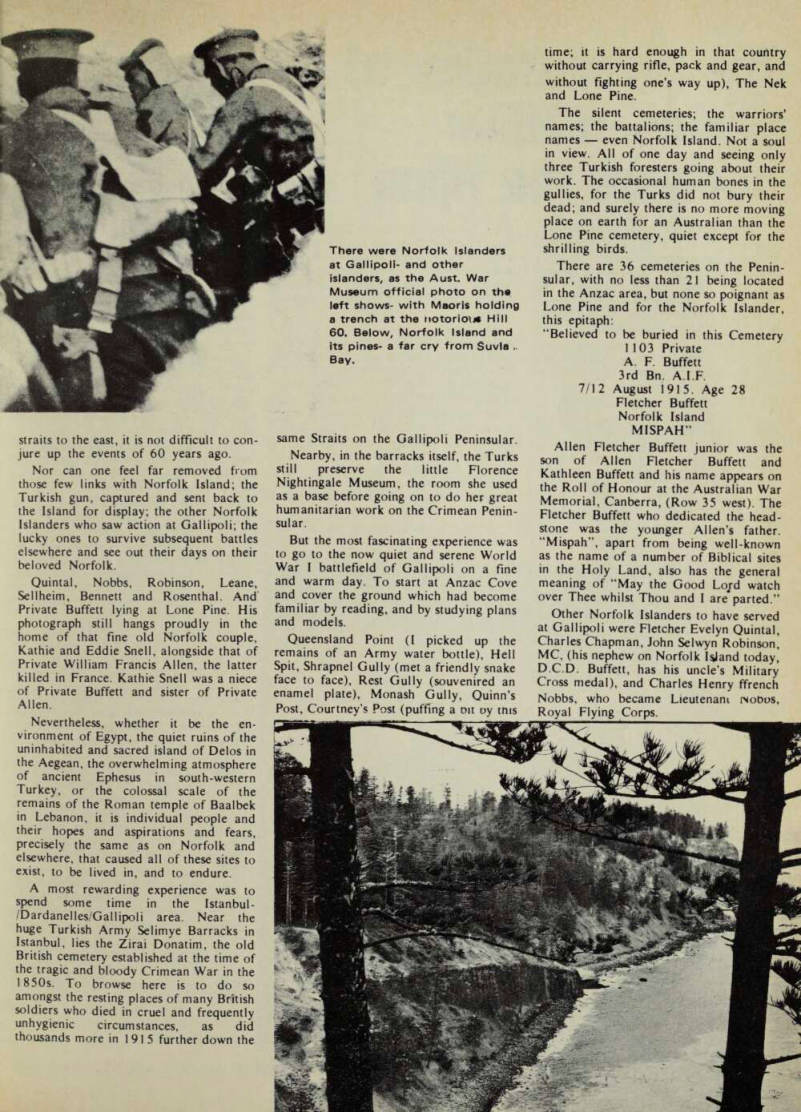
There were Norfolk Islanders at Gallipoli- and other islanders, as the Aust. War Museum official photo on the left shows- with Maoris holding a trench at the notorio[?] Hill 60. Below, Norfolk Island and its pines- a far cry from Suvla Bay.