The love of booze-not money
pp. 31-36 · Read in the full issue



is the root of Fiji’s evil
From Robert Keith-Reid
in Suva
The love of booze, not money, is the root of most evil in Fiji. To be precise, if evil-doers doing time in Suva Jail are to be believed, booze is the cause of around 60 per cent of the crimes felt to be an affront to respectable sections of Fiji society.
It’s a figure that Mr Justice Clifford H. Grant, Fiji’s Chief Justice, evi dently takes as being valid. Sitting as a Royal Commission, he has come up with recommendations for curb ing crime in Fiji that have its boozers —and they are very much in the majority—close to dropping their beer glasses in shock.
If the judge has his way, one Suva tippler theorises, most of the popu lation would be in the bonds of com pulsory teetotalism within a couple of years. For everyone aged 18 and over would need a valid drinking licence to be able, legally, to buy and drink liquor.
Bearing the holder’s photograph, name and birth-date, the licences would be obtainable as of right, but could be, oh so easily, lost. And woe it would be to those who infringed its conditions. To buy or booze without one would be to invite jail or a fine, and since a lot of boozers would inevitably be losing their licences a lot of people would pre sumably be going to jail.
To get drunk, to drive drunk or just to drink in public places where boozing is banned, like most public parks, would bring, apart from a penalty for the actual offence, man datory cancelling of the drinking licence—for six months in the first instance and for up to 12 months for subsequent infringements.
Habitual criminals would incur an even longer period of prohibition.
If a court decided that drink was a contributory cause of the crime, the offender, as well as being im prisoned, would get his drinking licence cancelled for up to two years—and this prohibition would run from the time he was released from prison.
Drunk drivers would get a real hammering: a fine or jail for the actual offence, plus mandatory can cellation of his drinking licence for from six to 12 months, plus man datory disqualification trom driving
for one year the first time around, or for five years for a second offence.
The judge doesn’t stop here, not by a long chalk. Assuming his re commendations, made as sole mem ber of the Royal Commission on Crime, were implemented from A to Z the Fiji of the future—say around 1984—could be something like this, possibly.
Want a driving licence? Okay, but only after you have given your ad vance signed consent to a blood test when any policeman thinks you might be under the influence while being in charge of a car.
Going out on a spree? Fine. Got a valid drinking licence? No? Then its going to be a lemonade night.
Still going out? Better make an early start with the merry-making then. All bars, pubs, nightclubs and cinemas have to close at midnight.
Found wandering in your neigh bourhood between 1 am and 5 am and unable to convince the friendly neighbourhood cop that you were just sleepwalking, or looking for the cat, or bugged by insomnia? Then that’s the crime of loitering mate, and of to jail you go.
Up in court again for a little mat ter of robbery, or housebreaking, or burglary, or loitering? Well this time, after jail, just you stay out of town for the time of the prohibition order lumped on vou by the court.
Still being bad? Well after you get out of jail, just you go back to
your home village and live there until the residential order dropped on you by the court expires.
The stringent liquor laws, the virtual curfew conditions, the clamp down on nightclub and cinema hours and the prohibition and residential orders are just a few of the ingredi ents in the recipe Mr Justice Grant has concocted as being what is needed for keeping Fiji clean.
They provoked immediate out raged reaction. But if one was to take a strictly pragmatic view, the judge’s hard-line ideas are, of course, the nasty medicine that must be administered by anyone who is really serious about wanting to quell a crime epidemic.
The judge’s report is the product of a phenomenally hardworking and forthright man and one which he volunteered to do last year at the height of governmental and public unease over a ballooning crime rate.
He completed the joo swiftly and thoroughly without seeming to slacken the pace of his ordinary duties as head of an undermanned and overworked judiciary.
The crime rate investigated by him showed a 94 per cent increase between 1970 and 1974, according to figures in the report. Robbery and demanding with menaces went up 328 per cent; burglary, housebreak ing and storebreaking by 136 per cent; assaults 84 per cent; receiving by 51 per cent and drunkenness by 43 per cent.
As outlined by the judge, the causes of Fiji’s crime problems are symptoms common, in one way or another, to most other young countries in which the traditional social structure and economy is undergoing rapid change.
Fijians form 42 per cent of the coun try s total population, they account for 80 per cent of the names on prison roll-calls.
Race, however, is only “minimally” a cause of crime, he stresses. While 86 per cent of robberies are com mitted by Fijians against non-Fijians, he found evidence suggesting that the reason is “not racial but morpho logical”.
Compared with Fijians, most non-
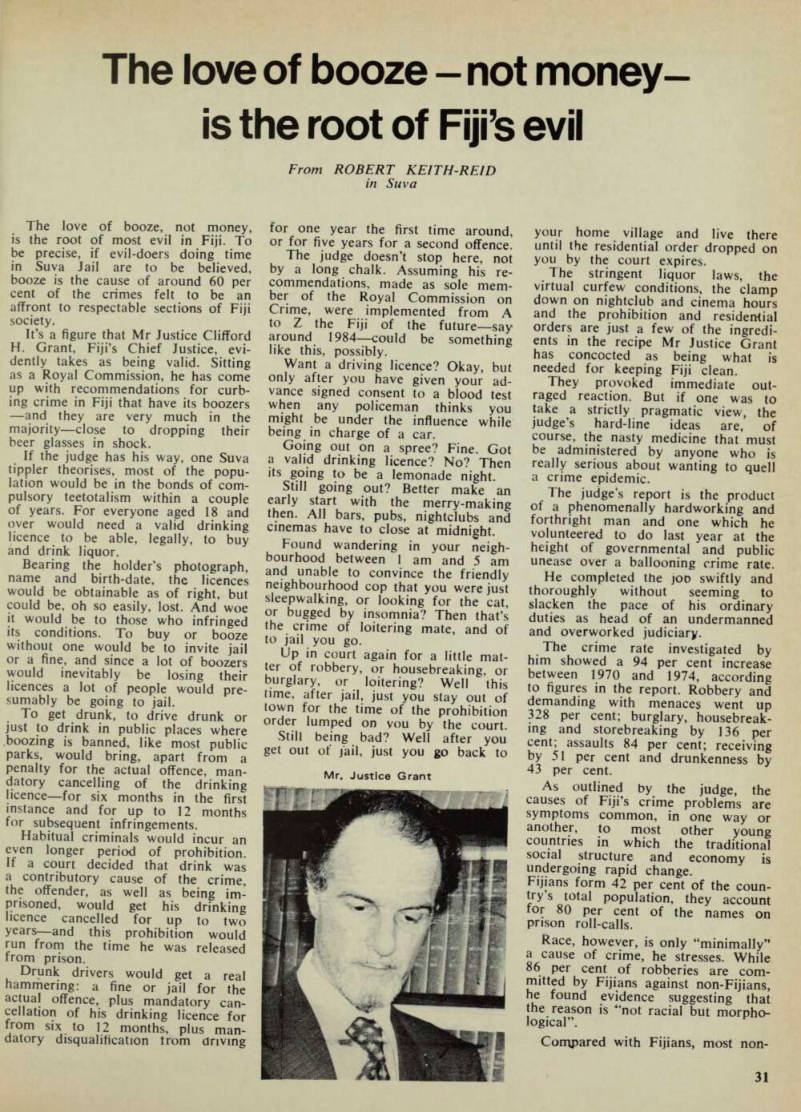
Mr. Justice Grant
Fijians are smaller, seem an easy target for this reason, and usually have more money or items worth stealing, the judge says.
Noting the 1970-1974 crime figures he says that, in the same period, beer consumption almost doubled.
“I am satisfied there is a direct relationship, despite the increase in population and tourists”, he says.
“My conclusion is supported by the fact that 60 per cent of the prison population blame liquor for the commission of their offences; and the courts throughout Fiji are constantly being informed by offenders that liquor was the cause of their criminal conduct”.
Making his diagnosis, Mr Justice Grant observes that crime is also mainly an urban problem—and that Fiji is fast becoming urbanised.
Old communal and family systems are breaking down and cramped “high density” living in towns stimu lates aggressive behaviour.
Contrary to popular beliefs un employment is not a major contribut ory factor, the judge says; only 19 per cent of convicts had no means of employment.
“What is far more likely to give rise to crime are awakening aspira tions, sometimes referred to as the ‘revolution of rising expectations’ if they are not realised”, he says.
Fijians especially, he says, are bewildered by the loss of traditional customs and ethics when they move into town and can’t cope with them selves or their children. The abolition of the bulk of Fijian Affairs regu lations (a legal code) formerly applied to Fijians only) has caused an “alarming” decline in village discipline.
The judge sees tourism as a mixed blessing, bringing employment and income, but also alien values which are contributory to crime.
Much of the slide downwards, he feels, is due to faults with the Royal Fiji Police Force: undermanned, ill equipped and, because of low pay, not getting men of the right calibre.
Meaningful economic development cannot continue without law and order being preserved, he warns.
“This has not been fully appre ciated by the government, resulting in a failure to provide an adequate police force”.
This failure was another major :ause of crime, since stiff deterrent sentences dealt out by courts would not be much of a deterrent to people who knew that there was not much chance of being caught by the police.
The Fiji public itself helps criminals in a big way, the judge says. Firstly, it fails to take simple
precautions like fitting iron grilles over windows.
Secondly, the judge laments, the public’s threshold of honesty is not as high as it should be”—people tend to buy what is offered without asking where it has come from.
“Positive steps must be taken by the public to protect their own per sons and property” the judge insists.
“They should avoid walking alone in unlit areas at night. They should report to the police anything sus picious that comes to their attention instead of adopting the attitude that it is no concern of theirs”.
Dealing with preventative mea sures, the judge complains that Fiji’s education system places too little
emphasis on such lessons as honesty and decency. Instead, 125,000 child ren are being crammed for examin ations that have little relevance to local needs.
The judge takes a hefty swipe at cinema proprietors for screening far too many films containing “gratuitous violence or glorifying crime”. He demands much tougher film censor ship—a complete ban on sexv vio lence and crime-orientated films— and says censors who don’t keep such films out of cinemas should be promptly sacked He would like one censor to be a police officer.
Suva’s brewery gets a broadside also. Fiji beer contains too much alcohol, the judge thinks. The
brewers “must be persuaded that it is not an economic proposition to continue their contribution to crime”.
His solution here, is to slap high excise duty on strong beers, low duty on weak brews.
The report airs a long list of other remedies: more prison accommoda tion to ease overcrowding and permit the segregation of first offenders from old lags; more support for youth clubs; more sports fields and facili ties so that sport can be promoted as an outlet for aggressive feelings; the gradual demolition of choc-a bloc tenement buildings; school lessons in honesty; and the creation of a Ministry of Justice.
Crime prevention depends largely on there being an adequate and com prehensive policy for a nation’s youth, the judge says.
“It is an essential part of planning for national development and would be the responsibility of a Minister of Justice who would concentrate on an evaluation of programmes, costs and benefits likely to accrue from the adoption of various crime control and crime prevention mea sures five years in advance”, the judge says.
Looking specifically at Fijian law lessness the judge suggests the ap pointment of village peace officers to restore discipline in the villages, with powers to arrest and detain without warrant and to report any offences to the nearest district police station.
Other duties would be to supervise offenders on probation, report juvenile delinquents to the welfare department, supervise work by ex tramural prisoners, serve summonses, help trace witnesses and generally liaise with the police and welfare authorities.
Mr Justice Grant also took the opportunity to comment on three matters not directly related to the problem of everyday crime.
“It is about time”, the judge says, “that the Fiji Parliament either com pletely abolishes the death penalty once and for all, or otherwise legis lates to specify the categories of murder for which it should be applied”
“Supreme Court judges should not be left, as they are now, to decide when the death penalty should be invoked”.
Dealing with the effectiveness ot corporal punishment, the judge says it is still too early to say what re sults have been achieved since punishment with a rattan cane was reintroduced for crimes of violence several years ago.
But caning does appear to be a deterrent. Since, however, the num ber of strokes is limited to 12, courts
have tended to order no more than six, “to keep something in reserve”, “This verges on the inadequate”, the Chief Justice says, and suggests the maximum should be raised to 24.
Recommending tougher measures against acts likely to incite racial hatred, the judge counsels the adop-. non or pena ties which could be USC H ‘° onp« ,hn| P ™rf hnnlH h h f CO f S should . b « empowered to close, for any period of up to one year, a newspaper found guilty of publishing material likely to inflame racial feeling, prejudice, public peace or advise disobedience of lawful orders given by military, police or prison authorities.
Furthermore the iudae cave courts shouM on be able to ban newspaper publishers, proprietors and editors from writing for or helping with the publication of any newspaper.
These recommendations brought an immediate howl of protest from the 18-month-old Fiji Sun, one of Fiji’s two dailies, which the judge accused of publishing “deadly” and “blatantly racist” letters in its open columns.
The 106-year-old Fiji Times also expressed some understandable reservations on this point, although in a rather more muted fashion.
Other aspects of the judge’s report did not go down well in other quarters either.
Prime Minister Ratu Sir Kamisese Mara stressed that its contents war ranted very long and careful study before any action was taken.
He did not like the idea of drink permits since, he said, people would just go back to brewing their own grog on the sly. Fiji had tried a liquor permit system before and it had not worked, he said, recalling British colonial days when non- Europeans were required to hold drinking permits.
The Prime Minister also came out strongly against the proposals for town prohibition and residential orders. These had been used during World War Two days and had caused more trouble in the villages, he said.
But the PM was all for the village peace officer concept as one he had been advocating himself from way back.
The Prime Minister pointed out that the government, of its own initiative, had already taken steps to improve the quality of the police force. Since the judge had been com missioned to prepare his crime re port, police pay had been increased, more men recruited and overseas expertise had been sought and
obtained.
Ratu Mara pointed, with satisfac tion, to a 28 per cent drop in crime figures in the Suva area in January this year compared with January, 1975, and said it looked as if action to boost police morale and efficiency was earning quick dividends.
Although the Prime Minister did not say it aloud, as he spoke to local journalists about the Chief Justice’s report, he seemed to hint that the lowered Suva crime rate was a more than adequate reason for regarding it as not needing urgent consider ation and complementary action.
Any government which tried to implement the more controversial of the report’s recommendations, such as that for liquor permits, would certainly be courting a lot of unpopularity.
And with a general election com ing up next year, Ratu Sir Kamisese Mara’s Alliance Party will certainly be wary of doing anything like that. • Mr Charles Wardrop, of Fiji, has been appointed chairman of Burns Philp (SS) Co Ltd. He suc ceeds Mr R. G. Kermode, who is now Mr Justice Kermode of the Fiji Supreme Court. Mr Wardrop joined BPs about 40 years ago as a motor workshop supervisor.