dispels a myth
pp. 29-30 · Read in the full issue
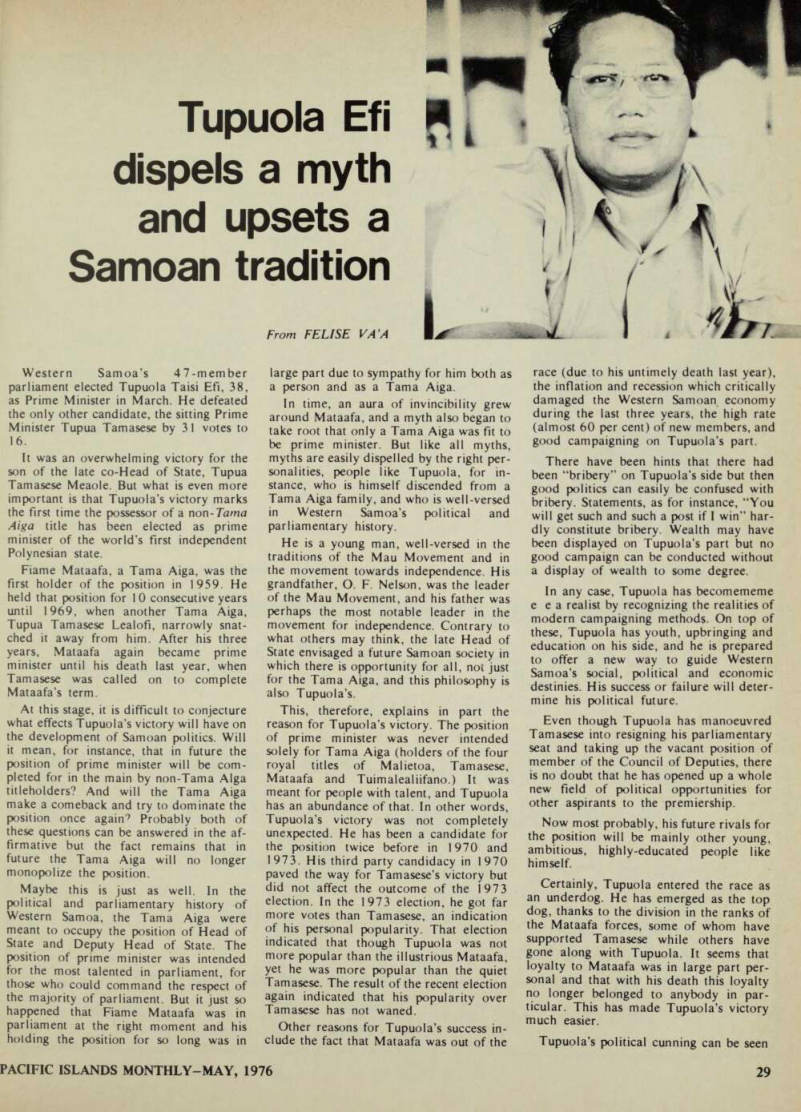
Tupuola Efi dispels a myth and upsets a Samoan tradition
From Felise Va 'A
Western Samoa’s 47-member parliament elected Tupuola Taisi Efi, 38, as Prime Minister in March. He defeated the only other candidate, the sitting Prime Minister Tupua Tamasese by 31 votes to 16.
It was an overwhelming victory for the son of the late co-Head of State, Tupua Tamasese Meaole. But what is even more
important is that Tupuola’s victory marks
the first time the possessor of a non -Tama Aiga title has been elected as prime minister of the world’s first independent
Polynesian state.
Fiame Mataafa, a Tama Aiga, was the first holder of the position in 1959. He held that position for 10 consecutive years until 1969, when another Tama Aiga, Tupua Tamasese Lealofi, narrowly snat ched it away from him. After his three years, Mataafa again became prime minister until his death last year, when Tamasese was called on to complete Mataafa’s term.
At this stage, it is difficult to conjecture what effects Tupuola’s victory will have on the development of Samoan politics. Will it mean, for instance, that in future the position of prime minister will be com pleted for in the main by non-Tama Alga titleholders? And will the Tama Aiga make a comeback and try to dominate the position once again 9 Probably both of these questions can be answered in the af firmative but the fact remains that in future the Tama Aiga will no longer monopolize the position.
Maybe this is just as well. In the political and parliamentary history of Western Samoa, the Tama Aiga were meant to occupy the position of Head of State and Deputy Head of State. The position of prime minister was intended for the most talented in parliament, for those who could command the respect of the majority of parliament. But it just so happened that Fiame Mataafa was in parliament at the right moment and his holding the position for so long was in
large part due to sympathy for him both as a person and as a Tama Aiga.
In time, an aura of invincibility grew around Mataafa, and a myth also began to take root that only a Tama Aiga was fit to be prime minister. But like all myths, myths are easily dispelled by the right per sonalities, people like Tupuola, for in stance, who is himself discended from a Tama Aiga family, and who is well-versed in Western Samoa’s political and
parliamentary history.
He is a young man, well-versed in the traditions of the Mau Movement and in the movement towards independence. His grandfather, O. F. Nelson, was the leader of the Mau Movement, and his father was perhaps the most notable leader in the movement for independence. Contrary to what others may think, the late Head of State envisaged a future Samoan society in which there is opportunity for all, not just for the Tama Aiga, and this philosophy is
also Tupuola’s.
This, therefore, explains in part the reason for Tupuola’s victory. The position of prime minister was never intended solely for Tama Aiga (holders of the four royal titles of Malietoa, Tamasese, Mataafa and Tuimalealiifano.) It was meant for people with talent, and Tupuola has an abundance of that. In other words,
Tupuola’s victory was not completely
unexpected. He has been a candidate for the position twice before in 1970 and 1973. His third party candidacy in 1970 paved the way for Tamasese’s victory but did not affect the outcome of the 1973 election. In the 1973 election, he got far more votes than Tamasese, an indication of his personal popularity. That election indicated that though Tupuola was not more popular than the illustrious Mataafa, yet he was more popular than the quiet Tamasese. The result of the recent election again indicated that his popularity over Tamasese has not waned.
Other reasons for Tupuola’s success in clude the fact that Mataafa was out of the
race (due to his untimely death last year), the inflation and recession which critically damaged the Western Samoan economy during the last three years, the high rate (almost 60 per cent) of new members, and good campaigning on Tupuola’s part.
There have been hints that there had been “bribery” on Tupuola’s side but then good politics can easily be confused with bribery. Statements, as for instance, “You will get such and such a post if I win” har dly constitute bribery. Wealth may have been displayed on Tupuola’s part but no good campaign can be conducted without a display of wealth to some degree.
In any case, Tupuola has becomememe e e a realist by recognizing the realities of modern campaigning methods. On top of these, Tupuola has youth, upbringing and education on his side, and he is prepared to offer a new way to guide Western Samoa’s social, political and economic destinies. His success or failure will deter mine his political future.
Even though Tupuola has manoeuvred Tamasese into resigning his parliamentary seat and taking up the vacant position of member of the Council of Deputies, there is no doubt that he has opened up a whole new field of political opportunities for other aspirants to the premiership.
Now most probably, his future rivals for the position will be mainly other young, ambitious, highly-educated people like himself.
Certainly, Tupuola entered the race as an underdog. He has emerged as the top dog, thanks to the division in the ranks of the Mataafa forces, some of whom have supported Tamasese while others have gone along with Tupuola. It seems that loyalty to Mataafa was in large part per sonal and that with his death this loyalty no longer belonged to anybody in par ticular. This has made Tupuola’s victory much easier.
Tupuola’s political cunning can be seen
by the fact that he has retained three ministers from Tamasese’s old cabinet, Lilomaiava Niko, former Minister of Justice, Vaovasamanaia Filipo, former Minister of Agriculture and Tofaeono Tile, former Minister of Works. He has also set up new mini-departments and switched around some of the old port folios.
The new ministers and their respon sibilities are: Tupuola Efi, Prime Minister, and Minister of External Affairs, Cabinet and Executive, Prime Minister’s Depart ment, Attorney-General, Legislative Department, Local and District Affairs.
Asi Eikeni, Minister of Economic Affairs, Economic Development, Industries and Trade, Statistics, Marketing Division, Copra Board, Cocoa Board, Forests and Fisheries. Ulualofaiga Talamaivao Niko, Minister of Justice, Labor, Police, Public Service Commission, Youth/Sport and Cultural Affairs. Letiu Tamatoa, Minister of Works. Fuimaono Mimio, Minister of Agriculture. Vaovasamanaia Filipo, Minister of Finance, Customs, Inland Revenue, Treasury, Exhange Control, National Provident Fund, Public Trust and Government Printing. Tofaeno Tile, Minister of Communications and Tran sport, Civil Aviation, Marine, Shipping, Telecommunications and Postal Com munications and Health. Lilomaiava
Niko, Minister of Education. Mano Togamau, Minister of Lands and Survey
and Broadcasting.
Ihe new Speaker is Leota Leuluaialii I Ale.
It was the same old story in the general elections many sweeping changes in the composition of parliament.
Almost 60 per cent of sitting members lost their seats. Of the 36 who stood for re-election, only 14 were returned. There were 28 new members. Five sitting mem bers were re-elected unopposed.
The government lost two cabinet ministers, Alfonso Philipp, minister of Education, and Fepuleai Samuelu, Minister of Post Office and Radio. Both were soundly defeated as was also Speaker Toleafoa Talitimu. Minister of Health Seiuli Taulafo decided not to stand for re election so as to devote more time to his transport business.
Other notable defeats included those of Western Samoa’s first woman parliamen tarian Leaupepe Faimaala and Masiofo Fetaui Mataafa who campaigned under her matai title of Laulu. However, they have been replaced in parliament by two woman parliamentarians, Mrs Sina An nandale, wife of leading businessman Ed ward Annandale, and liga Suafole, a veteran public servant.
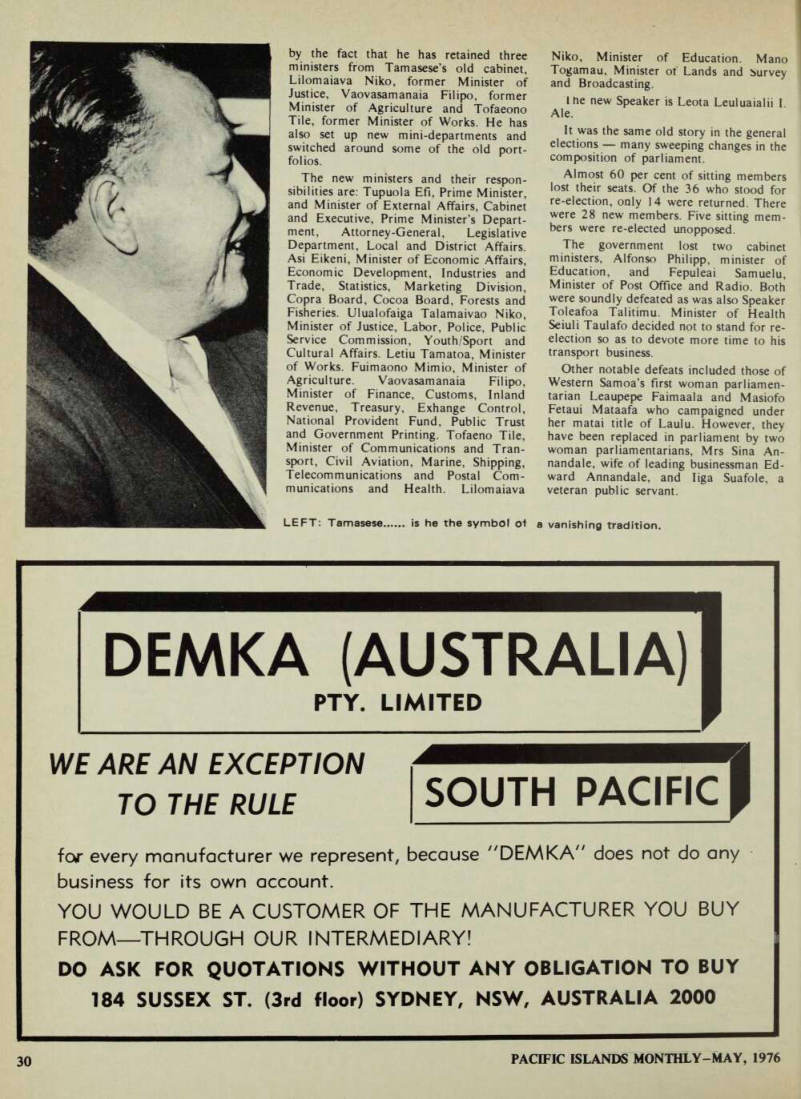
LEFT: Tamasese is he the symbol of a vanishing tradition.