Tropicalities
pp. 15-16 · Read in the full issue
Nuclear base
for Wallis
The islands of Wallis and Futuna, an almost forgotten outpost of the French Pacific, have come into prominence with suggestions that French nuclear testing in the Pacific could be eventually relocated in Wallis and that the island’s airport could be upgraded to replace Fiji as a stopover for UTA French Airlines across the Pacific.
These possibilities were aired in March in a Noumea newspaper close to the French Administration.
The islands have remained isolated from foreign contact. Several years ago they became “out of bounds” to South Pacific Commission staff when un favourable reports on local health and hygiene followed an SPC survey of Wallis.
In late 1974 they again erupted into publicity when the islanders’ protests for ced the expulsion of the resident French Administrator, Mr. J. de Agostini.
Recent problems have concerned tran sport and these appear to have been solved since the C.C.C. Caledonian shipping company has contracted to provide a 45day service out of Noumea while UTA has introduced an Air Nauru 737 to make weekly flights to Hihifo airport, on Wallis.
As an indicator that greater things may be ahead for this small territory of only 210 square kilometres, last year its
hereditary Polynesian “kings” were en
tertained in Paris by French President
Giscard d’Estaing.
Essential services in the territory are maintained by subsidies from France, with
locally-derived revenue coming mainly
from import tax. The budget voted by the elected Territorial Assembly has doubled over the past five years to about SAI million in 1975. At the same time ad ditonal French government expenditure has been between SAI and $2 million an nually, more than half of this to support the French public servants working for the islands, and a large amount paid outside the territory, for example in New Caledonia, for services such as transport.
Among recent developments have been a modern hospital in the capital, Mata Utu, of which the first section was com pleted in July, 1975. Work has now star ted to provide water and electricity for the whole population of Wallis. So far, only those in the administrative centre are sup plied with electricity. Plans are to have
electricity and water taken to all villagers by 1978. The water is to be pumped up from the considerable reserves located un derground. It is hoped that these water supplies could help promote local
agriculture and stock raising.
The islands’ exports are negligible in volume just 30 tonnes of trocas in 1974, for example. However the locally produced tapa cloth is very much sought after by those who can find it in such places as Noumea.
On the political side, in view of their own lack of material resources and their almost total dependence on French aid, and work opportunities, the Wallis Islan ders could always be counted upon to vote anti-autonomist in New Caledonia. Recen tly, a spokesman for the Territorial Assembly in Wallis said in Noumea that the islanders would be prepared to con sider becoming a department of France, being officially more integrated than as an
overseas territory.
It will be interesting now to watch whether the whispers among the French authorities in Noumea are likely to even tuate as to Wallis being developed as a
French Pacific air link or an eventual site for the re-location of the nuclear test cen tre currently operated in French
Polynesia.
Meanwhile, the latest from French Polynesia is that the French have carried out another nuclear test underground.
A tourist
rip-off in Fiji?
Did the Fiji tourist industry engage in a huge rip-off in 1974? That was the implication in a question posed by the Fiji Governor-General, Ratu Sir George Cakobau, when he opened the annual Fiji Tourism Convention at the new luxury hotel, Regent of Fiji, in Nadi Bay. He put some interesting figures to the convention.
In 1974, tourist traffic dropped by 2.8 per cent, but earnings from tourists rose by 22 per cent to a record $60.5 million.
Had charges been pushed up too much, with a consequent effect on 1975? Ratu Sir George asked. Did some people become too acquistive? Duty-free dealers took 47 per cent of total earnings, and the
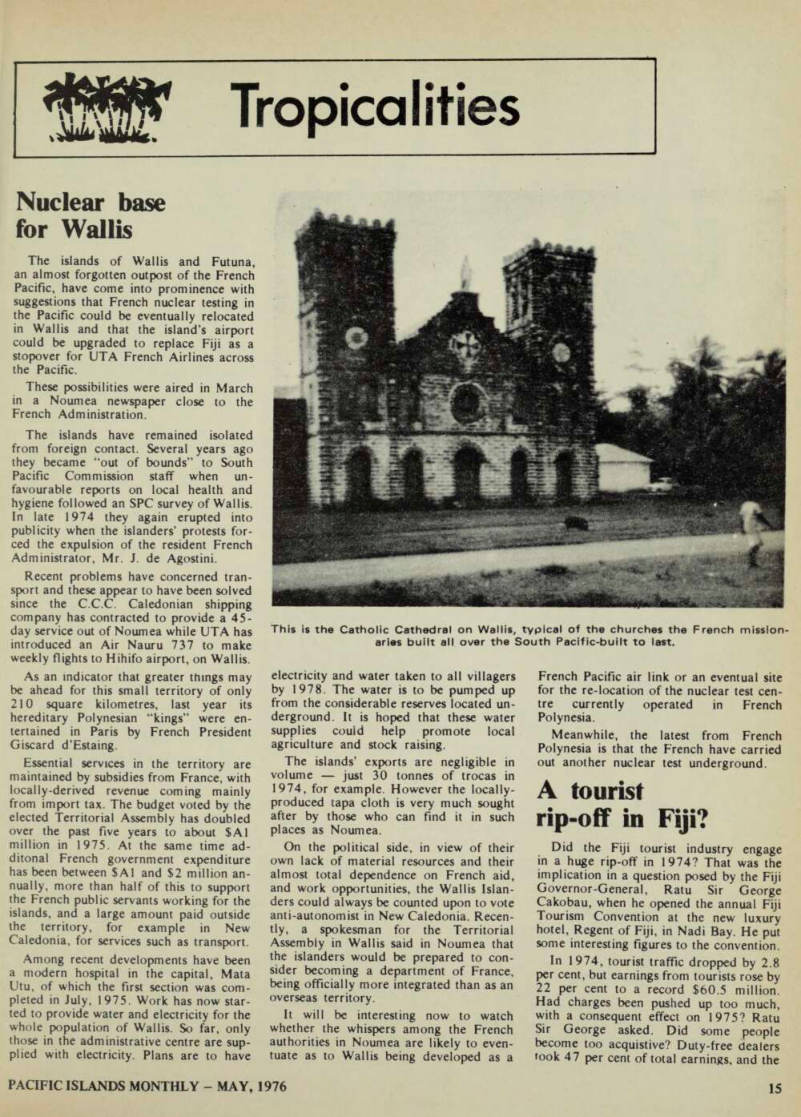
This is the Catholic Cathedral on Wallis, typical of the churches the French mission aries built all over the South Pacific-built to last.
hotels raked in 35 per cent. Dealers’ ear nings were up 30 per cent; hotel earnings rose 21 per cent.
The Governor-General said he felt sure duty free dealers and hoteliers had very good explanations, and no doubt the 400 at the convention would like to hear what their spokesmen had to say.
There seemed to be a faint touch of irony in the Governor-General’s remarks.
Justice from
the grave
A law enacted under the rule of the German Emperor Wilhelm (called Kaiser Bill by the British soldiers) in 1914 has been evoked in deciding title to a piece of land in Ponape in the United States Trust
Territory.
In 1914, just before Kaiser Bill set the world on fire with World War One, the German governor of Ponape determined the method by which ownership of a piece of land on Sokehs municipality should be awarded.
He ruled that if the owner of the land known as Lewho died without leaving an heir, his successor as owner should be chosen oy the Nanmwarki of Sokehs and the Governor of Ponape.
The decision was never made because along came the Kaiser’s war and the
governor found himself tied up with more
important matters.
Now, it’s been decided to utilise the ruling from the grave. In 1961, a Trust Territory court ruled that ownership should be decided according to that ruling.
That decision was disputed but now the last word on it has come from the courts.
Nanmwarki Artui of Sokehs and District Administrator Leo A. Falcom recognised as legal successor to the Ger man governor were able to execute the order.
They made a Solomonic judgment that the land be divided, half to Lina Higgins, also known as Lina Kilafwa, and half to Wehsel Liui and his sister Pina
Seikep.
Bottled
bath water
A successful enterprise producing
mineral water in Tahiti could be repeated in New Caledonia from spring waters at Mont Dore, outside Noumea.
Tahiti’s bottled “Eau Royale” comes from a royal batnmg pool on a property outside Papeete that once belonged to the
Pomare dynasty.
This “royal water” has been produced since December 1974 by the Caudele
company and is now distributed at the rate of 85,000 bottles per month. With mineral water being ever popular among the French, the Tahiti "Eau Royale” is supplied to the Mamao Hospital in Papeete, the nuclear test centre as well as French airlines Air Polynesie and UTA.
The spring water at Mont Dore outside Noumea has been under discussion for several years and a commercial project now appears likely with a possible output of 3.5 million litres per year.
New Caledonia offers an almost in satiable market for drink producers. It was recently claimed in the Noumea press that the territory may have broken a world record of 6 litres of whisky con sumed each year for every inhabitant.
Latest enticement for New Caledonians to enjoy a new gastronomical experience is the invitation launched from the nearby New Hebrides “Come to Vila for din ner”.
Since the February introduction of an Air Nauru 737, Vila is just a comfortable 50 minutes flight from Tontouta, New Caledonia. This makes Vila as accessible as some of the inland country towns Caledonians are prepared to drive to for a good Sunday lunch Those who wish to spend two nights at the Intercontinental Holiday Inn or Le Lagon can have their plane-fare and hotel room for less than