News
pp. 12-14 · Read in the full issue
The
In A
Nutshell
Marianas
Commonwealth
The Northern Marianas, one of the three island groups in the United States Trust Territory of the Pacific Islands, of ficially became a commonwealth within the United States on March 24 when US President Ford signed the deed of covenant at the White House.
Seven days later, the Marianas Govern ment was created by an order issued from the office of the US Department of the In terior. When the last signature was made to the documents, Marianas Senator Ed ward Pangelinan, former chairman of the Marianas Political Status Commission, who has worked hard for incorporation of the Marianas in the United States, described the Marianas’ separation from the rest of Micronesia as “wonderful”, and added that their job now was to make their territory “a showplace for democracy”. Later, there was a denial that the tylarianas was seeking union with Guam.
There may be more fragmentation of Micronesia. The Marshalls, who have declared themselves dissatisfied with the draft Constitution for the Federated States of Micronesia, have asked for separate negotiation with the United States over their future. They complain that the draft constitution discriminates against them in that their “special needs” are not recognised,
Typhoon At Palau
Typhoon Marie, blowing a regular 75 mph with 90 mph gusts, hit Koror in Palau early in April, causing almost total crop damage.
Damage is estimated at around US$l million and casualties included the Royal Palauan Hotel, which lost its roof, and the
Van Camp Fishing Company’s harbour at Malakal.
There was no news of Marie’s depredations in the outer islands as Marie
had effectively destroyed communications.
Food stocks at Koror were expected to last two weeks after which emergency sup plies would be needed.
More Bomb Protests
Spurred on by the South Pacific Forum’s decision at Rotorua to continue opposition to nuclear tests in the area, New Zealand’s Prime Minister Bob Muldoon was expected to make a protest on the Forum’s behalf to the French President over the latest bomb exploded by France at the beginning of April, but, if the Prime Minister’s own comment before leaving for France around the middle of April is any criterion, the protest will be less than half-hearted.
Mr Muldoon said it did not seem to make much sense to over-emphasise New Zealand’s opposition to French testing at a time when New Zealand is trying to per suade the French Government to continue to move towards a reasonable attitude over access of NZ products to the European Common Market.
Australia’s opposition to nuclear weapons testing has not softened; it is as strong as ever Foreign Affairs Minister Andrew Peacock said in the House of Representatives. The government was aware France was refraining from at mospheric tests in the Pacific, and hoped it would continue to do so. When his party was previously in government it had protested against such testing, both through the South Pacific Forum and the United Nations.
Polynesia's Budget
In French Polynesia, as in New Caledonia, the budget prepared by the French Administration continues to face a deficit over the volume of expected revenue. Under French law the territorial budget must balance each year.
Speaking in Papeete recently, Governor Charles Schmitt said the 1977 deficit would be about SAIO million. He said that the 1975 deficit had been overcome by a loan of about $A2.5 million, while the 1976 budgeted deficit was about $7 million. The governor thus foreshadowed the need for higher local taxes.
The governor also referred to the holding up of meetings of the Territorial Assembly by the autonomist members un til the June session. The governor pointed out that the Assembly could meet if two thirds of the members requested it. He sought a speedy summoning of the Assem bly for a special session to overcome the serious handicap of seven months delay in dealing with the budget.
Torres Strait Question
The Australian Government has decided its attitude to its Torres Strait border with Papua New Guinea, but is playing its cards close to its chest. The Prime Minister, Mr Malcolm Fraser, in reply to a question in Parliament from for mer Prime Minister and now Leader of the Opposition, Mr Gough Whitlam, said the Minister for Foreign Affairs, Mr An drew Peacock, would discuss the question with the Queensland Premier, Mr Johan nes Bjelke-Petersen. They should consider one view by some international jurists that any connection between the Torres Strait islands and Queensland isn’t exactly legal.
Coolidge, Yet Again
The oil leaks from the sunken former US navy vessel President Coolidge have been plugged by marine divers working on the wreck off Santo, in the New Hebrides.
The oil, which was causing a serious problem of pollution, was found to be
seeping from deteriorating plugs inserted
in the vessel’s hold after a survey had been made of its fuel reserves. This study was made over 1 5 months ago by a Fiji com pany Pacific Salvage, investigating the possibilities of salvaging 800 tonnes of oil
trapped in the ship.
This oil has been inside the wreck for 34 years, since October, 1942, when the great troop transport ship sank: The 27 000 tonne vessel measures 193 metres long and 40 metres wide.
After the salvage investigations, holes made in the ship’s hold were plugged
again, awaiting the expected pumping
operations. However, as time passed the stoppers have corroded, provoking the oil leaks. The authorities engaged a diving specialist, Mr Martin, to study the situation which revealed an estimated 1 200 litres of oil escaping each day. New bronze stoppers were set in place to replace the iron ones, with a sealing of concrete added for good measure.
Png Tourism: Official
Papua New Guinea is preparing a blue print to give it a large slice of tourism’s riches but not at the expense of this or
future generations. Only “respectable”
visitors will be welcome and custom, en vironment and the people will be “screened” f -om any harmful effects of tourism.
The Ministry of Labour, Commerce and Industry has been detailed to prepare a national plan, in close consultation with other ministries, department and govern ment agencies. Foremost in the plan will be a need for attention to be paid to the type of tourist the country wishes to at tract.
The plan will be required to comply with the eight aims, set out some years
ago, to develop the country. It will con form to the guidelines laid down in Sep tember, 1975, for a framework for in dustrial development, by increasing em ployment opportunities and laying special emphasis on the dignity of service in line with the traditional Melanesian concept of “caring for the stranger who comes in peace and goodwill”.
The government will encourage domestic and foreign investment in the in dustry and, if necessary, may provide ad ditional incentives. The role of the govern ment is seen as that of providing essential revenue-producing infrastructure. Priority for development is likely to be for projects where roads, airfields, telecom munications, power and water, sewerage and ancillary services are readily available, or can be supplied at low cost.
While every effort will be made to en courage visitors, including an easing of en try formalities, care will be taken to see that tourism does not spoil the country.
The national plan will be designed to protect and preserve the quality of social and cultural life, and the customs and traditions of the people. It will also be aimed at conserving the indigenous en vironment.
Plenty of PNG’s Pacific neighbours have first-hand experience of the effects of tourism on their countries and no doubt, if asked, would be prepared to pass on the benefit of what they have learned.
John May Is Sugar
John May, general manager of the Fiji Visitors Bureau for a few weeks, was in a spot recently when the board met to con firm his position, after he had been acting GM for some time. John was on the short list for a top executive post in the new Fiji Sugar Marketing Co, but for obvious reasons could not tell the FVB board and suggest confirmation be deferred a few weeks. The sugar job was offered to him about 10 days later; he accepted and now the FVB is looking for a new GM.
Trouble At The 'Y'
The staff of the Suva YWCA caused a stir late in March when they stopped work in protest “about a board’s attitude”. They complained a five-member committee of board members, appointed to recommend economy measures, acted too quickly, and without consulting the staff. The board was astounded, but their amazement was nothing compared with the attitude of the staff, who claimed they were not on strike, but just refusing (o do the work they were paid to do!
Norfolk's Future
Norfolk island should have greater self governing power while remaining an Australian territory, Mr Cedric Hampson, QC, submitted to the Royal Commission on the future of the island. Mr Hampson was counsel assisting the Royal Com
missioner, Mr Justice Nimmo. He sub mitted, in an address at the conclusion of evidence* that the island should have its own elected member in the Australian Parliament.
Mr Hampson submitted the Norfolk Island Council should have all govern mental .powers which applied to any geographical part of Australia. The powers should be transferred over a five year period. The MP would be allowed to speak on any measure, but would only be allowed to vote on a bill intended to apply to the island.
Corruption?
Mr John Falvey, Fiji’s Auorney- General, dropped a brick when he told the Senate there was more corruption in government circles than he had imagined.
He refused to name names, and did not point to any particular area of corruption.
Civil servants reacted angrily, and claimed Mr Falvey should say to whom he was referring. Mr Falvey opposed a motion in the Senate that an anti corruption commission be appointed. It would be difficult to get concrete evidence of corruption, unless an informant, who was possibly a party to corruption, was given protection, he said. PIM staffers, over the years, have heard of some startling cases, but would find it im possible to prove them.
Pardon Wanted
Chiefs from American Samoa recently sent a petition to the Western Samoa Head of State, Malietoa Tanumafili, seeking a pardon for Alainuuese Liu, who was con victed for the murder of American Samoa Senator Lualemana Faoliu. (PIM, March, page 14). Alainuuese was sentenced to death, which was mandatory. Senator Lualemana was visiting Satuiatua, Savaii.
He was shot in bed at night following an incident during a kava ceremony.
Tait-Eved View
A former Auckland police chief, Mr Gideon Tail, advocates the birch, a short prison sentence and then deportation for Pacific Islanders who commit rape. He said recently that city streets were unsafe because of the many Pacific Islanders and Maoris who had too much to drink.
Women were being molested and raped, bus drivers attacked and drunks were being “rolled”. Up to 100 arrests were made each night. Yet the police were at tacked by “do-gooders” who said the police operation was racially-biased.
Economic Crisis
As the New Caledonian economic crisis continued to April with the budget still not voted and no Paris approval of new nickel projects, various Caledonian protest voices could still be heard.
Among some of the protest voices in late March, albeit weak protests, were union members, a socialist in the
Territorial Assembly and a reportedly growing number of prostitutes.
Members of the Workers Federation of New Caledonia made use of the March visit of General Marcel Bigeard, Under secretary to the French Minister of Defence, to demand that all military of ficers demobilised in New Caledonia should surrender their second jobs in the territory in view of the local unem ployment situation threatening New Caledonians and the fact that these retired officers already enjoyed comfortable pen sions.
The union also demanded that French military officers should be demobilised in metropolitan France, not New Caledonia (again, to relieve the job shortage in Noumea).
In the Territorial Assembly the stalemate continued over voting a budget presented by the French Administration with a SAIO million deficit as the Ad ministration continues to increase public service expenditure at a time when the main source of revenue nickel is in no condition to match this increase. With the budget thus blocked for three months while the strings attached to further Over
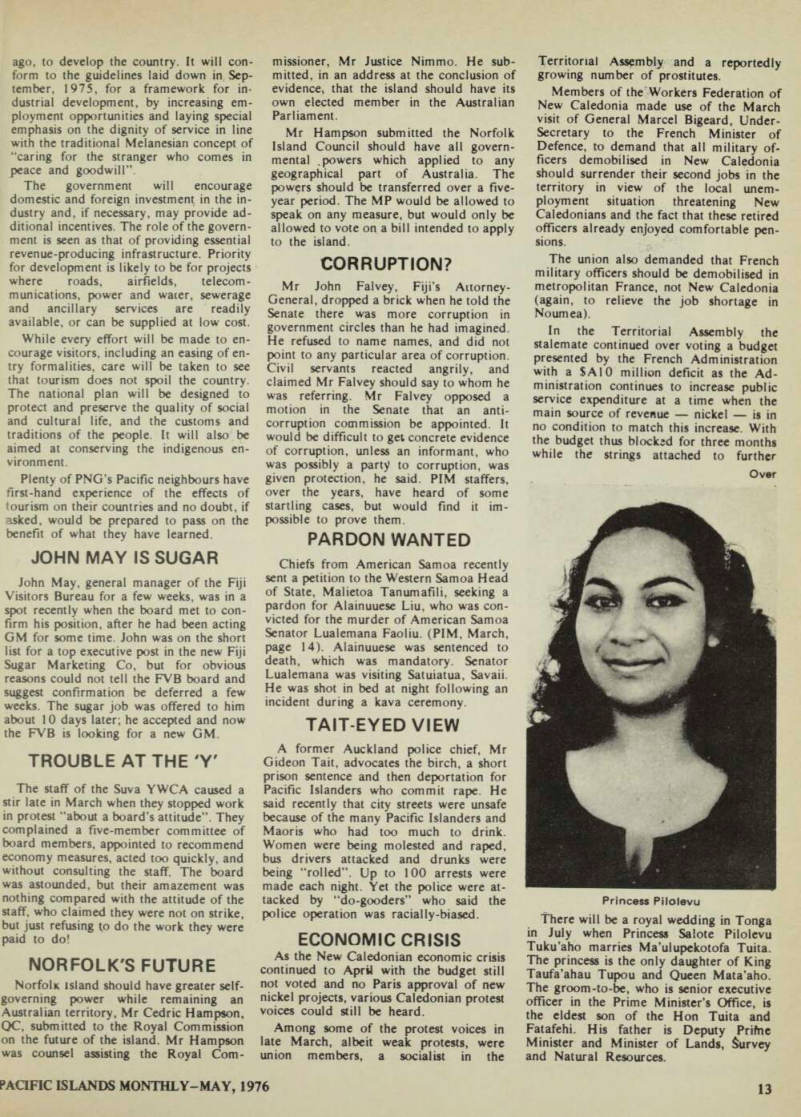
There will be a royal wedding in Tonga in July when Princess Salote Filolevu Tuku’aho marries Ma’ulupekotofa Tuita.
The princess is the only daughter of King Taufa’ahau Tupou and Queen Mata’aho.
The groom-to-be, who is senior executive officer in the Prime Minister’s Office, is the eldest son of the Hon Tuita and Fatafehi. His father is Deputy Prifnc Minister and Minister of Lands, Survey and Natural Resources.
Princess Pilolevu
“hand-outs” from Paris caused a belated alarm among certain Assembly members, one politician pointed out the plight of territorial pensioners and orphans. Some of these disadvantaged persons had not received their pensions, minimal as they are, since last October, under the Treasury crisis.
A further protest over the territory being marched to the brink of bankruptcy, ironic as it may be, comes from the French Army in Noumea where an increasing number of men are reported suffering from venereal disease. A local newspaper survey has claimed that a surprising num ber of women are turning to prostitution to feed their children during la crise economique.
New Zoo
The recently opened Lama Mountain zoo and botanical garden in Efate, has proved a popular attraction for visitors to the New Hebrides and to local people.
The garden and zoo, on top of Clem’s Hill, was opened just before Christmas.
The owner, Mr George Ah Tong, started to lay out the garden about two years ago because of his interest in gardening. The zoo, so far, comprises aviaries and fish pools. The aviaries house local pigeons and three species of birds from. New Zealand. In the fish ponds are fresh water
crayfish, tilapia and a Singapore species
known as koicarp. Mr Ah Tong plans to bring in more birds, animals and water lilies.
Nz Builds Exports
The New Zealand government in March appointed a marketing officer to its Con sulate-General in Noumea, as a move to promote Kiwi exports to the territory. The new trade representative is Mr Albert Caradant, a New Caledonian who has worked eight years in New Zealand for export sales of the General Foods com pany. Consul-General for New Zealand in Noumea, Mr Raymond Wright, recently pointed out that his country is now geared to compete for public tenders in New Caledonia, as in the recent case con cerning the construction of silos at Bourail.
In 1973 and 1974, New Zealand was in eighth position as a supplier of imports into New Caledonia, well behind France and Australia in the first two places. In the latest year ended June 1975, New Zealand’s exports to New Caledonia were worth about SNZ4 million.
Fiji's Sea Needs
Fiji is prepared to claim all the sea wealth within 200 miles of her coasts and what’s more she now has a couple of gun boats to support her claim.
Not that Fiji is going to engage in gun boat diplomacy, but she will declare an economic boundary 200 miles out if the United Nations does not get international
agreement on sea limits within a reasonable time.
The UN Law of the Sea conference is not making much progress in attempts to fix new boundaries. In Fiji’s case a unilateral declaration would not be well received in Japan, Taiwan or Korea, which fish large areas of the Pacific Ocean.
The Fiji Prime Minister, Ratu Sir Kamisese Mara, said Fiji’s claim would mean a fishing boundary extending 12 miles from a line drawn round the group, and an economic boundary lying 200 miles out. He remarked that the United States was the latest convert to the concept he espoused, and said it was “quite a significant convert”.
The US. which represents the US Trust Territory at the law of the sea conference, was prepared to put forward the territory’s case for the 200-mile limit, although it took a different view. Now the US, along with other countries has set the 200-mile economic limit, saying this gives owner ship of oil deposits, seabed minerals and other resources within the limit.
Fiji, the Philippines and Indonesia have asked the conference to accept their claim to jurisdiction over all the sea area inside their island groups. Fiji will have a problem or two to iron out if she goes ahead with the 200-mile claim. Some of the Lau islands are less than 200 miles from Tonga, and Tonga would have to be consulted before any new boundary was fixed.
The King's
New Export
The Tonga Commodities Board tur ned down a proposal by an American company offering to buy shredded coconut from the kingdom but King Taufa’ahau Tupou IV thought otherwise and a pilot project is underway.
The king returned to Tonga in March, fired as usual after an overseas trip, with an enthusiasm for new projects. He said on his return Tonga could earn more overseas from the sale of raw shredded coconut flesh than from copra.
A tonne of shredded coconut was worth 10 times more than copra. It was in great demand in the United States. On his way home he spent two days in Los Angeles, where he spoke to an American company about the possibility of exporting shredded coconut to the US.
The king said he had agreed with the company to launch a pilot project, marketing the shredded coconut, when he learned the Tonga Commodities Board had turned down a proposal from the company.
“I will do it myself since the board is not interested,” the king said.
He has ordered 24 shredding machines from India. The shredded coconut from the pilot project will be shipped to California, in plastic bags, under
refrigeration.