The Editor's Mailbag
pp. 25-27 · Read in the full issue
The Devil We
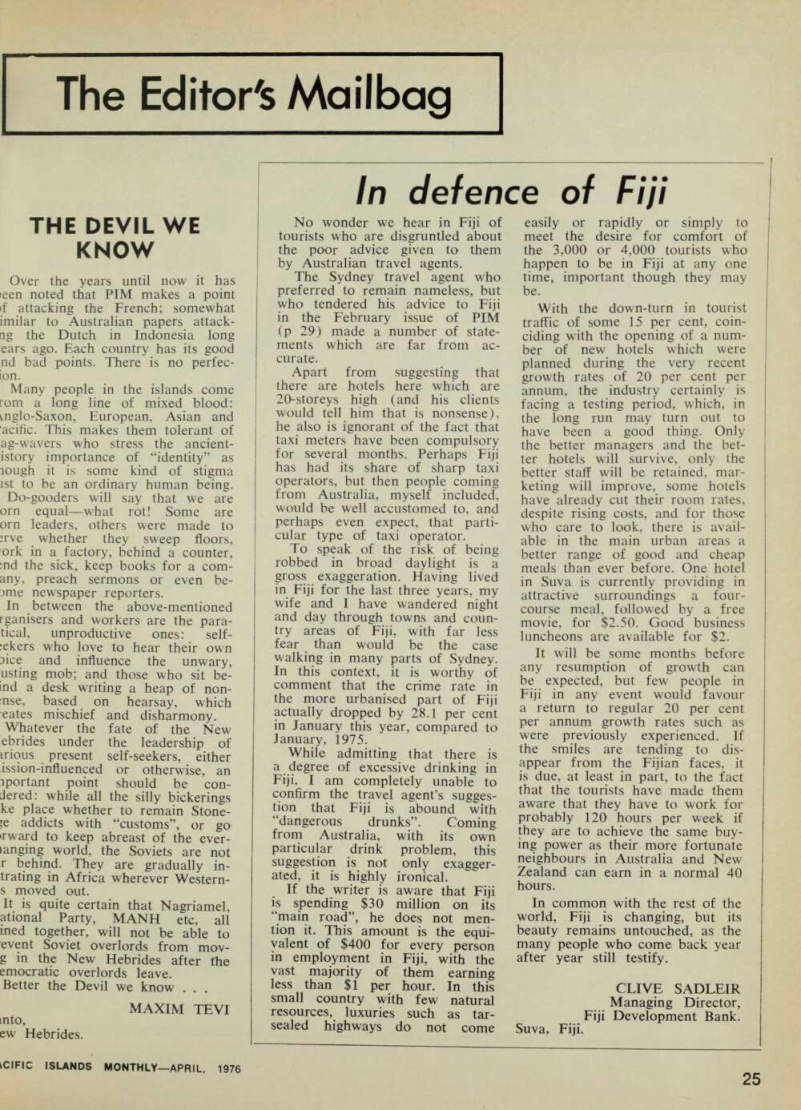
Know
Over the years until now it has >een noted that PIM makes a point if attacking the French; somewhat imilar to Australian papers attack ag the Dutch in Indonesia long ears ago. Each country has its good nd bad points. There is no perfec ion.
Many people in the islands come rom a long line of mixed blood: mglo-Saxon, European, Asian and acific. This makes them tolerant of ag-wavers who stress the ancient istory importance of “identity” as lough it is some kind of stigma ist to be an ordinary human being.
Do-gooders will say that we are orn equal—what rot! Some are orn leaders, others were made to irve whether they sweep floors, ork in a factory, behind a counter, ;nd the sick, keep books for a com any, preach sermons or even be )me newspaper reporters.
In between the above-mentioned rganisers and workers are the para tical, unproductive ones: self :ekers who love to hear their own Dice and influence the unwary, usting mob; and those who sit be ind a desk writing a heap of non nse, based on hearsay, which eates mischief and disharmony.
Whatever the fate of the New ebrides under the leadership of irious present self-seekers, either ission-influenced or otherwise, an iportant point should be con dered: while all the silly bickerings ke place whether to remain Stone ;e addicts with “customs”, or go ►rward to keep abreast of the ever langing world, the Soviets are not r behind. They are gradually in trating in Africa wherever Western s moved out.
It is quite certain that Nagriamel, ational Party, MANH etc, all ined together, will not be able to event Soviet overlords from mov g in the New Hebrides after the emocratic overlords leave.
Better the Devil we know . . ,
Maxim Tevi
into, ew Hebrides.
Letters
Waterhouse
Papers
I am making an extensive study }f social and economic change in he Siwai area of south Bougain /ille.
In approximately 1932-1934, a uissionary teacher Mr J. H. L. ‘Harry” Waterhouse, was living here before transferring to Rabaul vhere he died. During his stay he :ollected plant specimens, took holographs and gave at least one ecture in Australia on Siwai cus oms.
I have not been able to trace this ecture (or any other papers of his) hrough possible contacts in either labaul or Bougainville.
I would very much welcome any lues that could lead me to those iapers and the new Bougainvillean tiuseum might also benefit in other /ays.
John Connell (Dr)
)ept of Economics, Research School of Economics, INU, Canberra. ientified with the Australian Army
Army Request
Perhaps the word most readily Canungra.
In its many forms—Land HQ raining Centre (Jungle Warfare), Australian Training Centre (Jungle /arfare), Jungle Training Centre nd now, Land Warfare Centre—it as trained countless thousands of )ldiers and left its stamp unmistak aly upon the Army; its doctrines, ictical concepts and men.
Its past is a vital part of our mili iry heritage and, in an effort to itablish a Unit Museum, we are aw seeking information, photo aphs and mementoes associated ith this institution.
Any items of historical interest ould be gratefully received and, if eir return is desired, copying and ife despatch of same will be under ken.
Should any reader possess any such aterial could you please contact aptain M. B. Meadows of the Land r arfare Centre, Kokoda Barracks, anungra, Qld 4275. (Phone STD extension 236).
M. B. Meadows
(Captain for Commandant) anungra, Qld.