Tropicalities
pp. 21-23 · Read in the full issue
Fiji on the dope trail
Fiji may be a staging post for illicit drugs on the way to lucrative markets in Australia and New Zea land from the Far East. Drug run ners probably reason that customs officers in Australia and New Zea land will not apply such rigorous tests to cargoes from Fiji as they would to imports from known drug areas.
However, alert customs officers in Fiji, in a number of recent in cidents, intercepted drugs at Nadi Airport and at Lautoka. According to the Fiji Police Commissioner, Mr John Kelland, who believes Fiji is a dropping-off point for large quan tities of illicit drugs, some drugs seized were consigned to Australia.
Smugglers used surfboards and children’s water buggies to conceal drugs. These were consigned from Bangkok. A sniffing Labrador dog at Auckland, led searchers to a quantity of marihuana in water bug gies. Fiji customs officers, hearing of this, searched some water buggies at Lautoka and found marihuana.
They also found marihuana in simi lar buggies at Nadi Airport.
Five surfboards, consigned to Nadi Airport from Bangkok, lay at the airport for more than six months.
When nobody claimed them, it was decided that they should be auc tioned. But one suspicious customs man, knowing there was little or no use for surfboards in the placid vyaters round Fiji, decided it was time for a closer look.
He and other officers ripped the boards apart and were not altogether surprised to find 39 bags. It was be lieved there were hard drugs such as morphine or heroin in three of them, and marihuana in the re mainder. The drugs could have been worth more than $lOO,OOO on the international market.
Fiji does not have an internal drug problem worth speaking about— except, perhaps, the opium smokers —but as an archipelago she offers many advantages to drug runners to drop off and pick up drugs. Dealers m drugs, the objects of close official
attention, are always searching for new ways to keep a jump or two ahead of the authorities.
And the suspicion remains, in spite of the good work of the Fiji customs men in intercepting the re cent consignments, that a lot of drugs still get through.
Burial, Cook
Island’s style
Visit any of the Cook Islands and you will see graves in all manner of places ... in church yards, in a few designated cemeteries, in the front and back yards of homes and, in at least one instance, in the middle of the back verandah.
On some of the coral atolls, for example, Manihiki and Rakahanga, the graves are monolithic and raised above the surface of coral debris.
On Rakahanga there are grave houses which often shelter sewing machines, or lanterns, or some other article of possible future use to the dearly-departed.
There are legendary graves such as that of Rosa Cruickshank, the mystery European woman buried on distant Penrhyn Island. On Mangaia there used to be a ship’s plate that marked the last resting place of a sailor who did not survive the wreck of the Saragossa. He was denied a Christian burial as, at the time of his death, he was under the influence of alcohol.
In a tropical environment time is the essential factor in the disposal of the dead. And death is not a matter to be put into the hands of a professional undertaker. It is the duty of the senior male members of the family to arrange and direct the funeral; grave-digging is a shared activity and after the ceremony is oyer, by custom, the mourners press gifts of cash upon the chief mourner.
When some time later, the grave has settled, a further ceremony is held to build up a proper grave set ting and to erect the headstone. The chief mourner then provides a wake for all the mourners from the cash he received at the burial.
There are no restrictions upon where burials take place and quite usually the deceased is laid to rest near the family home. Often the pre sence of a grave will restrict the siting of a building. When the old Side School at Rarotonga was extended in the early 1960 s the buildings were carefully laid out so as not to dis turb an old grave.
There is an evening of sheer beauty associated with the Catholic Cemetery on Rarotonga. On All Souls’ Night the burial ground is decorated with a multitude of chains made of thousands of frangipani flowers and many candles light the graves. A priest conducts the memo rial service by moon and starlight to the accompaniment of the surge of the sea upon the reef and all about are people of all faiths come together amid the fragrance of the frangipani and illuminated by waver ing candlelight.
Taking the ‘thump’
out of a drum
The Papua New Guinea National Museum at Port Moresby has acquired a real treasure, an ancient drum bought from the Belian tribe of Ambunti in the East Sepik Pro vince.
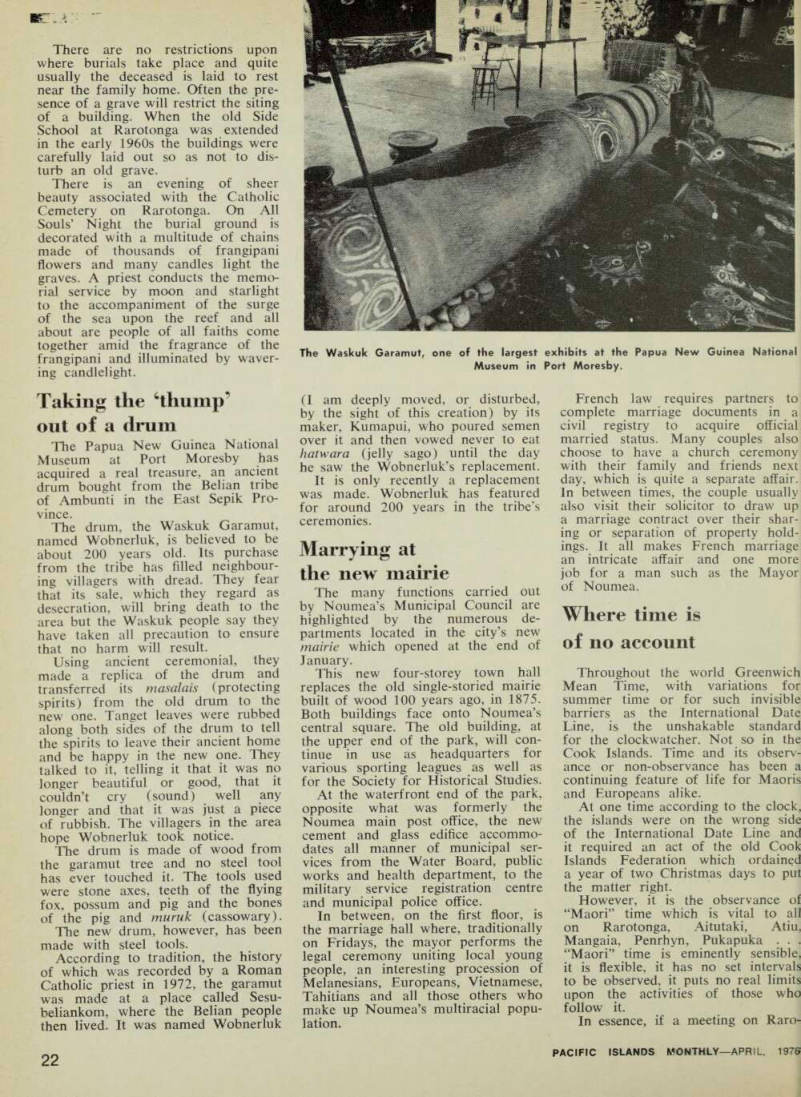
The drum, the Waskuk Garamut, named Wobnerluk, is believed to be about 200 years old. Its purchase from the tribe has filled neighbour ing villagers with dread. They fear that its sale, which they regard as desecration, will bring death to the area but the Waskuk people say they have taken all precaution to ensure that no harm will result.
Using ancient ceremonial, they made a replica of the drum and transferred its masalais (protecting spirits) from the old drum to the new one. Tanget leaves were rubbed along both sides of the drum to tell the spirits to leave their ancient home and be happy in the new one. They talked to it, telling it that it was no longer beautiful or good, that it couldn’t cry (sound) well any longer and that it was just a piece of rubbish. The villagers in the area hope Wobnerluk took notice.
The drum is made of wood from the garamut tree and no steel tool has ever touched it. The tools used were stone axes, teeth of the flying fox, possum and pig and the bones of the pig and muruk (cassowary).
The new drum, however, has been made with steel tools.
According to tradition, the history of which was recorded by a Roman Catholic priest in 1972, the garamut was made at a place called Sesu beliankom, where the Belian people then lived. It was named Wobnerluk
(I am deeply moved, or disturbed, by the sight of this creation) by its maker, Kumapui, who poured semen over it and then vowed never to eat hatwara (jelly sago) until the day he saw the Wobnerluk’s replacement.
It is only recently a replacement was made. Wobnerluk has featured for around 200 years in the tribe’s ceremonies.
Marryinsr at
J ®
the lieW mairie
The many functions carried out by Noumea’s Municipal Council are highlighted by the numerous departments located in the city’s new mairie which opened at the end of January.
This new four-storey town hall replaces the old single-storied mairie built of wood 100 years ago, in 1875.
Both buildings face onto Noumea’s central square. The old building, at the upper end of the park, will continue in use as headquarters for various sporting leagues as well as for the Society for Historical Studies.
At the waterfront end of the park, opposite what was formerly the Noumea main post office, the new cement and glass edifice accommodates all manner of municipal services from the Water Board, public works and health department, to the military service registration centre and municipal police office.
In between, on the first floor, is the marriage hall where, traditionally on Fridays, the mayor performs the legal ceremony uniting local young people, an interesting procession of Melanesians, Europeans, Vietnamese, Tahitians and all those others who make up Noumea’s multiracial population.
French law requires partners to complete marriage documents in a civil registry to acquire official married status. Many couples also choose to have a church ceremony with their family and friends next day, which is quite a separate affair, In between times, the couple usually also visit their solicitor to draw up a marriage contract over their shar ing or separation of property hold ings. H makes French marriage an intricate affair and one more job for a man such as the Mayor °I Noumea, wri .• • W liere time IS «
Oi 110 Accouiit
Throughout the world Greenwich Mean Time, with variations for summer time or for such invisible barriers as the International Date Line, is the unshakable standard for the clockwatcher. Not so in the Cook Islands. Time and its observ ance or non-observance has been a continuing feature of life for Maoris and Europeans alike, At one time according to the clock, the islands were on the wrong side of the International Date Line and it required an act of the old Cook Islands Federation which ordained a year of two Christmas days to put the matter right, However, it is the observance of “Maori” time which is vital to all on Rarotonga, Aitutaki, Atiu, Mangaia, Penrhyn, Pukapuka . . .
“Maori” time is eminently sensible, it is flexible, it has no set intervals to be observed, it puts no real limits upon the activities of those who follow it.
In essence, if a meeting on Ran>
The Waskuk Garamut, one of the largest exhibits at the Papua New Guinea National Museum in Port Moresby.
tonga, for instance, is announced as being for eight o’clock in the evening “European” time, then the parti cipants know that they will be under an obligation to attend on or about the specified time.
Eight o’clock in the evening “Maori” time means that the first to appear may be there at say four o’clock, that by eight o’clock there may be a handful in attendance, and that perhaps, and only perhaps, the meeting may finally commence at 10 o’clock, or 11 o’clock, or mid night, or ... But there will have been no hectic assembly and prob ably most of the issues will have been thoroughly but informally examined and the meeting can pro ceed along clearly-defined lines, without too many tedious diversions.
Ships also used to sail either by “European” or “Maori” time. On one occasion Dick Brown’s old motor vessel Apanui was to sail for the Northern Group. Friday’s Cook Islands News announced the de parture as for Monday; Monday told the story that she would sail on Tuesday; Tuesday said she would not leave before Thursday; Friday told all parties that Apanui definitely would not sail before Tuesday of the following week.
At noon on the Sunday Dick Brown rang his passengers ... he enquired: “Are you still coming on the Apanui? because if you are, the ship sails in an hour’s time” . . . and she did.
Hiri, a new
voice from PNG
The Papua New Guinea Govern ment has gone into the magazine publishing business with a very workmanlike publication, Hiri, a monthly intended for overseas con sumption.
According to Dr Reuben Taureka, Minister for Information and Broad wing, whose department, the Office 3f Information, produces Hiri “to establish a communications link vith people interested in our :ountry”.
As such, its name is appropriate. 3iri was an already well-established rading expedition when the first English missionaries arrived in Port Moresby in 1874. It was a major ink of a trading network along the 3 apuan coast to the eastern point )f the mainland, Dr Taureka says. >ne function of the expedition was he exchange of earthenware pottery or packages of sago and other foods.
But along with the bartering went he exchange of customs and ideas ind the renewal of friendships.
PNG hopes its new Hiri will per
form the same function in the modern world. And it isn’t partisan.
The first issue contains a report of Opposition Leader Tei Abal calling for a general election because the government “has failed to manage the country in the best interests of the people”.
Hiri’s main circulation areas are in Australia, New Zealand, Japan, Indonesia, Fiji and the United States.
Meanwhile, the PNG Government is cutting expenses. One victim of the axe is Papua New Guinea House in Sydney which will lose its trade and information departments. The Consul-General, Mr Vincent Iri, will remain with a small staff to handle entry permits and other travel docu ments.
The fate of the PNG Government news service which goes by telex every day to all the principal news papers and news services in Austra lia was unknown at the time of writing, but it is likely to be re tained.
Designed to feed the media with news from PNG “untreated” and without any special “angles”, it costs only a few dollars a day.
Necktie party
in Micronesia
Micronesian Congress jester, Sen ator John Mangfel, has come up with another historic bill—one to outlaw neckties, a “most insidious evil perpetrated upon the people of Micronesia”, and a “nefarious inven tion”, he said, when tabling his bill.
Congress solemnly accepted the bill for reading and referred it to the Committee on Education and Social Matters.
One of the evils, the bill said, was to compel its wearers to “suffer the constrictions of the throat and the chafing of the skin thereof, to say nothing of the effects of closing the system of ventilation permitted by the open collar”.
Anyone committing the unlawful act of wearing a tie, the bill con tinues, “shall be an idiot, and upon conviction thereof shall suffer his neck to be permanently surrounded by a large piece of Yapese stone money”.
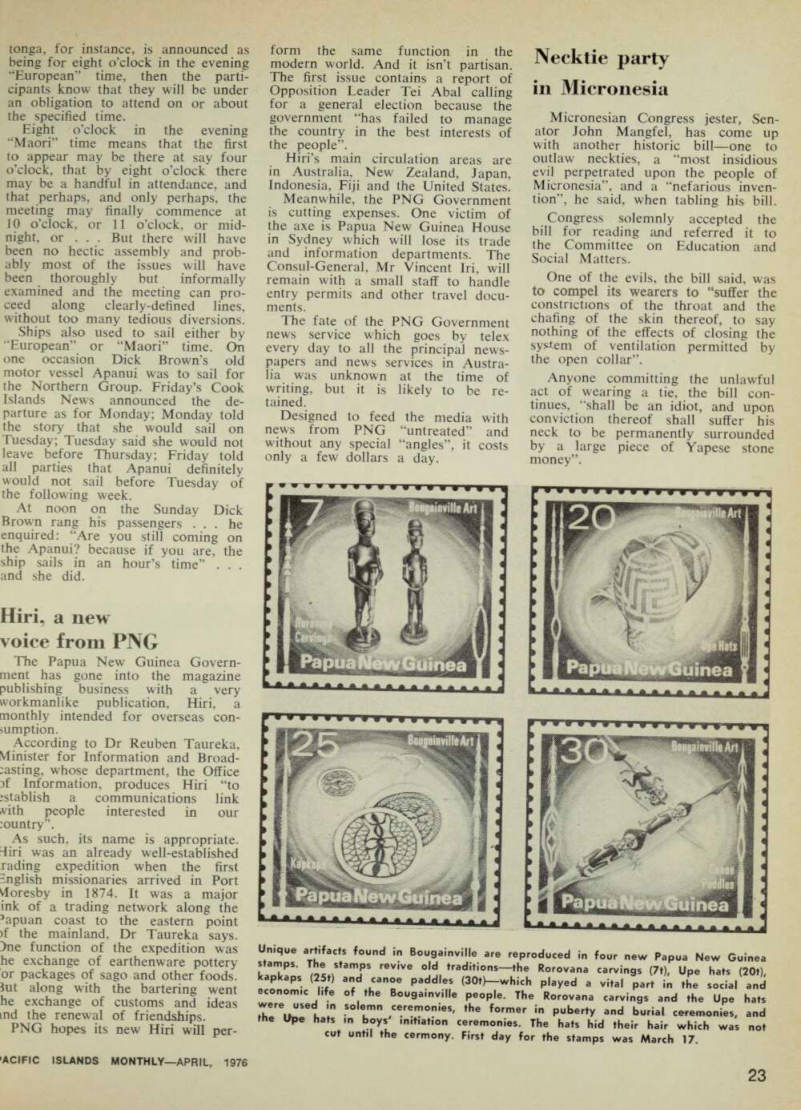
Unique artifacts found in Bougainville are reproduced in four new Papua New Guinea stamps. The stamps revive old traditions—the Rorovana carvings (7t), Upe hats (20t), kapkaps (25t) and canoe paddles (30t)-which played a vital part in the social and economic life of the Bougainville people. The Rorovana carvings and the Upe hats were used in solemn ceremonies, the former in puberty and burial ceremonies, and the Upe hats in boys' initiation ceremonies. The hats hid their hair which was not cut until the cermony. First day for the stamps was March 17.