Yesterday
p. 44 · Read in the full issue
Pacific Publications Pty Ltd, of Sydney, spread its wings 20 years ago when, on February 29, 1956, it bought the Fiji Times and Herald Ltd, which then owned the Fiji Times and Shanti Out (an Indian weekly). The deal was negotiated by PlM's founder, Mr R. W.
Robson, then publisher of PIM. In the last 20 years the Fiji Times itself has undergone a transformation, while several new publications have been launched. Pacific Publications with its subsidiary the Fiji Times and Herald Ltd is now part of the Herald and Weekly Times (Melbourne) group.
The sensational appearance of the Gilbert Islands auxiliary ketch, Arakarimoa, off the southern Guadalcanal coast on February 28, 1956, 1,000 miles from where it disappeared 62 days days previously, emphasised again the casual manner in which small ships operations in the Pacific were regarded.
The Arakarimoa left Tarawa on December 28, with another small craft, for Maiana 19 miles away. It did not arrive at Tarawa. Nothing was made public about the disappearance till February, more than a month after it went missing. Of 20 who were in the ship when it left Tarawa, 14 survived. One survivor said the Arakarimoa's engine broke down three hours out from Tarawa. It could not be repaired. There was no radio, and thus no means of signalling that the ship was in distress. The Arakarimoa finished up on Poole Reef. Some people lost their lives trying to get ashore in heavy seas.
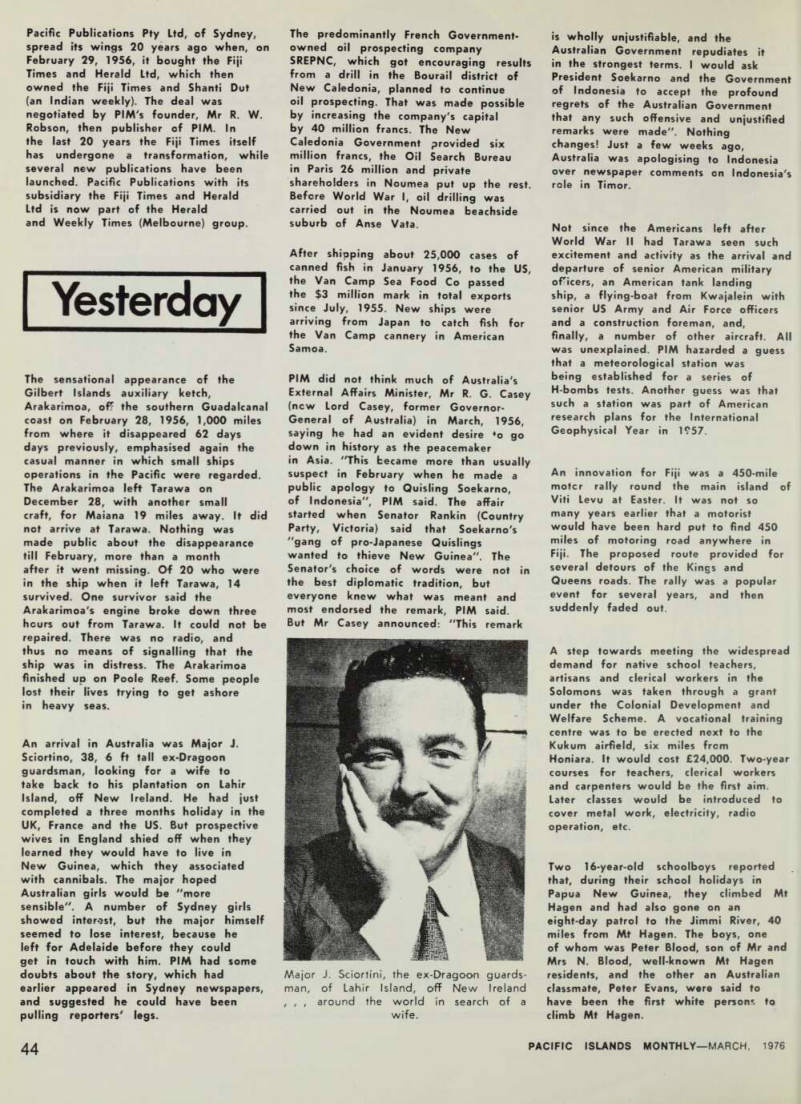
An arrival in Australia was Major J.
Sciortino, 38, 6 ft tall ex-Dragoon guardsman, looking for a wife to take back to his plantation on Lahir Island, off New Ireland. He had just completed a three months holiday in the UK, France and the US. But prospective wives in England shied off when they learned they would have to live in New Guinea, which they associated with cannibals. The major hoped Australian girls would be "more sensible". A number of Sydney girls showed interest, but the major himself seemed to lose interest, because he left for Adelaide before they could get in touch with him. PIM had some doubts about the story, which had earlier appeared in Sydney newspapers, and suggested he could have been pulling reporters' legs.
The predominantly French Government owned oil prospecting company SREPNC, which got encouraging results from a drill in the Bourail district of New Caledonia, planned to continue oil prospecting. That was made possible by increasing the company's capital by 40 million francs. The New Caledonia Government provided six million francs, the Oil Search Bureau in Paris 26 million and private shareholders in Noumea put up the rest.
Before World War I, oil drilling was carried out in the Noumea beachside suburb of Anse Vata.
After shipping about 25,000 cases of canned fish in January 1956, to the US, the Van Camp Sea Food Co passed the $3 million mark in total exports since July, 1955. New ships were arriving from Japan to catch fish for the Van Camp cannery in American Samoa.
PIM did not think much of Australia's External Affairs Minister, Mr R. G. Casey (new Lord Casey, former Governor- General of Australia) in March, 1956, saying he had an evident desire *o go down in history as the peacemaker in Asia. 'This became more than usually suspect in February when he made a public apology to Quisling Soekarno, of Indonesia", PIM said. The affair started when Senator Rankin (Country Party, Victoria) said that Soekarno's "gang of pro-Japanese Quislings wanted to thieve New Guinea". The Senator's choice of words were not in the best diplomatic tradition, but everyone knew what was meant and most endorsed the remark, PIM said.
But Mr Casey announced: "This remark
is wholly unjustifiable, and the Australian Government repudiates it in the strongest terms. I would ask President Soekarno and the Government of Indonesia to accept the profound regrets of the Australian Government that any such offensive and unjustified remarks were made". Nothing changes! Just a few weeks ago, Australia was apologising to Indonesia over newspaper comments on Indonesia's role in Timor.
Not since the Americans left after World War II had Tarawa seen such excitement and activity as the arrival and departure of senior American military officers, an American tank landing ship, a flying-boat from Kwajalein with senior US Army and Air Force officers and a construction foreman, and, finally, a number of other aircraft. All was unexplained. PIM hazarded a guess that a meteorological station was being established for a series of H-bombs tests. Another guess was that such a station was part of American research plans for the International Geophysical Year in 1957.
An innovation for Fiji was a 450-mile motcr rally round the main island of Viti Levu at Easter. It was not so many years earlier that a motorist would have been hard put to find 450 miles of motoring road anywhere in Fiji. The proposed route provided for several detours of the Kings and Queens roads. The rally was a popular event for several years, and then suddenly faded out.
A step towards meeting the widespread demand for native school teachers, artisans and clerical workers in the Solomons was taken through a grant under the Colonial Development and Welfare Scheme. A vocational training centre was to be erected next to the Kukum airfield, six miles from Honiara. It would cost £24,000. Two-year courses for teachers, clerical workers and carpenters would be the first aim.
Later classes would be introduced to cover metal work, electricity, radio operation, etc.
Two 16-year-old schoolboys reported that, during their school holidays in Papua New Guinea, they climbed Mt Hagen and had also gone on an eight-day patrol to the Jimmi River, 40 miles from Mt Hagen. The boys, one of whom was Peter Blood, son of Mr and Mrs N. Blood, well-known Mt Hagen residents, and the other an Australian classmate, Peter Evans, were said to have been the first white persons to climb Mt Hagen.
Major J. Sciortini, the ex-Dragoon guards man, of Lahir Island, off New Ireland ... around the world in search of a wife.