Outpost of Empire—a vanishing
pp. 46-48 · Read in the full issue
hree celebrates a birthday
By Michael Hook
Tarawa atoll is the capital of the Gilbert and Ellice Islands Colony (a name now changed as Ellice parted company with the Gilberts last October and became Tuvalu) and on the islet of Bairiki is Colony Headquarters, the last sign of a vanishing breed.
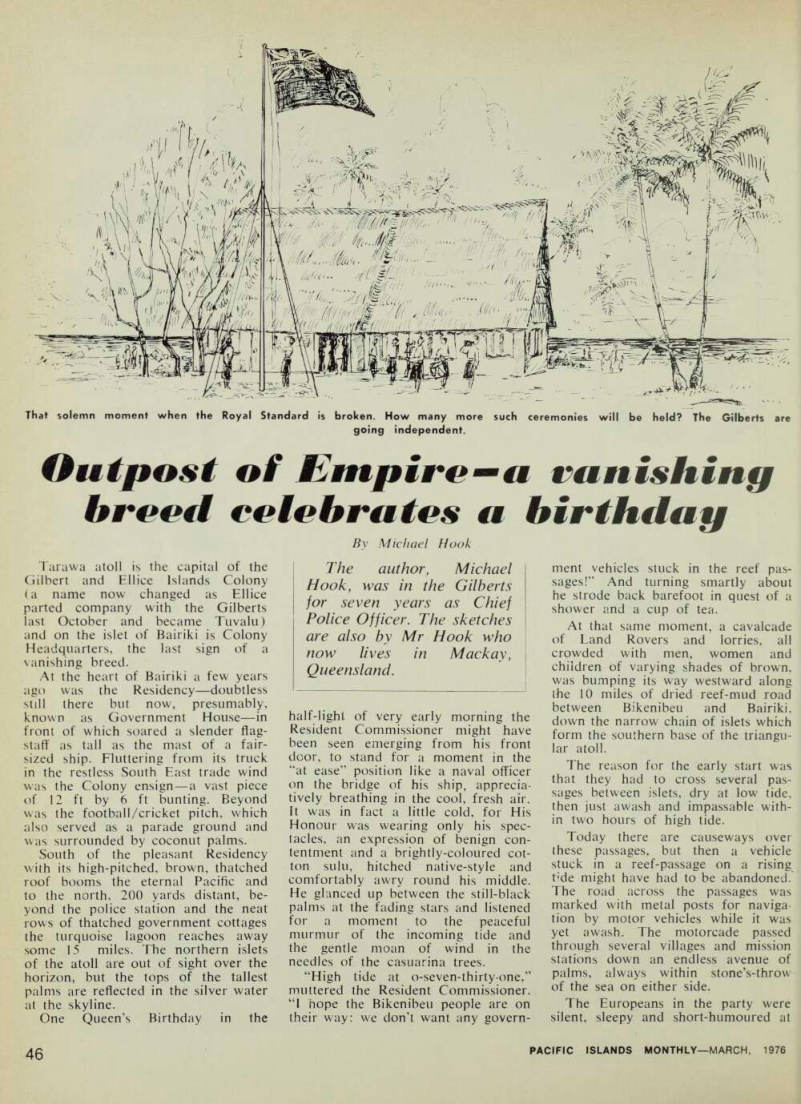
At the heart of Bairiki a few years ago was the Residency—doubtless still there but now, presumably, known as Government House—in front of which soared a slender flag staff as tall as the mast of a fair sized ship. Fluttering from its truck in the restless South East trade wind was the Colony ensign—a vast piece of 12 ft by 6 ft bunting. Beyond was the football/cricket pitch, which also served as a parade ground and was surrounded by coconut palms.
South of the pleasant Residency with its high-pitched, brown, thatched roof booms the eternal Pacific and to the north, 200 yards distant, be yond the police station and the neat rows of thatched government cottages the turquoise lagoon reaches away some 15 miles. The northern islets of the atoll are out of sight over the horizon, but the tops of the tallest palms are reflected in the silver water at the skyline.
One Queen’s Birthday in the
The author, Michael Hook, was in the Gilberts for seven years as Chief Police Officer. The sketches are also by Mr Hook who now lives in Mackay, Queensland.
half-light of very early morning the
Resident Commissioner might have been seen emerging from his front door, to stand for a moment in the “at ease” position like a naval officer on the bridge of his ship, apprecia tively breathing in the cool, fresh air.
It was in fact a little cold, for His Honour was wearing only his spec tacles, an expression of benign con tentment and a brightly-coloured cot ton sulu, hitched native-style and comfortably awry round his middle.
He glanced up between the still-black palms at the fading stars and listened for a moment to the peaceful murmur of the incoming tide and the gentle moan of wind in the needles of the casuarina trees.
“High tide at o-seven-thirty-one,” muttered the Resident Commissioner.
“1 hope the Bikenibeu people are on their way: we don't want any govern
ment vehicles stuck in the reef pas sages!” And turning smartly about he strode back barefoot in quest of a shower and a cup of tea.
At that same moment, a cavalcade of Land Rovers and lorries, all crowded with men, women and children of varying shades of brown, was bumping its way westward along the 10 miles of dried reef-mud road between Bikenibeu and Bairiki. down the narrow chain of islets which form the southern base of the triangu lar atoll.
The reason for the early start was that they had to cross several pas sages between islets, dry at low tide, then just awash and impassable with in two hours of high tide.
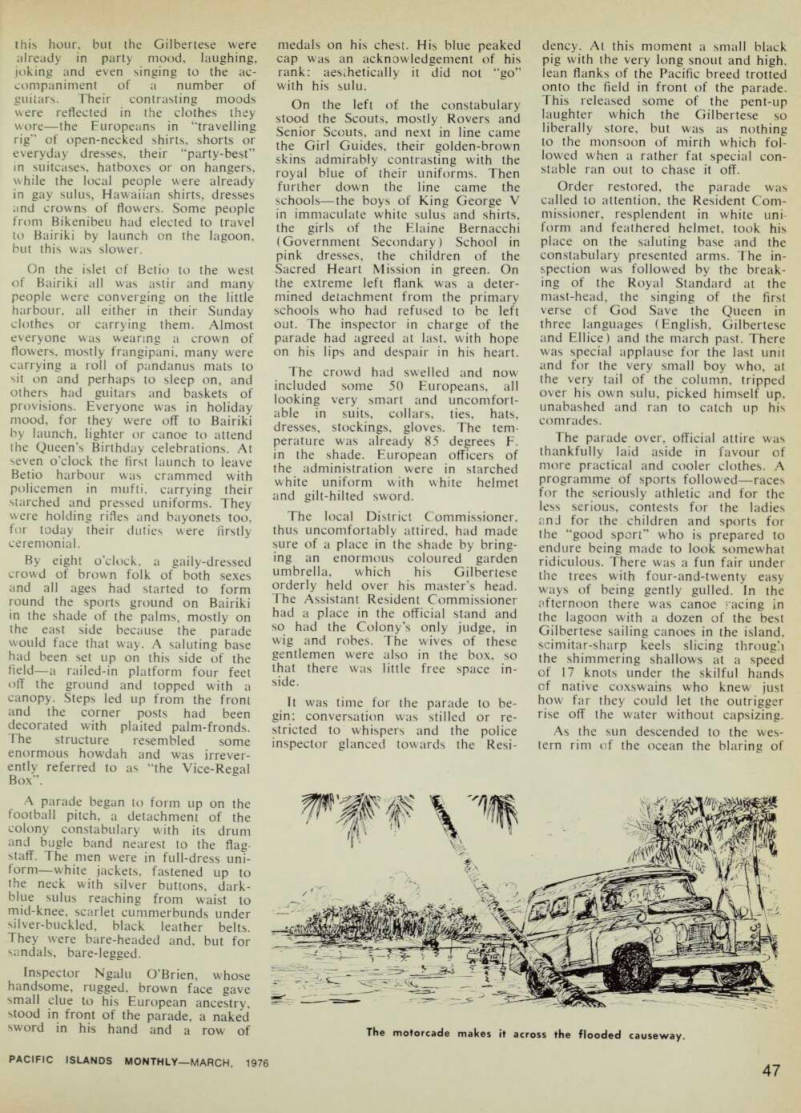
Today there are causeways over these passages, but then a vehicle stuck in a reef-passage on a rising t : de might have had to be abandoned.
The road across the passages was marked with metal posts for naviga tion by motor vehicles while it was yet awash. The motorcade passed through several villages and mission stations down an endless avenue of palms, always within stone’s-throw of the sea on either side.
The Europeans in the party were silent, sleepy and short-humoured at
That solemn moment when the Royal Standard is broken. How many more such ceremonies will be held? The Gilberts are going independent.
this hour, but the Gilbertese were already in party mood, laughing, joking and even singing to the ac companiment of a number of guitars. Their contrasting moods were reflected in the clothes they wore—the Europeans in “travelling rig” of open-necked shirts, shorts or everyday dresses, their “party-best” in suitcases, hatboxes or on hangers, while the local people were already in gay sulus, Hawaiian shirts, dresses and crowns of flowers. Some people from Bikenibeu had elected to travel to Bairiki by launch on the lagoon, but this was slower.
On the islet of Betio to the west of Bairiki all was astir and many people were converging on the little harbour, all either in their Sunday clothes or carrying them. Almost everyone was wearing a crown of flowers, mostly frangipani, many were carrying a roll of pandanus mats to sit on and perhaps to sleep on, and others had guitars and baskets of provisions. Everyone was in holiday mood, for they were off to Bairiki by launch, lighter or canoe to attend the Queen’s Birthday celebrations. At seven o’clock the first launch to leave Betio harbour was crammed with policemen in mufti, carrying their starched and pressed uniforms. They were holding rifles and bayonets too, for today their duties were firstly ceremonial.
By eight o'clock, a gaily-dressed crowd of brown folk of both sexes and all ages had started to form round the sports ground on Bairiki in the shade of the palms, mostly on the east side because the parade would face that way. A saluting base had been set up on this side of the field—a railed-in platform four feet off the ground and topped with a canopy. Steps led up from the front and the corner posts had been decorated with plaited palm-fronds.
The structure resembled some enormous howdah and was irrever ently referred to as “the Vice-Regal Box”.
A parade began to form up on the football pitch, a detachment of the colony constabulary with its drum and bugle band nearest to the flag staff. The men were in full-dress uni form—white jackets, fastened up to the neck with silver buttons, dark blue sulus reaching from waist to mid-knee, scarlet cummerbunds under silver-buckled, black leather belts.
They were bare-headed and, but for sandals, bare-legged.
Inspector Ngalu O’Brien, whose handsome, rugged, brown face gave small clue to his European ancestry, stood in front of the parade, a naked sword in his hand and a row of
medals on his chest. His blue peaked cap was an acknowledgement of his rank: aesthetically it did not “go” with his sulu.
On the left of the constabulary stood the Scouts, mostly Rovers and Senior Scouts, and next in line came the Girl Guides, their golden-brown skins admirably contrasting with the royal blue of their uniforms. Then further down the line came the schools—the boys of King George V in immaculate white sulus and shirts, the girls of the Elaine Bernacchi (Government Secondary) School in pink dresses, the children of the Sacred Heart Mission in green. On the extreme left flank was a deter mined detachment from the primary schools who had refused to be left out. The inspector in charge of the parade had agreed at last, with hope on his lips and despair in his heart.
The crowd had swelled and now included some 50 Europeans, all looking very smart and uncomfort able in suits, collars, ties, hats, dresses, stockings, gloves. The tem perature was already 85 degrees F. in the shade. European officers of the administration were in starched white uniform with white helmet and gilt-hilted sword.
The local District Commissioner, thus uncomfortably attired, had made sure of a place in the shade by bring ing an enormous coloured garden umbrella, which his Gilbertese orderly held over his master’s head.
The Assistant Resident Commissioner had a place in the official stand and so had the Colony’s only judge, in wig and robes. The wives of these gentlemen were also in the box, so that there was little free space in side.
It was time for the parade to be gin; conversation was stilled or re stricted to whispers and the police inspector glanced towards the Resi
dency. At this moment a small black pig with the very long snout and high, lean flanks of the Pacific breed trotted onto the field in front of the parade.
This released some of the pent-up laughter which the Gilbertese so liberally store, but was as nothing to the monsoon of mirth which fol lowed when a rather fat special con stable ran out to chase it off.
Order restored, the parade was called to attention, the Resident Com missioner, resplendent in white uni form and feathered helmet, took his place on the saluting base and the constabulary presented arms. The in spection was followed by the break ing of the Royal Standard at the mast-head, the singing of the first verse of God Save the Queen in three languages (English, Gilbertese and Ellice) and the march past. There was special applause for the last unit and for the very small boy who, at the very tail of the column, tripped over his own sulu, picked himself up, unabashed and ran to catch up his comrades.
The parade over, official attire was thankfully laid aside in favour of more practical and cooler clothes. A programme of sports followed—races for the seriously athletic and for the less serious, contests for the ladies and for the children and sports for the “good sport” who is prepared to endure being made to look somewhat ridiculous. There was a fun fair under the trees with four-and-twenty easy ways of being gently gulled. In the afternoon there was canoe racing in the lagoon with a dozen of the best Gilbertese sailing canoes in the island,
scimitar-sharp keels slicing through
the shimmering shallows at a speed of 17 knots under the skilful hands of native coxswains who knew just how far they could let the outrigger rise off the water without capsizing.
As the sun descended to the wes tern rim of the ocean the blaring of
The motorcade makes it across the flooded causeway.
bugles and the drubbing of drums were heard from the direction of Bairiki Police Station as a contingent of the constabulary marched smartly across the football field towards the Residency. As they halted at the foot of the flagstaff, two men moved for ward and uncleated the halyard. The onlookers fell silent and, to the stir ring notes of “Sunset” from the buglers and a roll from the drum mers, the sun and the flag sank together.
Presently, from the Residency came the pleasant buzz of conver sation and soda syphon, the tinkle of ice and laughter and the sane silence of contented thoughts and good cigars. The pleasant, spacious living-room and the patio outside, close above the ocean reef and under coloured lights strung between the tall palms, were astir with guests both brown and white.
By mid-evening the large open sided maneaba on the west boundary of the football ground was so full of people that scarcely enough room had been left for the performers at the bat ere (the island night’s enter tainment which always rounds off any day of festivity). The Resident Commissioner and his party sat in chairs on one side: they were in evening dress and wore crowns of flowers which had been cere moniously placed upon their heads by a swirling chorus of Ellice Island girls.
Here on Tarawa, where civil ser vants were drawn from every part of the Colony, space on the programme was shared between the groups from different islands. This made for great variety—from the formal ruoia (a rhythmic graceful movement of the arms and body while seated cross legged) of the Gilbertese to the tempestuous, rollicking, gayer and (perhaps to Westerners) more typi cally “South Sea” songs and dances of the Polynesians from the Ellice Islands. In all these the well-thumped drum, quickening to a crescendo, played a big part. Some of the songs were sad, some gay, most old, some new, and all required a “chorus” of young men and women to sing and sway and clap and swirl from an otherwise stationary line behind the principal performers.
Until late, the melodies and clap ping and thumping continued, long after the visitors from Bikenibeu had left on their long trek homeward and those from Betio had set their course westward over the dark-bright waters of the lagoon and down that magic path of silver moonlight, lulled by the lilt of the waves and the quiet crooning of a guitar.