Magazine Section
pp. 37-43 · Read in the full issue

The Kokoda Trail, A Great Track
To Take-If You Don't Weaken!
Kokoda is a pleasant community in a delightful mountain valley, worth a visit for its scenery alone even if it were not the scene of some of the most gallant actions in World War 11.
Some mornings when you wake up the forest is wet and dripping with rain and the ground is muddy underfoot.
Sometimes the sun is fiercely hot as soon as it rises and, by eight o’clock, dust and heat are pressing around you.
On the wet days leeches and in sects hiding in the long grass wriggle through the eyelets of your boots and bite into your flesh.
On the hot days the sun burns your nose bright red.
Kokoda has no public accommo dation or facilities for tourists. How ever, it has a weekly air service from Port Moresby and air charters can be arranged.
One way to see the Kokoda Trail is to fly to Kokoda and walk to Port Moresby over the unbelievably im possible terrain, slippery mud, water logged flats, creek beds and swamp moss forest where the 39th Battalion earned fame. Should you respond to this challenge, remember that many people have tried and failed.
Kokoda means, for most people in Papua New Guinea, an heroic jungle campaign of World War 11, when Australian and other Allied troops succeeded in turning back a Japanese advance only 40 miles from Port Moresby.
But the Japanese attack had been going on for more than two months then. It started 33 years ago on July 21, 1942, with a landing at Basabua, a beach near Gona on the north coast of the Northern Province.
The first group of invaders con sisted of about 3,000 Japanese troops with more than 1,000 native carriers and some horses. Lightly equipped for quick progress, they set off im mediately for Kokoda where the mountain pack-track started. Some rode bicycles. Soon after, the main Japanese force followed.
The Kokoda Trail , a pleasant track meander ing over Papua I\ew Guinea’s Owen Stanley Range or a blood-soaked battlefield writ large in Australian military his tory, Maclaren Hiari , a Papua ISew Guinea jour nalist, in this keenly researched article , takes PlM’s readers , tourists or pilgrims , along the trail , supplies history and hints on how to make the journey with the least possible discomfort.
The attacking enemy force drove back a platoon of the 39th Battalion in a series of skirmishes, and occu pied Kokoda on July 29, after a fierce battle.
The 39th Battalion consisted of only 480 officers and men who, nevertheless, succeeded in recaptur ing Kokoda on August 8.
Within days, they were again driven out, having, for the second time, waited in vain for reinforce ments to be flown in.
Meanwhile, an AIF infantry bri gade had arrived at Port Moresby and was sent to help the forward troops. But it was unable to advance as a whole and, attacking in small units, was overrun and thrown back.
The Japanese pushed on towards Port Moresby.
Then Lt-General Rowell took over command of the New Guinea Force and improved organisation of sup plies, reserves and transport.
Throughout August and Septem ber, the Japanese continued to pour into the bases which they had now established on the north coast. By September 12, they had 5,000 men in the forward zone. Yet, only four days later, their advance on Port Moresby was halted and turned into a retreat.
They had just forced the Austra lians back from loribaiwa Ridge to Imita Ridge, within a long day’s march from Port Moresby.
Then reinforcements arrived from a second AIF brigade. The enemy was ambushed and turned back. On November 2, the Australians, led by Major-General G. Vasey, recaptured Kokoda.
By January 23, 1943, Japanese resistance in Papua was at an end.
That’s what the history books say about the Kokoda Trail.
But, in the memory of those who lived through those dark days, the Kokoda campaign was more than a near-suicidal retreat under a vacil lating command, which somehow turned into victory.
The men who fought in Papua New Guinea look back on a time of greatness. They remember the unbelievable speed of the Japanese advance into Papua New Guinea and the way the enemy made light of the allegedly “impassable barrier” of the Owen Stanley Range.
They remember the physical misery of struggling and fighting along a steep, slippery, malarial jungle track which seemed never ending to soldiers fighting against impossible odds.
They remember the wounded who were agonisingly carried on stretchers along this track.
But most of all they remember the cheerfulness of their comrades— and their incredible courage in battle.
Today, the Returned Servicemen’s League has built a war museum at the southern end of the Kokoda Trail which was turned into a national walking track in 1972, to give pleasure to tourists and the people of this country.
But the name Kokoda will always spell courage and heroism to those who remember.
Today, trail walkers are required to carry a load-weight of no more than 17 kilograms. This includes a lightweight sleeping bag or blanket, waterproof ground sheet, small bu-
tane stove, dehydrated foods, water bottles, first-aid kit, camera and boots fitted with metal grips.
Maps can be obtained from the Department of Lands and Surveys or Plan Drawing Service Limited in Port Moresby. The Director of Civil Defence and Emergency Services should be advised of your plans as a precautionary measure.
Walkers need practice or training before commencing the walk over the challenging Trail.
The Kokoda Trail varies considerably and, apart from the wide variations in gradient, there are considerable variations in surface (rocky, slippery mud, water-logged flats, creek beds, swamp moss forest).
The Trail, in places, is difficult to define with over-grown kunai grass but some sections have been cleared.
“The average bush-walker should find little difficulty with the conditions, though boots equipped to handle steep muddy slopes are strongly recommended. These boots are also good for crossing creeks and rivers with slippery stones and logs”, said the former Executive Director
of the National Parks Board, Mr Neville Gare, after walking the Kokoda Trail in 1972.
Most river and creek crossings are satisfactory, particularly in the Kagi, Nauro section where log bridges are maintained. The distance of Temple ton Crossing and lora Creek Crqss ing resulted in bridge construction and maintenance at minimal level.
There is a tendency for the lora Creek to rise during the wet season, No moves have been made yet to erect suspension bridges, Overnight accommodation is avail able on the route at Isurava, Olola, Kagi, .Efogi Number 1, Menari, Nauro and Überi villages. The stan dard of the rest-houses varies but the one at Menari was erected for visiting magistrates. There are also shelter huts scattered along the route, built by the local people. You will find some of these huts on the maps of the Trail.
A small number of hazards, signs and indicators of the Kokoda Trail marking and signposting will be shown in some cases on good clear maps.
Airstrips are in operation at Kagi, Efogi, Menari and Nauro as well as Kokoda itself. This means that the middle of the densely-populated forest of the Kokoda Trail has a weekly air service operated by Aerial Tours connecting with Port Moresby so that walkers can finish the walk after two days trek from the other end.
Radio communication is available en-rolite with a transceiver at Efogi Number 1 village operated by the Department of Agriculture, Stock and Fisheries and connected to the Department of Posts and Telegraphs in Port Moresby.
Using this communication system, it is possible to charter an aircraft to Efogi or other nearby small jungle airstrips to pick up passengers. The cost will depend on the size of the aircraft.
The central section between Efogi Number 1 and Menari villages are particularly interesting points on the route. Efogi 1 is probably the best place and visits to the nearby ham lets or a rest in the nearby village or by the rivers are worth experienc ing.
There is little evidence of the war time compaign, but good research and interpretation could make it interesting for the walkers in places like Templeton’s Crossing, loribaiwa, Imita Ridge, Isurava, Alola, Brigade Hill, Mayola Ridge and of course, Kokoda and Owers Corner.
While rain must always be ex pected, there are some glorious, fine mornings in which to enjoy the mountain views, the mist rising from valleys and the varied vegetation, birds and insect life of the moss forest, rainforest and even the swamps along the route.
Bird life is profuse and many walkers will want to take time to study these and the interesting vegetation.
Food is available at the villages.
The walk can probably be com pleted in from five to 10 days de pending on the hiker’s intention.
The route covers about 60 miles or more. Elevation ranges from 1,000 feet to 6,700 feet through a range of vegetation from river swamp to moss forest.
The Kokoda Trail has always been a challenge to the people of Papua New Guinea, particularly those from the Northern Province.
From early age, children ia Aus tralia learn stories of the Kokoda Trail battles. Papua New Guinea children also learn about these stories as their fathers still talk about them.
Continued on p 43
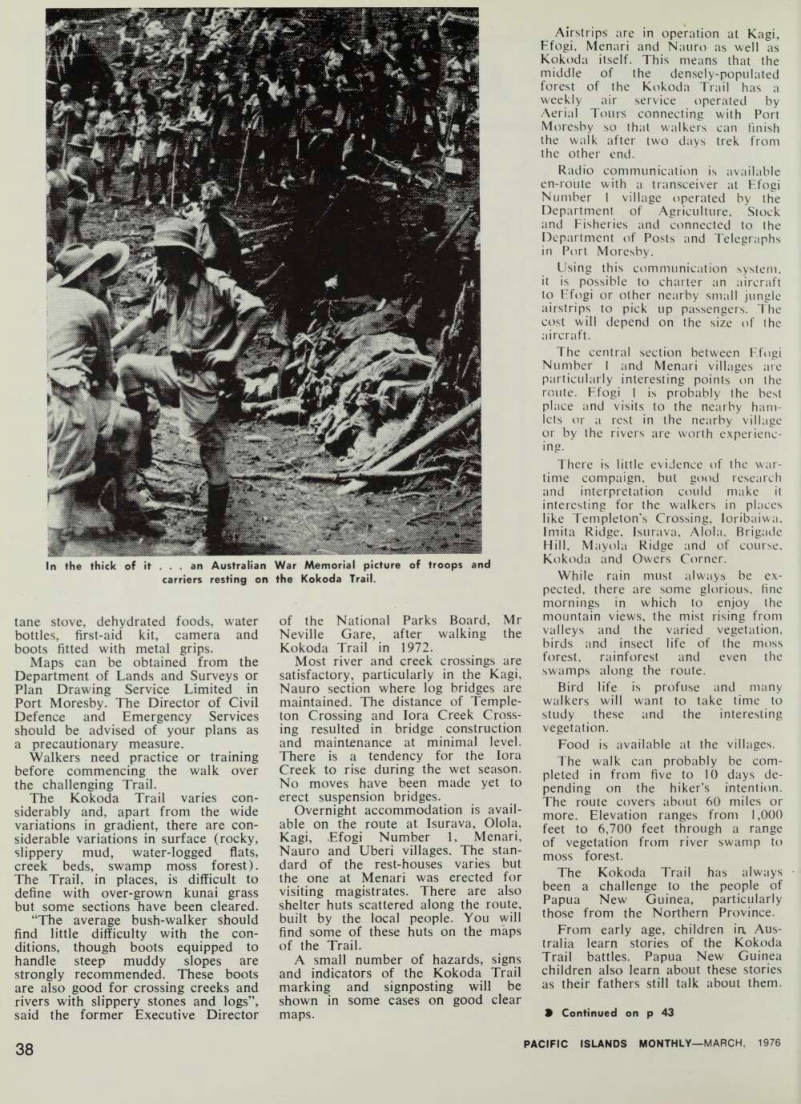
In the thick of it ... an Australian War Memorial picture of troops and carriers resting on the Kokoda Trail.
The Ilimo Local Government Council of Kokoda Sub-Province, is vitally interested in this history.
The council president, Mr Dick son Hango, believes the history of the trail should be preserved as a memorial to the men from Papua New Guinea who lost their lives on it.
One month before the Indepen dence celebrations last September, the Ilimo councillors were celebrat ing the completion of another suc cessful trail walk, the third annual Kokoda Trail walk which attracted 50 contestants from the Northern Province.
Prizes of KlOO each for the fastest man and woman and K5O for the second fastest were the attraction.
Last year’s winner, Mr Lancelott Angita, of Kanga Village near Ko koda, broke his previous record by walking from Owers Corner to Kokoda in 31 hours five minutes.
His old record was 52 hours five minutes.
The winner of the women’s prize was Vera Ilua of Kokoda Plantation, in 53 hours 15 minutes.
Anyone who has slogged through these mountains will know how good these times are.
Mr Hango believes the preservation t)f the Kokoda Trail should go hand
in hand with the continued economic development of the Kokoda Sub- Province area.
Interest in walking the Trail began after the bishops’ walk in May, 1972.
Bishop Ravu Henao, of the United Church, who walked the Trail with the head of the Anglican Church in Papua New Guinea, Bishop David Hand, and the Anglican Archbishop of Sydney, Archbishop Marcus Loane, described the walk as “a big event tying together the people of all churches”.
Archbishop Loane said he regarded the walk as a move to focus the
eyes of Australians and Papua New Guineans on the emerging native leadership in Papua New Guinea.
Meanwhile, an appeal to raise funds for the protection and pre servation of the Kokoda Trail is gaining strong support from council individuals, social organisations and private firms throughout Papua New Guinea.
The appeal was launched by the Ilimo Council after last year’s walk.
So far, the Ilimo Council has received K5OO towards the appeal.
The council will also be sending out letters to the Returned Service men’s League and overseas organis ations for donations.
The council, which has already donated K2OO, will make arrange ments with the Hiri Council in Port Moresby to build a shelter at Owers Corner.
Donations will be used to protect and preserve the Kokoda Trail in cluding the building of shelter huts and signposts along the route for hikers.
The Kokoda Trail is now becom ing world-renowned as a route over which both Papua New Guineans and overseas visitors could test their fitness, their determination and their ability to walk together as a team in difficult conditions.
One of the bronze plaques on the Kokoda monument, which honours the native carriers who made a large con tribution to the success of the campaign.