An 'Old Chef's' Recipe For A New
pp. 27-75 · Read in the full issue


South Pacific Commission
By T. R. SMITH, a former Secretary-General of the SPC
The South Pacific Commission has existed for 29 years because, on balance, the Islanders, for whose benefit it was first set up, have believed that it has been, and can still be, useful to them.
The number of times during the 29 years that doubts have arisen as to whether it is being useful enough :an be measured by the number of proposals for review conferences during that time. Now, once more, a review conference is planned, but inless this one is something vastly different from the wishy-washy talk :ests that have been called confer ences in the past, the plans should 3e dropped now.
We don’t need carefully-drafted esolutions which smooth the ruffled eathers of governments, but swift igreement on action which will give s acific Islanders what they both need md wa-nt.
Stuart Inder writes (PIM, Dec 975, p 3) that the commission is tear death because nobody now mows what it is supposed to do.
Unless we find out quickly what t must do, and make sure that it an do just that, it should be allowed 0 die quickly. When aged organisms nd organisations inhibit necessary hange, they must die to allow space or the vigorous new growth which /ill assure the needed change.
Those, and I am one, with a strong ttachment to the old commission, an yet hope that it will burst into ew life, discard its dead wood and et on with the job it should do. That ope, and nothing else, justifies a ew conference to review its work.
A conference, however plain- Doken it is, will be a waste of time nd money unless the preparatory ork for it has already been done roperly. That means that ideas on hat the SPC should do, what it can o, and what methods it should use, lould be thought out, tossed around le Pacific and sorted out before and. Conference time will ether ise be frittered away in talk and 1 manoeuvres to suppress schemes hich are too vague or impractical >r acceptance.
Similar preparatory work for the Duth Seas Conference in 1947 was ane quite thoroughly but it was ane mainly by officials in Canberra id Wellington.
There was no other way then of iding out what the Islanders them-
selves believed they needed, and therefore wanted.
Today, responsible Island leaders are well informed on what they and their people want, and they are well able to make 90 per cent of the pro posals for the review conference.
They should do so.
No longer need the commission act as “adviser” to colonial govern ments on the “development” of sub ject peoples. That function is obso lete and the word “advisory”, which has hung uselessly and confusingly round the commission’s neck for nearly 30 years, should be dropped.
The job now is to carry out decisions made by Islanders.
Should the word “development” also be dropped?
I think not, but it should be re interpreted. It has a restrictive effect, particularly when it limits, to econ omic and social development plans, any thoughts on what the SPC might do.
It would not be untrue to say that the missionaries were the first people organised to bring technical aid to the Pacific Islanders, and the mission aries frequently spoke of “civilis
ation” as their purpose. The (British) “Report on Aborigines’’ of 1837 quoted with approval the words of the Rev W. Whewell, who said: “It is not to be doubted that this country has been invested with wealth and power, with arts and knowledge, with the sway of distant lands . . . for some great and important purpose in the government of the world. Can we suppose otherwise than that it is our office to carry civilisation and humanity, peace and good govern ment and, above all, the knowledge of the true God, to the uttermost ends of the earth”.
That the organisers of the London Missionary Society in 1795 saw their purpose as not limited to the saving of souls is shown by one of their rules which said, in part, that “Godly men who understand the mechanic arts may be of signal use to this undertaking as missionaries, espec ially in the South Sea Islands and other uncivilised parts of the world”.
The first party of 30 men which the society sent to Tahiti in 1796 included only four ministers. The rest comprised six carpenters, two shoemakers, two bricklayers, two weavers, two tailors, a shopkeeper, a harnessmaker, a gentleman’s ser vant, a gardener, a surgeon, a black smith, a cooper, a butcher, a cotton manufacturer a hatter, a draper and a cabinet maker.
Neither then nor now would the Tahitians have asked for such a selection of “technical experts”, but the missionaries must have thought that the skills of those men repre sented a fair cross-section of the arts of civilisation.
It would be a baseless insult now (and perhaps it was then) to des cribe the South Pacific as an un civilised part of the world, but per haps we may speak of civilisation if we first sterilise the word and then use it as some anthropologists do today.
In that sense, civilisation means the whole body of accumulated knowledge, technology practices and institutions by which, in about the last 5,000 years, the majority of Asian and European peoples have changed from neolithic farmers and
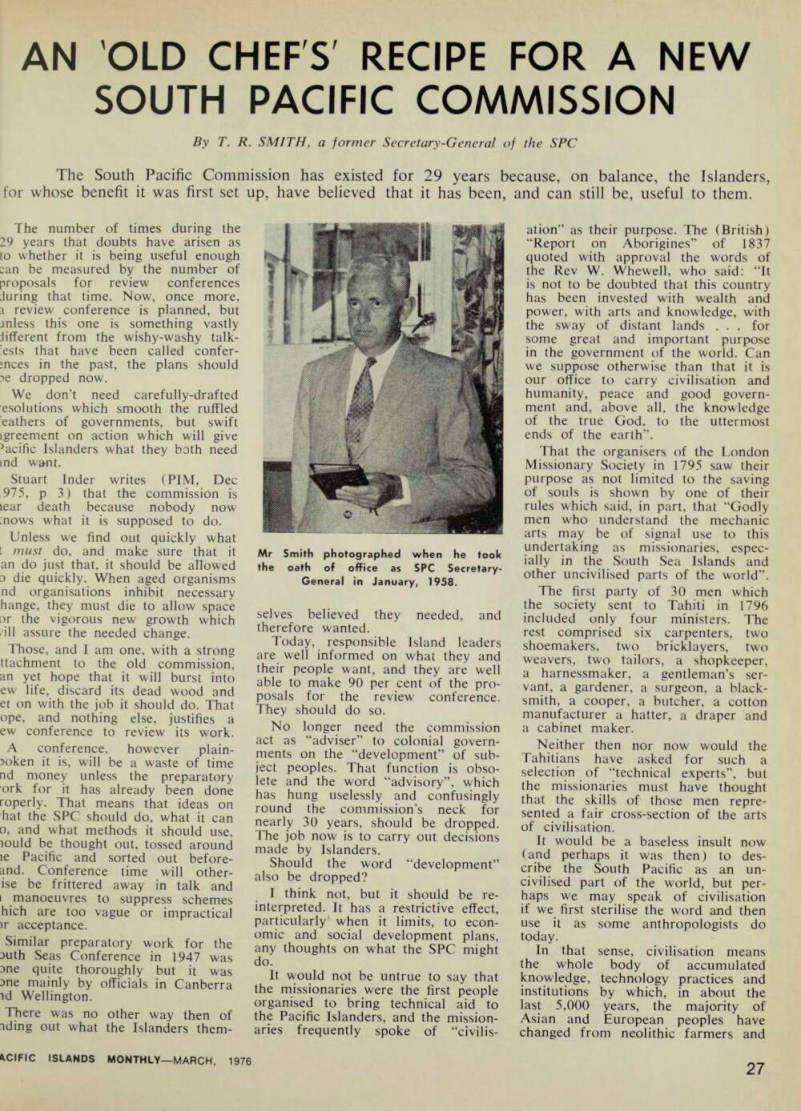
Mr Smith photographed when he took the oath of office as SPC Secretary- General in January, 1958.
nomads to members of the modern, compartmented and specialised, but integrated and balanced society.
Without entering the discussion on how long people have lived in the Pacific, we can say that during most of the 5,000 years the develop ment of Western civilisation has taken, Pacific Islanders were isolated and quite unaware of what was hap pening on the European-Asian mainland. Though they developed their own agricultural, navigational and other technologies, as well as their own social systems, they knew nothing of Western civilisation.
As Europeans used the term, they were uncivilised. They had a lot to learn from the newcomers and, of course, they quickly learned a great deal. Establishment of the South Pacific Commission in 1947 was in part a recognition that they could be helped to learn more, and in part an acceptance by Western peoples of an obligation to help more effectively.
But, as Fiji’s Prime Minister, Sir Kamisese Mara, has said, the SPC was a child of its era—the colonial era. Its constitution and its methods were devised with the intention that it would advise and help the adminis tering governments in the discharge of the responsibility which they accepted. It was, as was said, auxiliary. Limitations were therefore imposed on .its scope, and appointees to its governing body were never the men who made policy for their governments.
The South Pacific Forum was founded partly to get away from those limitations. It has the right freely to discuss political questions, and its members are political leaders with authority to decide policies binding on their governments.
The South Pacific Commission still has the weakness of an auxiliary md advisory body when the authori ses it was established to advise have already shed most of their responsi ailities.
There is considerable truth in the charge that colonialism implied ex iloitation and repression, but those vho stress that aspect tend to forget hat it also implied help, instruction ind protection. Within the area bounded by its limitations, the South Pacific Commission has given a ;olid measure of help and instruction, >ut it has not been concerned with irotection.
The word protection, as I use it lere, has nothing to do with defence n military terms. It is a necessity n our divided and specialised com nercial community in which men ire organised into interest groups o protect interests common to their
members. From trade unions to farmers’ federations and manufac turers’ associations, innumerable such groups protect the interests of their members with little or no con cern about the consequent injury to the members of other groups.
To preserve equilibrium and peace in the modem state, a government regulates trade practices, controls prices and wage rates, guards human rights and provides the complicated administrative machinery necessary to preserve law and order. In the colonial era, the colonial govern ments accepted the obligation to protect the interests of their Island subjects. A century ago planters in Queensland and Fiji exercised their undisputed right to exploit the labour of unprotected Islanders. The Western Pacific High Commission and the British Navy were marshalled to pro tect the naive and unorganised Mela nesians.
For most Pacific Islanders the colonial era has ended, but can they, with their new governments, yet fully protect their own interests? The South Pacific Forum stands as proof that leading men among them are convinced that some additional power is needed.
Conflicts between shipowners and trade unions in New Zealand or Australia have at times left some Islanders critically short of food and other supplies, and have caused economic loss when produce decayed because the ships needed for convey ing it to market were laid up. Steps to protect metropolitan interests restrict opportunities for Islanders to migrate in search of work or to run their own ships.
No one is likely to dispute the right to come into the South Pacific of those concerns which are spending billions of dollars on development of the technology for taking mineral nodules from the sea floor. In our society they have the right to reap the profits of their enterprise.
But how far do we recognise the right of the inhabitants to benefit from the natural resources of their region? The Law of the Sea Con ference has noticed the right. Will it, in the end, be able to provide effective protection?
Western peoples have brought much of their developed technology to the South Pacific and applied it in the solution of oceanic problems. But there has been insufficient recog nition of the need for new techniques specially adapted to solve Island problems.
We still want an adequate and cheap source of energy for Island
• Continued on p 75
dustries, a reliable and economical ethod of distilling sea water and II exploration of the problem of productive Island soils. The Cook anders tried to adapt techniques vised for producing food crops and eet water in the Arabian desert to i needs of their atolls. Expert ad :e and more applied research could rhaps have helped them to success d could certainly have saved them >m expensive failure.
Somebody should make these >blems known and perhaps should ange for specialised work directed their solution. The SPC has anged expert enquiries into de opment bank facilities and the irist industry. The scope for more rk is immense. in this article I have tried to sug t the scope for possible aid in South Pacific. In outline it covers: I. Material aid for economic de opment. Island leaders know their :ds and, to a considerable extent, re defined them in development ns. The need is to co-ordinate se plans and to supply the supple ntary money, material and skills ded for their realisation. !. Further education and train , particularly in the fields of com nications, transport, management, mce, administration and manufac '• A means of defining and mak known the legitimate interests 1 rights of South Pacific peoples I perhaps ensuring that those rights interests are safeguarded. . The channelling of developed miques and research facilities into k for the solution of problems :ific to Pacific Islands. Health and ial problems, often made apparent he adjustment to a Western way life, should be included here, f we take the wider view which iggest, a conference to review the k of the South Pacific Commis i will appear as not worth the . But if the conference can come *vith a statement of what Islanders lire and expect from their own misation, worthwhile progress be seen. . additionally, an organisation be planned with the resources, will and the working methods it to do what it should, the con nce will have done its job. ut, perhaps in the process, the th Pacific Forum, the South fic Bureau for Economic Co ation and the South Pacific imission will all have been