The Mailbag
pp. 21-25 · Read in the full issue


Church's Role In New Hebrides
I was saddened and dismayed when I read in your January issue (p 21) the letter from my friend David Burt on the Church’s role in the New Hebrides. Saddened because I believe he mistakes the involve ment of individual Christians in New Hebrides politics for the Church itself supporting a particular political party. Dismayed that he appears to give such a blanket endorsement to the remarks of Messrs Joffick and Curtis, whom he admits he has never met. The thought of such men having political power in the New Hebrides makes me shudder.
Last September I concluded 10 wonderful years of life in the New Hebrides. 1 am grateful that during those years many New Hebrideans extended their friendship to me, and I think I have come to some under standing of their hopes, their fears, their desires and their needs. For nearly six years I was an elder in the Presbyterian Church—active in wor ship, work, and the discussions and planning of church committees.
Pastors and elders earned my con stant respect for their readiness to keep politics out of church services and meetings, despite their natural keen interest in the rapid develop ment of political life in the country.
I agree with David that the Church as such should not be permanently allied with any political party, though it might support a party on particular issues. But I strongly favour the participation of individual Christians in political parties, and believe that many pastors and elders are very able to make a major con tribution in the New Hebrides.
During His earthly ministry Christ showed His concern for the total well-being of men and women. He fed the hungry and healed the sick; He denounced wealthy and politic ally-powerful men who treated the poor unjustly and misled their fol lowers. I believe the Christians who are involved in New Hebrides poli tics are following His example. They are not (in general) seeking earthly power, but are expressing their con cern for their fellow men and women and are working to help them. Many are dedicated men already making significant sacrifices for their people.
I thank God that pastors, priests, elders and other Christians have been called to serve in the new Territorial Assembly.
Bob Hindle
Oakleigh, Vic.
The Lost Caravel
The letter by David Call in the December 1975 PIM (p 21) claims that Langdon’s hypothesis about the influence of a lost Spanish caravel is “psychologically unsound” because “castaways simply do not found dy nasties, no matter how ‘culturally superior’ they may assume their civilisation to be”. This seems not to accord with historical facts in the Pacific or elsewhere.
H. E. Maude’s Evolution of the Gilbertese Boti (Polynesian Society, Wellington) shows how a small group of Samoan castaways and their descendants established the major dynasty of the southern Gil bert Islands. Peter France’s Charter of the Land (Oxford University Press, Melbourne) quotes an instance of a strange castaway being found by a Fijian tribe whose chieftaincy was vacant and chose this person on the spot as their chief, as they assumed he was supernaturally superior.
Jean Guiart (Structure de la Chefferie en Melanesie du Sud, Paris) shows how many New Cale donia tribes are headed by immi grant Tongans, at least some of whom were castaways. Rarotongan (Cook Islands) tradition tells of the immi grant Tangiia having become domi nant over the island, sending for a higher-ranking person from another island (Pa Ariki ) to be brought as high chief over them all because Tangiia himself was not of suffic iently high birth. All these examples were long before European times.
Cases of this kind are numerous in the Pacific, some involving people of the same ethnic or “racial” type, some not. They seem to be dependent on several factors—perhaps the main three are technical superiority, or ganisational superiority and super natural superiority. Whether the superiority is real seems not to be
early as important as whether it is elieyed or assumed—both by the ominant and the subordinate group, have myself been taken for a re irned ancestor to whom people ied to accord various superior attri- Jtes and powers, while working nong the coastal Orokaiva of apua. And a colleague and I were mown” to be personal represent ives of the President of the USA a village in the Markham Valley Papua New Guinea where we ere undertaking research. The fact at we refuted this only confirmed e “fact” for the people who said at they knew we were not allowed admit the real reason for our esence.
Such treatment is very tempting the ego, and anyone landed per anently and in isolation in such a nation would be likely to respond giving the leadership expected, ovided it was reasonably skilfully rried out, and provided the immi ant married locally, it could easily cur that he would not only main n leadership in his lifetime, but ss it to his children. And there are my cases of this having happened the Pacific (and probably else icre for that matter).
Would strong European men in ge numbers accept the leadership a 13-year-old girl of their own Iture and society? This is precisely iat Frenchmen in thousands did Joan of Arc. Would one of the
)st modern, industrialised, “deve
ied”, “educated” nations on earth
voluntarily elect a foreign-born per son of low class as their leader and let him change their whole social and political system? This is what the Germans did with Adolf Hitler.
Cases of the acceptance of foreign or low-class, or otherwise unusual persons in leading roles are many in world history. Sometimes this accept ance of the leadership of a stranger resulted from military dominance, but usually it did not, as in most of the cases cited above.
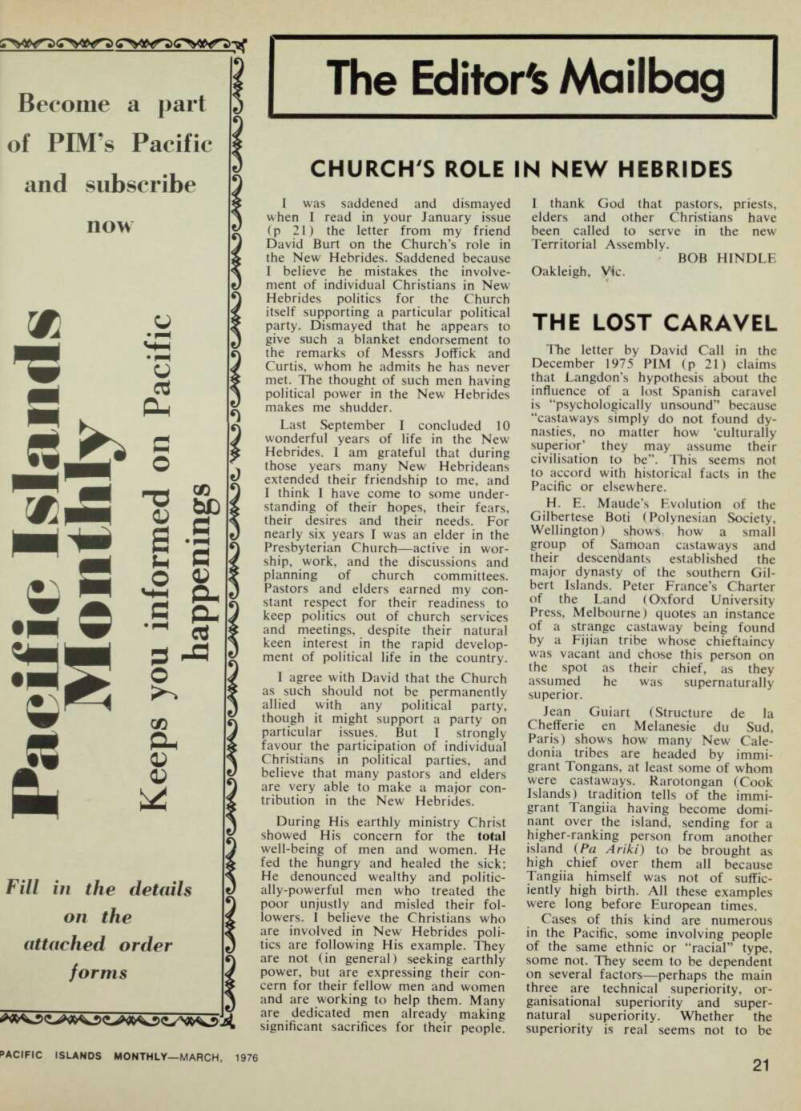
The English missionary John Williams converted the Atiu chief Rongomatane to Christianity in one night’s conversation on board ship —without even going ashore. No force was involved, only assumed supernatural superiority which both sides accepted. Nor was it a fraud— both parties believed deeply. Rongo matane thereupon converted not only his own people but those of neighbouring Mauke and Mitiaro in a matter of days.
The Tahitian missionary Papeiha, with one Tahitian friend and no weapons, subordinated warlike Raro tongan chiefs in a relatively short time to his presumed superior reli gion. The Manihiki castaway Elikana (or Eriteina) did likewise in Tuvalu, long before European colonials, missionaries or businessmen ever established there.
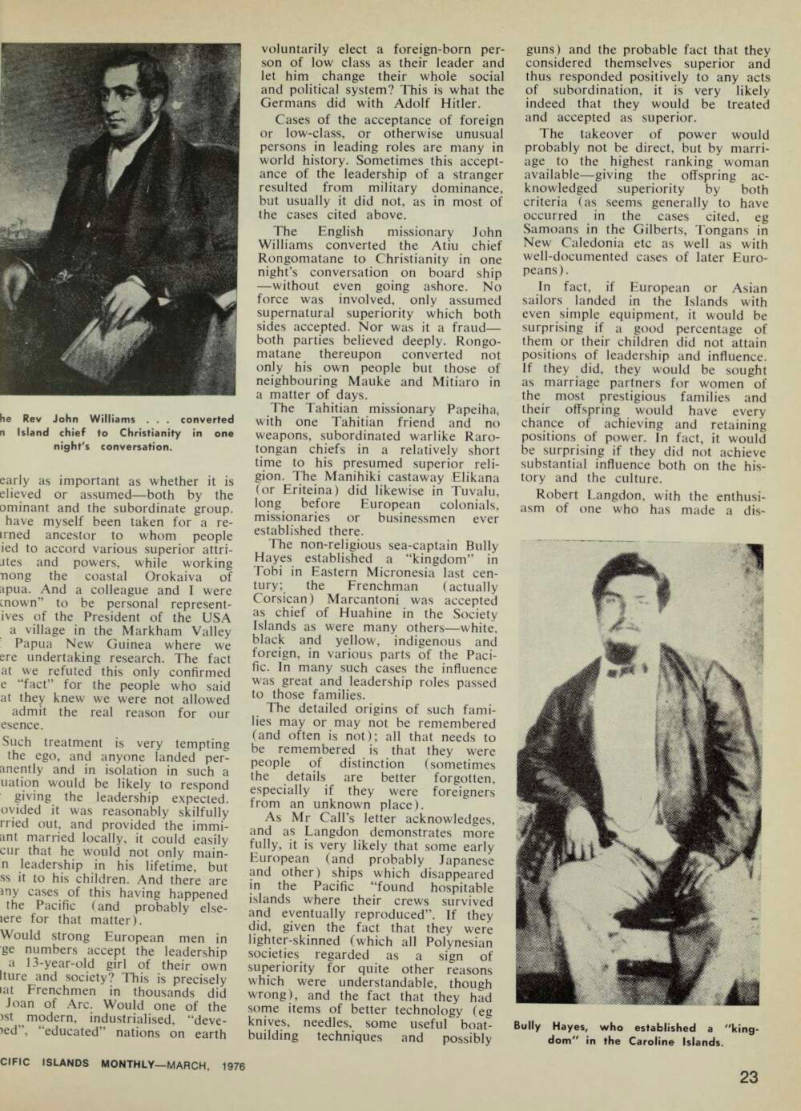
The non-religious sea-captain Bully Hayes established a “kingdom” in Tobi in Eastern Micronesia last cen tury; the Frenchman (actually Corsican) Marcantoni was accepted as chief of Huahine in the Society Islands as were many others—white, black and yellow, indigenous and foreign, in various parts of the Paci fic. In many such cases the influence was great and leadership roles passed to those families.
The detailed origins of such fami lies may or may not be remembered (and often is not); all that needs to be remembered is that they were people of distinction (sometimes the details are better forgotten, especially if they were foreigners from an unknown place).
As Mr Call’s letter acknowledges, and as Langdon demonstrates more fully, it is very likely that some early European (and probably Japanese and other) ships which disappeared in the Pacific “found hospitable islands where their crews survived and eventually reproduced”. If they did, given the fact that they were lighter-skinned (which all Polynesian societies regarded as a sign of superiority for quite other reasons which were understandable, though wrong), and the fact that they had some items of better technology (eg knives, needles, some useful boat building techniques and possibly
guns) and the probable fact that they considered themselves superior and thus responded positively to any acts of subordination, it is very likely indeed that they would be treated and accepted as superior.
The takeover of power would probably not be direct, but by marri age to the highest ranking woman available—giving the offspring ac knowledged superiority by both criteria (as seems generally to have occurred in the cases cited, eg Samoans in the Gilberts, Tongans in New Caledonia etc as well as with well-documented cases of later Euro peans).
In fact, if European or Asian sailors landed in the Islands with even simple equipment, it would be surprising if a good percentage of them or their children did not attain positions of leadership and influence.
If they did, they would be sought as marriage partners for women of the most prestigious families and their offspring would have every chance of achieving and retaining positions of power. In fact, it would be surprising if they did not achieve substantial influence both on the his tory and the culture.
Robert Langdon, with the enthusi asm of one who has made a dis-
The Rev John Williams . . . converted [?]n Island chief to Christianity in one
night's conversation.
Bully Hayes, who established a "king dom" in the Caroline Islands.
covery, may well have overstated his case and represented some possi bilities as probabilities or certainties.
Each of the possibilities he has raised low needs detailed checking and one lopes it will get it.
Personally I’d be surprised if the inclusion doesn’t show that, despite some undoubted exaggerations and ;ome wrong guesses, Langdon has nade a tremendous contribution to he history of the Pacific.
R. G. Crocombe
Professor of Pacific Studies Jniversity of the South Pacific, iuva, Fiji.
Wanted!
Would anyone having any know edge (a) of the Allied International ?opra Pool, operated during a part >f World War II and headquartered n San Francisco in 1943 and (b) 4ajor A. D. Sinclair, formerly of he New Zealand Army, former District Officer at Christmas Island n the Central Pacific, known to lave lived in Vancouver; dead or live, please communicate with the ndersigned.
Lester Gaynor
-52 Burgess Avenue, Vestwood, Mass 02090
Jsa.
Bougainville
Dispute
Your story on Bougainville (PIM, >ec, p 9) sounded like a cricket latch report. The headline, “Mr omare ahead on points in the Bou ainville contest” set the tone of the ory which continued to tell us that le so-called “secessionist leaders” ere being so badly beaten by Mr omare on points that they “seemed Imost pathetically eager to accept le promise of another round of dis issions . .
Some people might regard a game cricket as a matter of life and jath but I don’t think the people volved in the Bougainville dispute id it as amusing as a game of icket.
Even if your correspondent is ght in saying that Mr Somare is lead on points, what is that going prove? Is it going to end the dis ite? I think not. Instead I think s going to prolong it. After all, uch of the Bougainville issue is ised on pride and dignity, especially i the part of the Bougainvillians. hey are not just about to come awling back to the government to
say that they give up. A story like yours is going to make them react otherwise.
I think your correspondent will be doing Mr Somare and everybody else a lot more service if he refrains from dishing out point-by-point ac counts of how the Prime Minister is winning and how badly the other side is losing and simply reports the facts. Everybody wants to see the dispute ended and THAT will be the real victory for the Prime Minister and his government. If the issue is taken merely as a point-scoring exercise, I think we can settle down to a long drawn-out affair.
The Bougainville situation may well be a “contest” but if such in
sensitive media treatment prevails, there will be no winner.
Carolus Ketsimur
Boroko, PNG.
A New Inder
Tell Stuart Inder, Up Front, he should do himself and us a favour and get a new sketch at the top of his column; does nothing for him.
Something a bit more pacific.
Father Matthew Kelty.
Bogia, Madang, PNG. • Stuart Inder admits he's getting older and that it’s time he updated his image. It won’t however, make him look, or feel, any more pacific.