Churches bridged the gap
pp. 31-35 · Read in the full issue

A Christian Reality
It was no dream when Pacific Churches bridged the gap
From ROXANNA COOP in Port Moresby
The third assembly of the Pacific Conference of Churches in Port Moresby in January climaxed with an air of achievement and expectancy after 10 days of an uncertain search for “God’s Mission in a Changing Pacific Society”.
The image of church relationships that emerged was one of solidarity, marked by a new official collabora tion of Roman Catholics and Pro testants of the region.
Unifying forces seemed to be at work everywhere. French and English-speaking peoples, clergy and aity, men and women, all seemed o pull together signifying a new beginning for the Pacific churches.
The most notable achievement was he acceptance of Roman Catholic :hurches into membership, an his oric action in that regional unity lad only been accomplished previ )usly by the Caribbean Conference )f Churches.
Catholics entered through the ■piscopal Conference of Bishops f the Pacific (CEPAC), an associa ion of 10 dioceses and 12 bishops -the dioceses of Suva, Samoa, Parawa, Marquesas Islands. Cook slands. New Caledonia, Wallis and ■utuna, New Hebrides, Tonga and "ahiti.
The Rev Sione ’A Havea of onga, a Methodist and a participant hroughout the 15-year history of he PCC, confessed that the getting agether of the churches of the ’acific was “something I never reamed would happen in my life me.
“It is very clear that our unity is lore than our differences ... We re entering a new stage in our onference of churches”, he said.
Bishop Patelisio P. Finau of the atholic Diocese of Tonga called it a great achievement ... we Chris ans have been working in isolation )o long, even within the same auntries”. He commended the atmosphere of trust” that grew uring the Waigani assembly, dissi ating many long-held fears of oman Catholic domination.
The Vatican observer, Fr Basil leeking, enlarged the context of the ecision by quoting a letter from
Pope Paul VI to the Roman Catholic Church following the World Coun cil of Churches fifth assembly at Nairobi. In this letter the pontiff urged Roman Catholics “to be more committed to the search for the restoration of the complete unity of Christians”.
Unity was discerned in many quarters. French-speaking churches were guaranteed a bi-lingual member of staff of the secretariat, further assured by the election of John Doom of French Polynesia as general secretary-designate to succeed the present general secretary in the event of retirement during the next five years.
Laity, especially women, pressed for greater participation in the decision-making bodies of the churches. The assembly itself wit nessed a greater shared leadership in that only half of the 50 delegates were clergy and, altogether, half the lay representatives were women.
Of the clergy, at least half repre sented a new generation. “The older power of ministers is left behind, and there are more young leaders”, ac cording to Doom. The assembly was, in effect, a reunion of 12 graduates of the regional Pacific Theological College, launched only 10 years ago.
Even the dry spell of the assembly was marked by deliberations that amended constitutional provisions and conference structures to accom modate the unifying trends.
For those who asked about the purpose of it all, one clear sign emerged in a concrete resolution of support for the political liberation of the New Hebrides.
The delegates from 17 churches urged the condominium powers, Britain and France, to take “immedi ate constructive steps towards build ing up a political unity”.
The Rev Kingsley Gegeyo, execu tive secretary of the Melanesian Council of Churches of Papua New
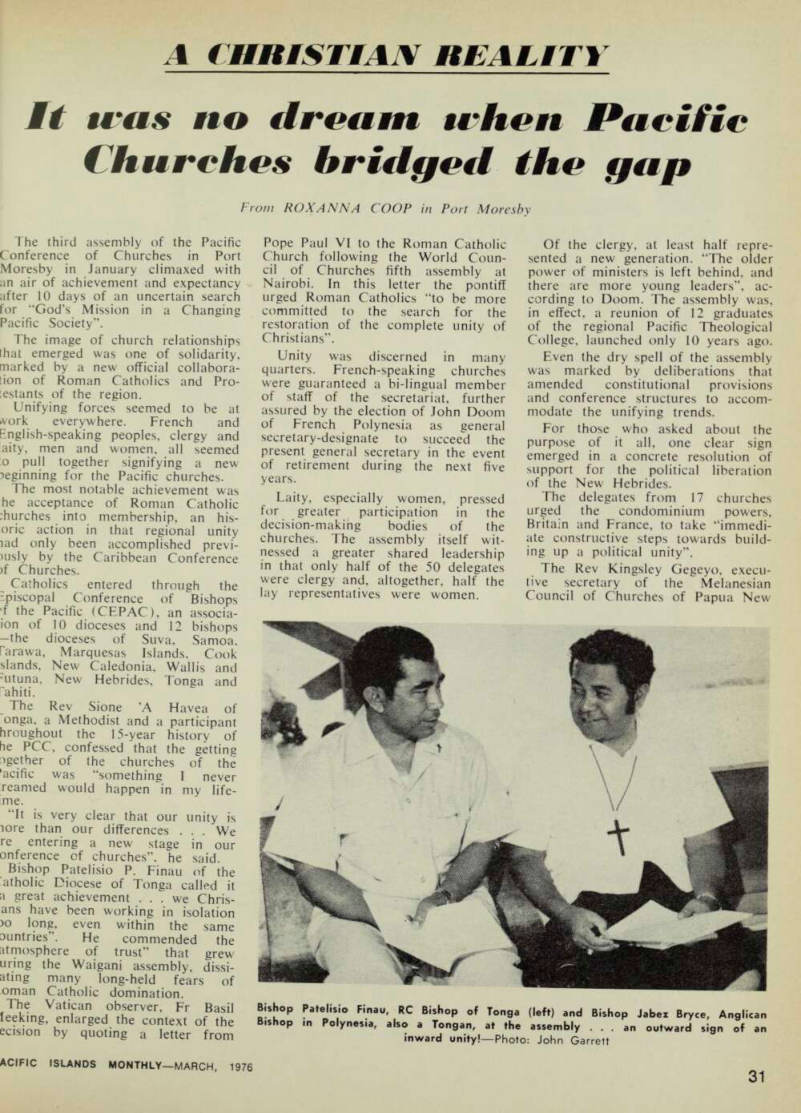
Bishop Patelisio Finau, RC Bishop of Tonga (left) and Bishop Jabez Bryce, Anglican Bishop m Polynesia, also a Tongan, at the assembly ... an outward sign of an inward unity!— Photo: John Garrett
Guinea, one of 50 observers at the assembly, humorously reflected on the potential power of Christian unity when he told delegates he liked to remind PNG Prime Minister Michael Somare that he represented but one and three-quarter million people.
Unanimous action was taken at the assembly on the frequently divisive issue of a nuclear-free zone.
Delegates from the French territories supported a resolution condemning nuclear weapons testing and “the disregard of the stated wishes of the peoples of the region for self determination in this matter”.
A commission report observed that people of French Polynesia are “deeply divided” over the nuclear testing issue because of related im provement in the number of jobs available and the standard of living.
Reflecting on the assembly’s stand, Doom said, “It is good to let people know, but action is difficult, especi ally when politics is involved . . .
Fhe people must have their own responses. Otherwise we have im perialism of the churches”.
Overseas observers from Australia, Britain, New Zealand and the United States were tentative about their offers to internationalise the mission 3f the churches.
Aware of the neo-imperialism of
initiatives from the west, they ex pressed their solidarity with move ments for economic and political liberation and invited the delegates’ churches to originate new mission structures that would most effectively meet Pacific needs.
The caution was in light of the fact that denominations have attained regional co-operation in the Pacific.
The Rev Paula Niukula, of Fiji, explained, “If we have a strong soli darity, we will not need to worry about a new colonialism of the churches”. Observing that the pre sent trends of internationalisation of mission are along denominational lines, he stressed the importance of building Pacific unity before “de nominational links are hardened”.
At the same time, the assembly nullified a 10-year-old identification with the World Council of Churches by eliminating a constitutional pro vision for membership which sug gested that relationship to the world body was desirable.
PCC membership is now simply open to all churches, national coun cils of churches and ecumenical organisations in the Pacific which “accept the basis and functions of the PCC”. Sharing of resources with the WCC was not altered, and a consultation on priorities for con tinued project funding followed at Popondetta.
Commenting on the state of the PCC, the newly-elected chairman, Bishop Jabez Bryce of the Anglican Diocese of Polynesia, said, “We are like the governments of our coun tries. We are taking up the reins of
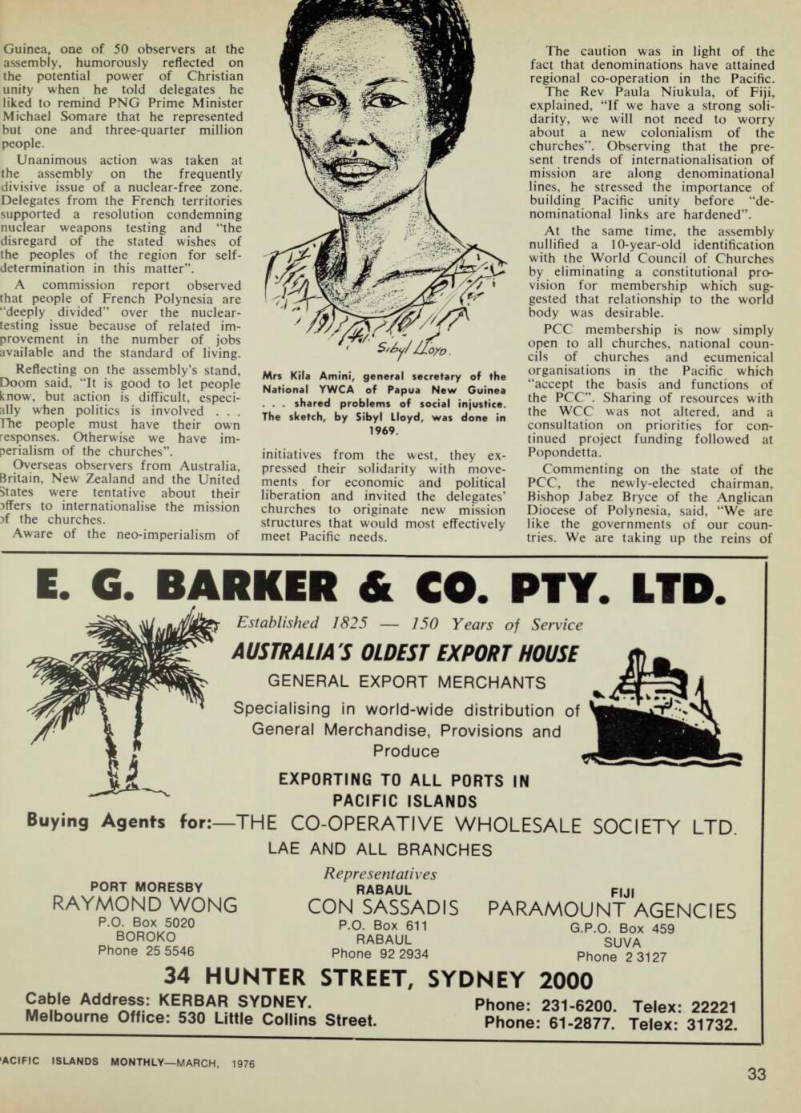
Mrs Kila Amini, general secretary of the National YWCA of Papua New Guinea . . . shared problems of social injustice.
The sketch, by Sibyl Lloyd, was done in 1969.
the churches for the first time, and the directions are not yet clear. The churches have to re-examine why they exist”.
Reflecting the bishop’s impressions, the out-going chairman, the Masiofo Fetaui Mata’afa of Western Samoa commented that the assembly had been “awakened to a new state of awareness of the things which go on around us ... and aroused to a state of confusion because new stan dards and sets of values in the Pacific today are not clear cut”.
Still, the directions seemed to point clearly toward the values of total human development, justice and
human dignity.
The coming together of leaders lifted “critical awareness of what we can do in our own countries to develop our own resources”, accord ing to the Rev Baiteki Nabetari, theological college principal in the Gilbert Islands and a “youth” ob server.
Mrs Kila Amini, general secretary
of the national YWCA of Papua New Guinea, appreciated sharing problems of social injustice with the people involved in particular situ ations, noting that it was not until she met a New Hebridean at the International Women’s Year meeting in Mexico City that she became fully aware of New Hebrideans’ lack of
citizenship privileges.
Low wages in the face of high inflation and unfair distribution of lands were also cited as areas for the churches’ collective as well as local examination.
Niukula, staff co-ordinator of the PCC Family Life Programme, warned the delegates against continu ing to say “that’s their problem” in response to the social and political concerns of certain Pacific countries.
“The land problems in Tonga and the political problems of the New Hebrides are also my problems”, he said, pleading for the sharing of concerns, personnel and resources.
Other resolutions passed for im-
plementation by churches and the on-going programmes of PCC in cluded a request for consciousness raising to help Pacific peoples inter pret the forces affecting their lives and detect changing human values.
Consciousness-raising and mutual discussion were affirmed as styles of education appropriate for young people, as distinct from “the lecture type of teaching by elders” in the commission report on human values.
Styles of evangelism were chal lenged along with education by the Rev Sitiveni Ratuvili of Fiji, a staff member of the PCC Church and Society Programme, who said, “We must evangelise with our lives . . . or we will be guilty of another kind of imperialism—evangelical im
perialism”.
The fact that the unprecedented political stand on the New Hebrides came through the Commission on Evangelism was another sign of the wholeness implicit in assembly pro ceedings. The report included not only recommendations for self-study and renewal of the churches but also suggestions for “prayer, planning and action” to confront “forms of in justice and oppression” in Pacific countries.
The concept of church and society programme was new to some dele gates who complained they were not aware of resolutions from the 197 f assembly at Suva.
They directed the Church and Society Programme to co-ordinate action on questions of injustice affecting the region and to confer with churches outside the region where they can co-operate in meeting problems of financial and economic
exploitation.
Fr Patrick Murphy, of the Catho lic Bishops Conference in PNG, was
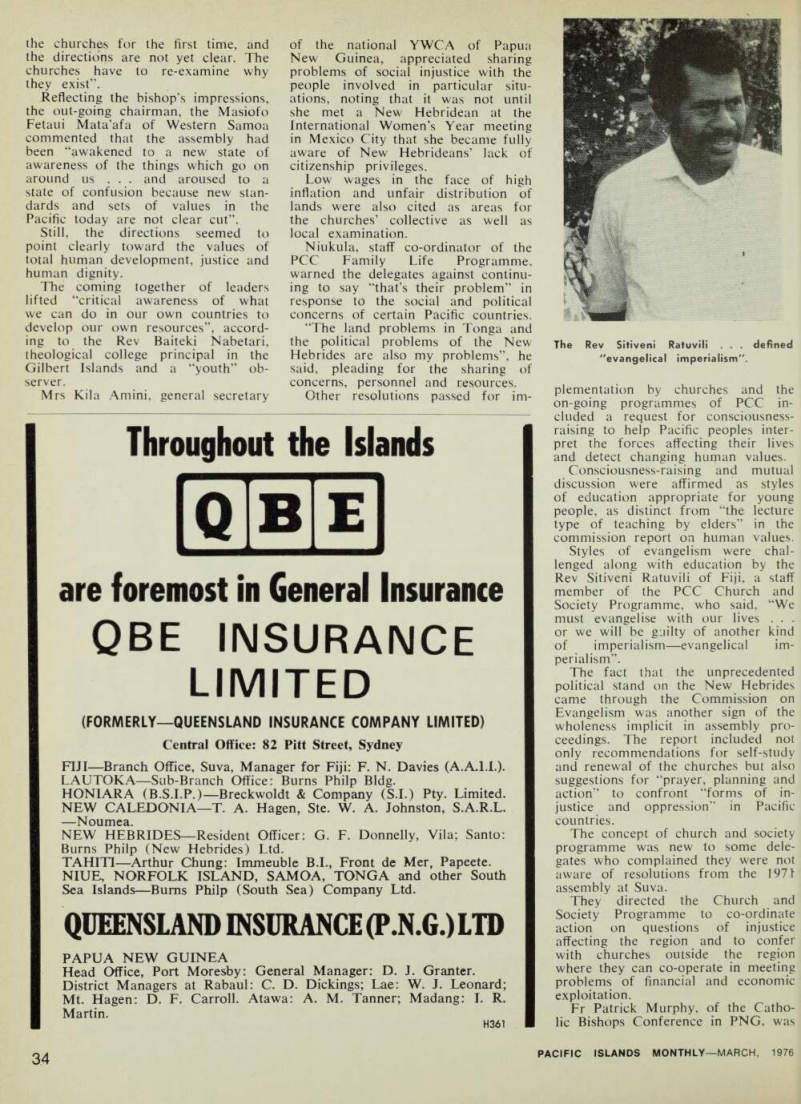
The Rev Sitiveni Ratuvili . . . defined "evangelical imperialism".
named co-ordinator of the Church and Society Programme with Mrs Amini as chairman for the next five years in a move to strengthen its objectives.
Bishop Finau contended that the assembly had discerned “the aspira tions of people”, and it was now the churches’ job to put them into action.
Bishop Finau’s statements on de velopment and human values early in the assembly called for sweeping changes in church and society.
“Discussing the problems of the Pacific means looking at the root problem of justice because to deve lop people without justice is hope less”, he said.
“TTie emerging Pacific countries have to be wary of still being ■colonial’ in mentality—of blindly and docilely accepting all the worst features of western materialism”, he argued.
The Catholic leader told delegates to “beware of the new and the old local oppressors whose oppressive roles are camouflaged because they are local people”.
“These oppressors are worse than the western oppressors”, he declared, "and here we have to look at the matais, the chiefs and nobles in our island societies”.
He emphasised that in the Pacific “we have to preserve our person centredness and community-centred ness as against individualism”, but he urged delegates to go beyond— “to feel compassion and become contemporary critics”.
The membership application of CEPAC was accepted after being de ferred at the Suva assembly. At the same time—and for the first time— two national councils of churches were received into membership, both including Roman Catholics. These are the Solomon Islands Christian Association and the Fellowship of Christian Churches in Samoa.
Church of Christ of the New Hebrides was also accepted, bringing the total member bodies of PCC to 21.
The Rev Posenai L. Musu, of Western Samoa, who has served as general secretary for the past year, was confirmed in his post.
Members of the new executive committee, in addition to Bishop Bryce, are Fr Brian McDonald-Milne of the Anglican Church of Melanesia, Revs losia Taomia of Tuvalu, Lalo milo Kamu of Western Samoa, Fred Karlo Timakata of the New Heb rides, Pasteur Waimo Passil of New Caledonia and Mrs Kila Amini of Papua New Guinea.
The United Church of Papua New Guinea and the Solomon Islands hosted the assembly.