Yesterday
p. 44 · Read in the full issue
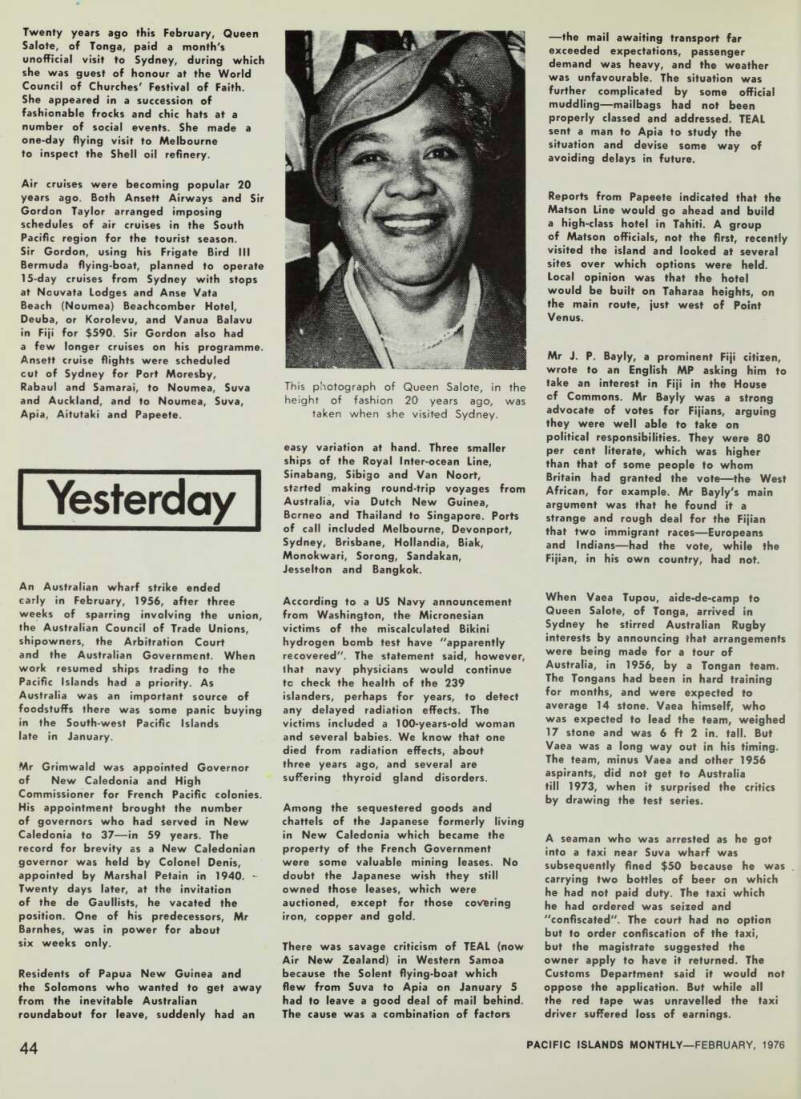
Twenty years ago this February, Queen Salote, of Tonga, paid a month's unofficial visit to Sydney, during which she was guest of honour at the World Council of Churches' Festival of Faith.
She appeared in a succession of fashionable frocks and chic hats at a number of social events. She made a one-day flying visit to Melbourne to inspect the Shell oil refinery.
Air cruises were becoming popular 20 years ago. Both Ansett Airways and Sir Gordon Taylor arranged imposing schedules of air cruises in the South Pacific region for the tourist season.
Sir Gordon, using his Frigate Bird 111 Bermuda flying-boat, planned to operate 15-day cruises from Sydney with stops at Nouvata Lodges and Anse Vata Beach (Noumea) Beachcomber Hotel, Deuba, or Korolevu, and Vanua Balavu in Fiji for $590. Sir Gordon also had a few longer cruises on his programme.
Ansett cruise flights were scheduled cut of Sydney for Port Moresby, Rabaul and Samarai, to Noumea, Suva and Auckland, and to Noumea, Suva, Apia, Aitutaki and Papeete.
An Australian wharf strike ended early in February, 1956, after three weeks of sparring involving the union, the Australian Council of Trade Unions, shipowners, the Arbitration Court and the Australian Government. When work resumed ships trading to the Pacific Islands had a priority. As Australia was an important source of foodstuffs there was some panic buying in the South-west Pacific Islands late in January.
Mr Grimwald was appointed Governor of New Caledonia and High Commissioner for French Pacific colonies.
His appointment brought the number of governors who had served in New Caledonia to 37—in 59 years. The record for brevity as a New Caledonian governor was held by Colonel Denis, appointed by Marshal Petain in 1940. • Twenty days later, at the invitation of the de Gaullists, he vacated the position. One of his predecessors, Mr Barnhes, was in power for about six weeks only.
Residents of Papua New Guinea and the Solomons who wanted to get away from the inevitable Australian roundabout for leave, suddenly had an
easy variation at hand. Three smaller ships of the Royal Inter-ocean Line, Sinabang, Sibigo and Van Noort, started making round-trip voyages from Australia, via Dutch New Guinea, Borneo and Thailand to Singapore. Ports of call included Melbourne, Devonport, Sydney, Brisbane, Hollandia, Biak, Monokwari, Sorong, Sandakan, Jesselton and Bangkok.
According to a US Navy announcement from Washington, the Micronesian victims of the miscalculated Bikini hydrogen bomb test have "apparently recovered". The statement said, however, that navy physicians would continue to check the health of the 239 islanders, perhaps for years, to detect any delayed radiation effects. The victims included a 1 00-years-old woman and several babies. We know that one died from radiation effects, about three years ago, and several are suffering thyroid gland disorders.
Among the sequestered goods and chattels of the Japanese formerly living in New Caledonia which became the property of the French Government were some valuable mining leases. No doubt the Japanese wish they still owned those leases, which were auctioned, except for those covering iron, copper and gold.
There was savage criticism of TEAL (now Air New Zealand) in Western Samoa because the Solent flying-boat which flew from Suva to Apia on January 5 had to leave a good deal of mail behind.
The cause was a combination of factors
—the mail awaiting transport far exceeded expectations, passenger demand was heavy, and the weather was unfavourable. The situation was further complicated by some official muddling—mailbags had not been properly classed and addressed. TEAL sent a man to Apia to study the situation and devise some way of avoiding delays in future.
Reports from Papeete indicated that the Matson Line would go ahead and build a high-class hotel in Tahiti. A group of Matson officials, not the first, recently visited the island and looked at several sites over which options were held.
Local opinion was that the hotel would be built on Taharaa heights, on the main route, just west of Point Venus.
Mr J. P. Bayly, a prominent Fiji citizen, wrote to an English MP asking him to take an interest in Fiji in the House cf Commons. Mr Bayly was a strong advocate of votes for Fijians, arguing they were well able to take on political responsibilities. They were 80 per cent literate, which was higher than that of some people to whom Britain had granted the vote —the West African, for example. Mr Bayly's main argument was that he found it a strange and rough deal for the Fijian that two immigrant races—Europeans and Indians—had the vote, while the Fijian, in his own country, had not.
When Vaea Tupou, aide-de-camp to Queen Salote, of Tonga, arrived in Sydney he stirred Australian Rugby interests by announcing that arrangements were being made for a tour of Australia, in 1956, by a Tongan team.
The Tongans had been in hard training for months, and were expected to average 14 stone. Vaea himself, who was expected to lead the team, weighed 17 stone and was 6 ft 2 in. tall. But Vaea was a long way out in his timing.
The team, minus Vaea and other 1956 aspirants, did not get to Australia till 1973, when it surprised the critics by drawing the test series.
A seaman who was arrested as he got into a taxi near Suva wharf was subsequently fined $5O because he was carrying two bottles of beer on which he had not paid duty. The taxi which he had ordered was seized and "confiscated". The court had no option but to order confiscation of the taxi, but the magistrate suggested the owner apply to have it returned. The Customs Department said it would not oppose the application. But while all the red tape was unravelled the taxi driver suffered loss of earnings.
This photograph of Queen Salote, in the height of fashion 20 years ago, was taken when she visited Sydney.