Magazine Section
pp. 37-43 · Read in the full issue
Us Marines At Guadalcanal Again:
Pilgrimage Into A Bloody Past
From MICHAEL McCOY at Kira Kira
Joe Goble is a quietly-spoken man from North Carolina. He owns a prosperous little jewelry business in the small town of Newton, about 40 miles from Charlotte. Life for him today is peaceful although this has not always been so. At the age of 24 he became involved in some of the most ruthless and desperate fight ing in World War 11.
He enlisted in the Marine Corps in October, 1940, and after serving in both Cuba and Samoa he was landed on Guadalcanal on September 18, 1942. This small island in the Pacific hitherto unknown to many, had, after the initial US landings of August 7 of that year, gained a notoriety that made mention of its name synonymous with the fierce fighting that took place there.
A little over a week after arrival, Platoon Sergeant Joseph Goble of “B” Company, 1 /7th Marines to gether with 281 other marines under the command of Lieutenant-Colonel “Chesty” Puller landed on a beach about six miles west of Henderson Airfield. They had advanced only 400 yards before they were ambushed by Japanese soldiers. Fighting a des perate retreat, they were evacuated by the destroyer USS Ballard which Puller had commandeered. When the marines were eventually taken aboard the destroyer it was found that they had lost 60 men. In later accounts this action became known as “Little Dunkirk”. It was later when Joe was back in the States that he learned that the ambush he had walked into consisted of more than 2,000 Japanese.
During his brief stay on Guadal canal Joe made five sorties behind enemy lines on reconnaissance mis sions. He sadly remembers how on one of these missions he and an
other marine were the only survivors of a Japanese attack. The 13 other members of the patrol they buried on a grassy hill to prevent looting of the bodies. To this day those marines lie there in their unmarked graves.
On October 8, 1942, his battalion together with the 3/sth Marines crossed the Matanikau River to re connoitre enemy positions and strength on the western side. After scrambling up the thick jungle they emerged on the grassy hills above the river. Joe vividly recalls how, on the morning of October 9, several weary marines spread a blanket in the depression on the grassy hill they were camped upon and commenced a poker game. Joe’s warning to seek more adequate shelter was scarcely out of his mouth before a burst of Japanese machine-gun bullets scat
tered the cards and sent the un harmed players diving for cover.
Throughout that day they ad vanced further west. Joe’s company encountered sporadic fire from enemy troops in the valleys. At 3 pm as Joe’s squad was advancing in single-file along a ridge top, they were fired on by snipers in the thick bush in the valley below. The man behind Joe clutched his stomach and fell to his knees. Joe immediately grabbed him under the arms to pull him to safety. As he did so, a sniper sighted on him and squeezed his trigger. A dum-dum bullet fired from a British Lee-Enfield rifle struck Joe’s right leg and exploded, smashing his femur., Joe believes that the fact he can still walk today is due in no small measure to the work of the medical-corpsman who splinted his
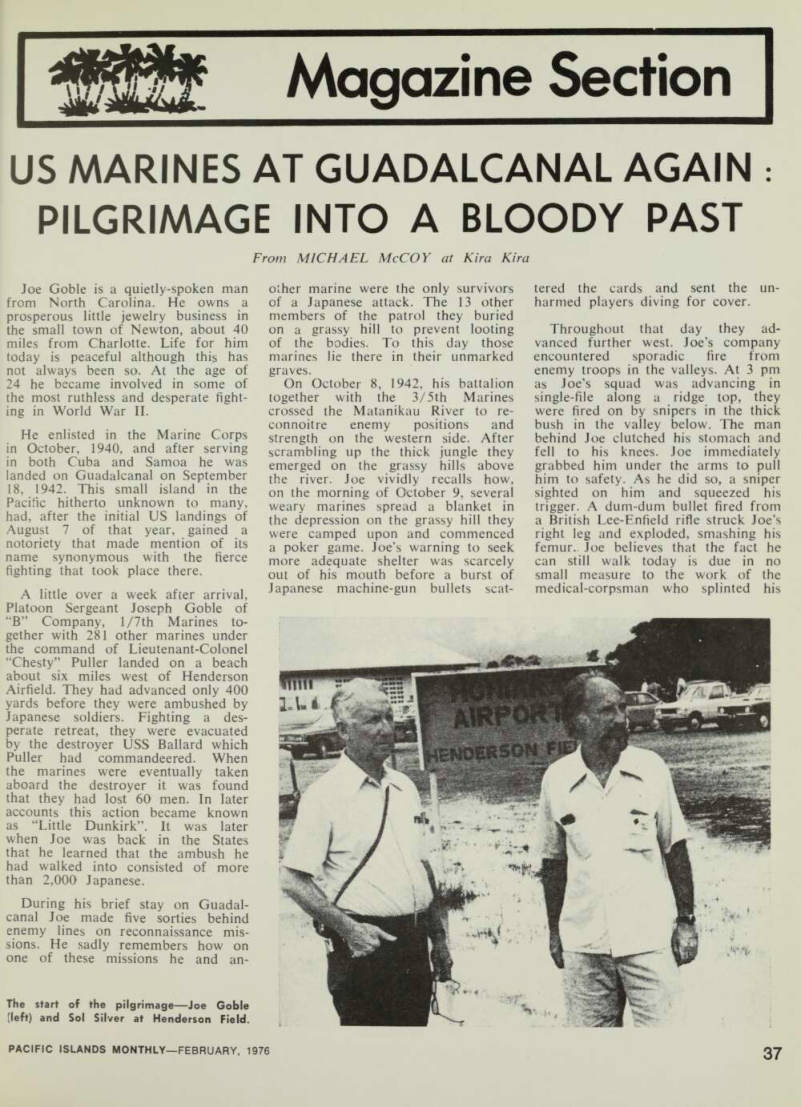
The start of the pilgrimage—Joe Goble [left) and Sol Silver at Henderson Field.
leg with a palm-frond and stopped the flow of blood.
Joe was carried down to the coast several hours later on a make-shift stretcher of rifles and a poncho.
Although the detail carrying Joe and three other wounded marines passed through enemy-held terrain, they did not encounter a single Japanese. At the coast they were met by Higgins boats and taken to a field hospital near Henderson Field. Joe was soon evacuated to a US base hospital on Espiritu Santo in the New Hebrides about 600 miles south-west of Guadalcanal. From there he was finally shipped back to the US where he spent 14 long months in a navy hospital in Maryland. For his efforts to aid his wounded comrade seconds before he himself was shot, Joe re ceived the Silver Star.
Around the time when Joe was returning to the US, Sol Silver, a native New Yorker, joined the marines. As a PFC in “C” Com pany, 1/lst Marines, Sol saw action over much of the Pacific. He first landed on Guadalcanal in October, 1943, after leaving Palau in what is now the US Trust Territory of Micronesia. Although Sol’s sojourns on Guadalcanal were after the bitter
days of 1942 and early 1943, he spent enough time on the island to appreciate those early days. He made a number of trips to Guadal canal from late 1943, through 1944 and early 1945. In those years Henderson Field was a vast military complex. In place of the muddy fighter strip of 1942 were a series of runways, taxiways and parking bays for heavy bombers. Guadal canal was then a stop-over point for troops moving to and from other areas in the Pacific. Heavy aircraft left Henderson on bombing raids north of the Solomons. The whole reason behind the campaign for Guadalcanal was epitomised in these later days.
Sol’s time in the Solomons was spent on routine manoeuvres and practice landings. The Russell Islands, about 50 miles west of Guadalcanal, Sol remembers with a certain fond ness. Days spent swimming in clear, warm water over coral reefs and drinking fresh coconut milk must have been a very welcome respite from the bitter jungle fighting and the beach landings under heavy fire.
Sol left Guadalcanal for the last time as a marine early in 1945. On April 1 of that year he landed in
another island in the Pacific. Like Guadalcanal, Okinawa was to be consequently remembered for the desperate struggle that took place there.
Several months ago, more than 30 years after leaving, Sol and Joe, to gether with some 50 veterans of the Ist Marine Division, returned to Guadalcanal.
The Mendana Hotel now stands on the beach where Joe and the 1 /7th Marines were ambushed 33 years ago. Named after the Spanish discoverer of the Solomon Islands, the Mendana is a very comfortable hotel even by world standards. A large banner was draped over the main entrance. “Welcome Home— -Ist Marine Division” it proclaimed.
These men, in most cases with their wives, had travelled to the opposite side of the world to visit an island that no doubt many of them feared they would never leave.
Joe’s reaction to his return was typical of the group as a whole. For him the return seemed unreal. “I can’t believe I’m back; I never thought I’d see this place again”, Joe said with a certain awe as he looked
• Continued on p 43
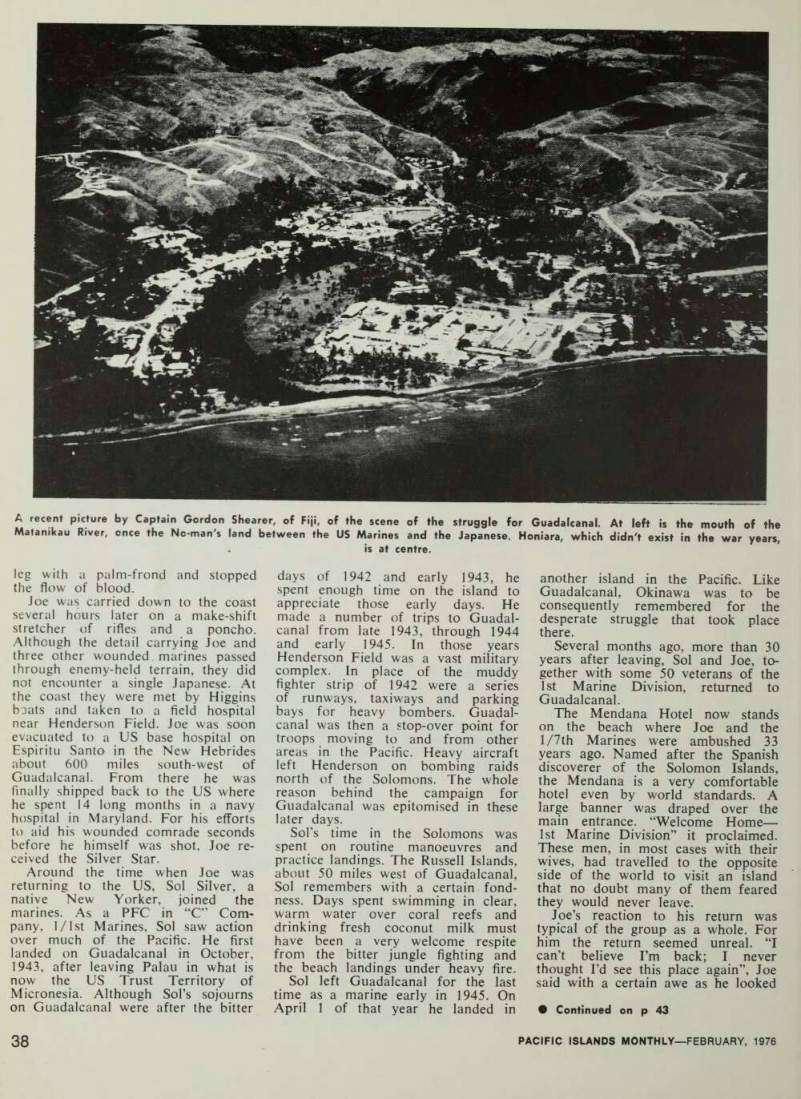
A recent picture by Captain Gordon Shearer, of Fiji, of the scene of the struggle for Guadalcanal. At left is the mouth of the Matanikau River, once the No-man's land between the US Marines and the Japanese. Honiara, which didn't exist in the war years, is at centre.
over the hills he had walked as a marine.
With little difficulty Joe found the very spot where he was shot on October 9, 1942. He traced the path he took over the Matanikau River and over the grassy ridges. As Joe pointed out his movements on that October day, Sol was moved to remark how vivid was Joe’s recollection. “The whole thing is really burnt into his brain, he can never forget the time he spent here”.
Although the township of Honiara, the capital of the Solomon Islands now stands along the coast where much of the action took place during the Guadalcanal campaign, the grass hills behind the town are much as they were 30 years ago.
Along the tracks where Joe walked as a marine, rusty pieces of metal still litter the ground. C-ration tins, pieces of shrapnel, mortar bombs and unexploded hand-grenades are still to be seen. Coca-Cola bottles, spent cartridge cases and magazine clips are everywhere. Fox-holes still line the ridge-tops. Sol climbed into a few of these and, by digging in the loose earth at the bottom, found numerous pieces of wartime mis cellany that he recognised at once.
Sol Silver is an astute man, keenly aware of the world around him. He admitted to a certain reluctance be fore returning to Guadalcanal. He remembers the war as “a bad dream, a nightmare, not something to come back to”. Once back on Guadalcanal though, standing on the ridges look ing over the grassy plains, he too was overcome by that feeling of un reality that Joe professed to. Sol is more philosophical than the other veterans with regard to the war and Guadalcanal in particular. Unlike the majority of marine veterans Sol regards the latter-day conflict of Vietnam as “a mistake—an illegal war my country was suckered into”.
The emphasis on “my country” is most apparent: Sol is a keen patriot.
He regarded Guadalcanal as a neces sary evil; something that had to be done. With the Japanese perilously close to Australia and given the strategic position of Henderson Field, his sentiments are no doubt justified in that context of 1942.
Sol was able to appreciate Guadalcanal for what it is today.
When not viewed in its wartime set ting, Guadalcanal is a beautiful island. With cool, clean, fast-running rivers all along its coast, palm fringed beaches and, by tropical stan dards, very pleasant climate, Guadal canal could easily be any city dweller’s idea of a South Pacific paradise. The tranquility of the island today belies the image it pre sented to the world 30 years ago.
Perhaps the only people to benefit from the war on and around Guadal canal are the salvage divers who work in the Solomons today. Mostly Australians, they have found that the returns from the wartime scrap metal in the waters around Guadal canal are quite lucrative. Brass pro pellers from Japanese and US ships, copper and brass engine-room fittings and the brass shell cases from US ammunition dumps are all easily dis posed of on the scrap metal market in Australia.
Like the land, the sea-bottom around the coast of Guadalcanal and particularly around Red Beach where the initial landings took place, is littered with wartime debris. Jeeps, bulldozers, landing craft, pontoon bridges, aircraft and shell cases are all accessible to anyone proficient with scuba apparatus.
No doubt, the most grisly wartime relics still on Guadalcanal are the human remains. Skeletons are not uncommonly found as the township of Honiara expands. In 1972, a Solomon Islander from Guadalcanal found the skeletal remains of several US soldiers in thick bush on Mount Austen behind Honiara. With these remains were several items of personal effect. A gold ring, tooth brushes and, most importantly, the dog-tags identifying the bodies were also there.
Joe Gaffney, who was then man ager of the Mendana Hotel, collected these dog-tags and sent a letter to the appropriate authorities in the US notifying them of the find. Several months later a representative of the US Air Force Attache’s Office in Canberra, Australia, arrived in Honi ara to collect the bones.
I went with Tech Sergeant Wood
and Joe Gaffney to the place where the remains were found. After about a mile walk through the forest we found the graves on a small embank ment bordering a narrow stream. By digging in these shallow graves we came across more bone fragments and the remains of boots as well as buttons and brass eyelets from cloth ing and equipment. Nearby, along the stream bed, we found a consider able number of human bones. Skull fragments, ribs, femurs and sections of vertebrae were all there. All of these unidentified remains were solemnly collected and carried back to Honiara. Ironically enough, these bones were sent to a US Air Force base in Japan where, in the case of the identified remains, it was to be decided whether or not to send them to any next-of-kin still living.
The Japanese, too, have returned to collect their dead. More than 20,000 Japanese soldiers died on Guadalcanal and over the past few years there have been several groups from the Japanese War Graves Com mission return to Guadalcanal to collect their soldiers’ remains. These groups have also erected monuments at various sites on the island dedi cated “to the Japanese and American soldiers who gave their lives in their country’s cause”.
Before the Ist Marine Division veterans left Guadalcanal they visited the village of Jacob Vouza, war-time Sergeant-Major Jacob Vouza of the Solomon Islands Police who was captured by the Japanese. Repeatedly bayoneted by his captors, he refused to betray the positions of the US troops he then served.
After being left for dead he man aged to scramble back to the Ameri can lines where he gave a full report on the Japanese positions and strengths. Today Vouza is an old man. He is still held in great esteem by his people. In turn Vouza has a great deal of respect and admiration for the American people. Since the war Vouza has visited the US where he was decorated by the Marine Corps for his gallantry. He proudly wears his Marine Corps uni form and flies the American flag in his village which has been affec tionately renamed “California”.
Although Guadalcanal is looked upon almost reverently by the Americans who fought there, to the Solomon Islander in 1975 it is but one of the islands of the Solomon Islands. A British protectorate since before the war, the Solomons today are striving towards independence.
While not a rich country in terms of resources, they possess an un spoilt beauty and a lifestyle that many richer countries would do well to emulate.
Jacob Vouza