Tropicalities
pp. 17-19 · Read in the full issue
Marvellous do for Tuvalu
“Parting is such sweet sorrow”, wrote Shakespeare, and the Gil bertese and Tuvaluans (ex-Ellice Islanders) would have agreed with him, if they’d been asked on New Year’s Day.
But they were too busy holding celebration separation ceremonies at Funafuti to think up suitable classi cal quotes for the occasion—the formal final separation of the two partners in the 60-year-old Crown Colony of the Gilbert and Ellice Islands.
Tuvalu was proclaimed a separate colony on October 1 last year but the joint administration continued until January 1 this year.
Now the two are separate colonies with the Gilberts expecting to go in dependent by 1977. But no separa tion of two distinctly separate races has been attended with so much goodwill. It was Tuvalu’s decision, arrived at by referendum in which the people voted overwhelmingly for their new status.
They believed that, if they stayed with the Gilbertese, who outnumbered them by seven to one, they would be dominated by their partners.
Such a situation almost anywhere else would have created great re sentment one way or another but, from the first mention of separation in 1972, the Gilbertese, albeit regret fully, agreed that if that was what the Ellice people wanted, they could have it so far as the Gilbertese were concerned.
One New Zealand newspaper, re porting the formal separation, said the Gilbertese were glad as the Tu valuans would have been a econ omic liability. Well, that’s news to PIM. The Gilbertese would have welcomed the Tuvaluans as partners in an independent state.
The most striking thing about the ceremonies, which lasted for several days on Funafuti, was the great goodwill which was expressed in many ways.
Tarawa sent its Chief Minister, Mr Toalipi Lauti, and four other
ministers to the celebrations and be fore they left Funafuti they presented the new country of Tuvalu with Its first gift, a motor cycle.
In case anyone thinks that a motor cycle is a rather prosaic gift for one country to give to another on such an occasion, such a gift will be of far more use on Funafuti than, say, a kava bowl or a set of war clubs.
The Tuvaluans can do with all the utility gifts they can get. After all, the only thing they’ve taken with them from the GEIC is a ship.
Funafuti’s population of around 1,100 was quadruppled for the cere monies and many telegrams of con gratulation arrived, including one from the Queen and another from the Prime Minister of New Zealand, Mr Muldoon.
The Tuvaluans used the occasion to pick their team for the South Pacific Festival of Arts at Rotorua (NZ) in March. The dancing com petition for places lasted three days.
Everything went without a hitch and, as the Queen’s Commissioner in Tuvalu, Mr Tom Layng, heading the festivities, told PIM, “Separation was achieved with great goodwill. It was incredible that there have been no unpleasant incidents of any kind to mar the setting up of a separate territory”.
Which isn’t really surprising. The rest of the world could study with great profit the Islanders’ pacific way of doing things.
Niuean gets
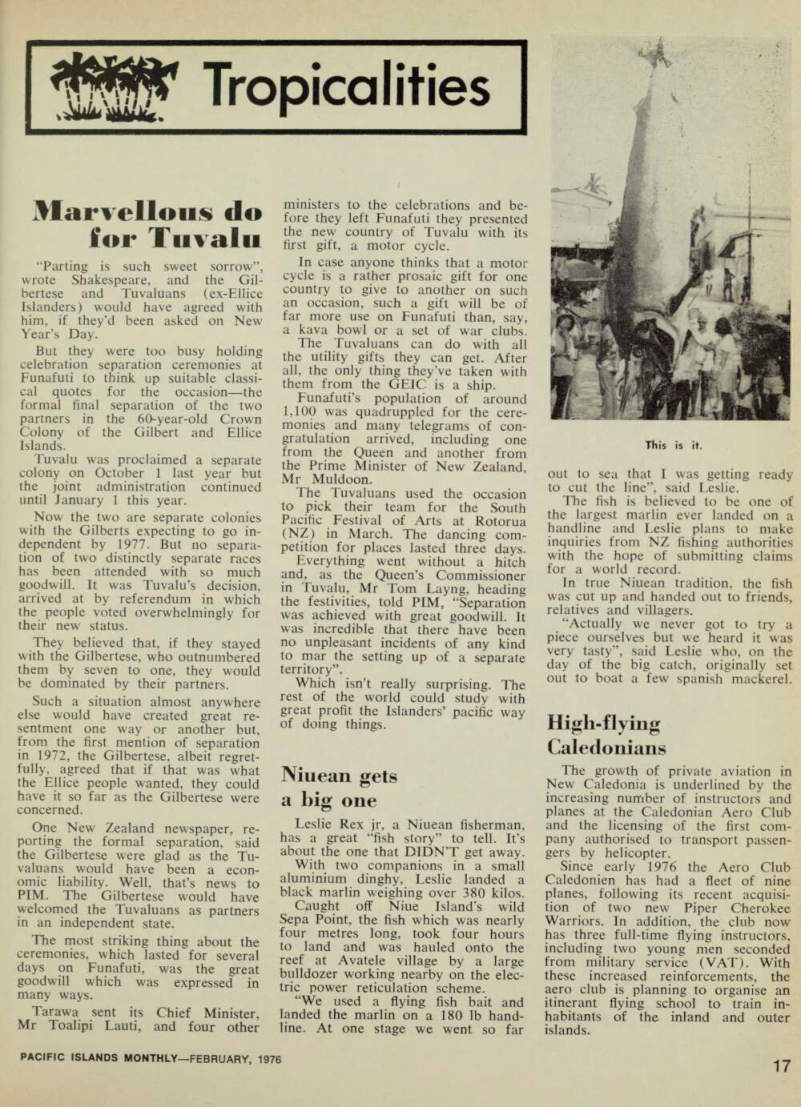
a big one Leslie Rex jr, a Niuean fisherman, has a great “fish story” to tell. It’s about the one that DIDN’T get away.
With two companions in a small aluminium dinghy, Leslie landed a black marlin weighing over 380 kilos.
Caught off Niue Island’s wild Sepa Point, the fish which was nearly four metres long, took four hours to land and was hauled onto the reef at Avatele village by a large bulldozer working nearby on the elec tric power reticulation scheme.
“We used a flying fish bait and landed the marlin on a 180 lb hand line. At one stage we went so far
out to sea that I was getting ready to cut the line”, said Leslie.
The fish is believed to be one of the largest marlin ever landed on a handline and Leslie plans to make inquiries from NZ fishing authorities with the hope of submitting claims for a world record.
In true Niuean tradition, the fish was cut up and handed out to friends, relatives and villagers.
“Actually we never got to try a piece ourselves but we heard it was very tasty”, said Leslie who, on the day of the big catch, originally set out to boat a few Spanish mackerel.
High-flying
Caledonians
The growth of private aviation in New Caledonia is underlined by the increasing number of instructors and planes at the Caledonian Aero Club and the licensing of the first com pany authorised to transport passen gers by helicopter.
Since early 1976 the Aero Club Caledonien has had a fleet of nine planes, following its recent acquisi tion of two new Piper Cherokee Warriors. In addition, the club now has three full-time flying instructors, including two young men seconded from military service (VAT). With these increased reinforcements, the aero club is planning to organise an itinerant flying school to train in habitants of the inland and outer islands.
This is it.
At the last official count in early 1975, New Caledonia had 10 planes registered locally for public transport, three for the armed forces, two for the gendarmerie as well as six private helicopters and 43 private planes.
Meanwhile, the first company licensed to transport passengers by helicopter is Air Noumea, operating a French Alouette (“skylark”) helicopter. Air Noumea is owned by well-known Caledonian mining per sonality Mr Jean-Claude Berton.
They’re running
round Tahiti
While Caledonians are keen to challenge overseas sportsmen to their annual races around the island by bicycle or rally car, the Tahitians have now set the pace with a round the-island foot race.
The lead was given by solitary marathon runners from the French gendarmerie and Foreign Legion.
Then, in December, a relay team, the 31 “Bureaucrates” of the Nuclear Test Centre (CEP) ran the route of 116 kilometres (72 miles) in 8 hours 58 minutes, making an average speed of 12.88 km/hour (8 mph).
The problem of
changing history
PIM has a new frontispiece map this issue, but only to keep up with the changing Pacific.
Since Independence, Papua New Guinea is one nation, with no dotted line down its central mountain chain to distinguish the old Papua from the old New Guinea. And, of course, the Gilbert & Ellice Islands Colony has now been split into the Gilbert Islands and Tuvalu. Another recent change has been the name of the British Solomon Islands Protectorate, which is now simply the Solomon Islands. And a change to come soon is in the Marianas, currently part of the Trust Territory of the Pacific Islands, but to have a separate identity.
Although PIM usually manages to keep up editorially with the changes, unfortunately the office system which puts the addresses on our subscriber copies doesn’t. PIM circulation department has always used stencils to label envelopes, and some of these stencils still show addresses in the “GEIC”, the “BSIP” or simply “New Guinea”.
One of our PNG subscribers wrote
during the month that he was still getting his copy addressed to “TPNG” (meaning the Territory of Papua and New Guinea) and although he “enjoyed the magazine very much and have never regretted taking out a subscription”, he’s greatly surprised to see PNG still addressed as a territory. Our apolo gies to this reader and hundreds of others in PNG, the Solomons, the Gilberts and Tuvalu, but we have been aware of the problem, and re lief is now at hand!
It costs money to change stencils, but we haven’t changed them because all our stencils are being discarded and in the next couple of months we are going on computer. Our com puter will get it right (so they keep telling us!) And, before we get any more let ters—yes, we do realise that the front cover of PIM still refers to the GEIC, but this is the last issue on which you will find that.
Footnote: We are relieved to see the people who design stamps share our problems. We’ve just received the latest GEIC definitives—or what presumably were designed to be GEIC definitives.
The set shows various Island
activities, such as fishing coconut dehusking, and copra loading, but in each case the Gilbert & Ellice Islands name has been blocked out and replaced with a Gilbert Islands overprint. The method of blocking out will create the interest, as the printers have used at different times red, black and gold—but with vary ing results! Mostly the red doesn’t do the job effectively, usually the black destroys the whole design of the stamp, and the gold overprint (on the 35c stamp) can’t even be seen unless the stamp is held to the light in a particular way.
We can only imagine that both the designers and the printers are tearing their hair; although collectors perhaps will be happy at these oddi ties forced on the world by changing Pacific history.
Details of the stamps are: 1c (cut ting toddy), 2c (lagoon fishing), 3c (cleaning pandanus leaves), 4c (casting nets), 5c (Gilbertese canoe), 6c (dehusking coconuts), 8c (weav ing pandanus fronds), 10c (weaving a basket), 15c (tiger shark and fishermen), 20c (beating a rolled pandanus leaf), 25c (loading copra), 35c (fishing at night), 50c (local handicrafts), and $1 (weaving a coconut screen).
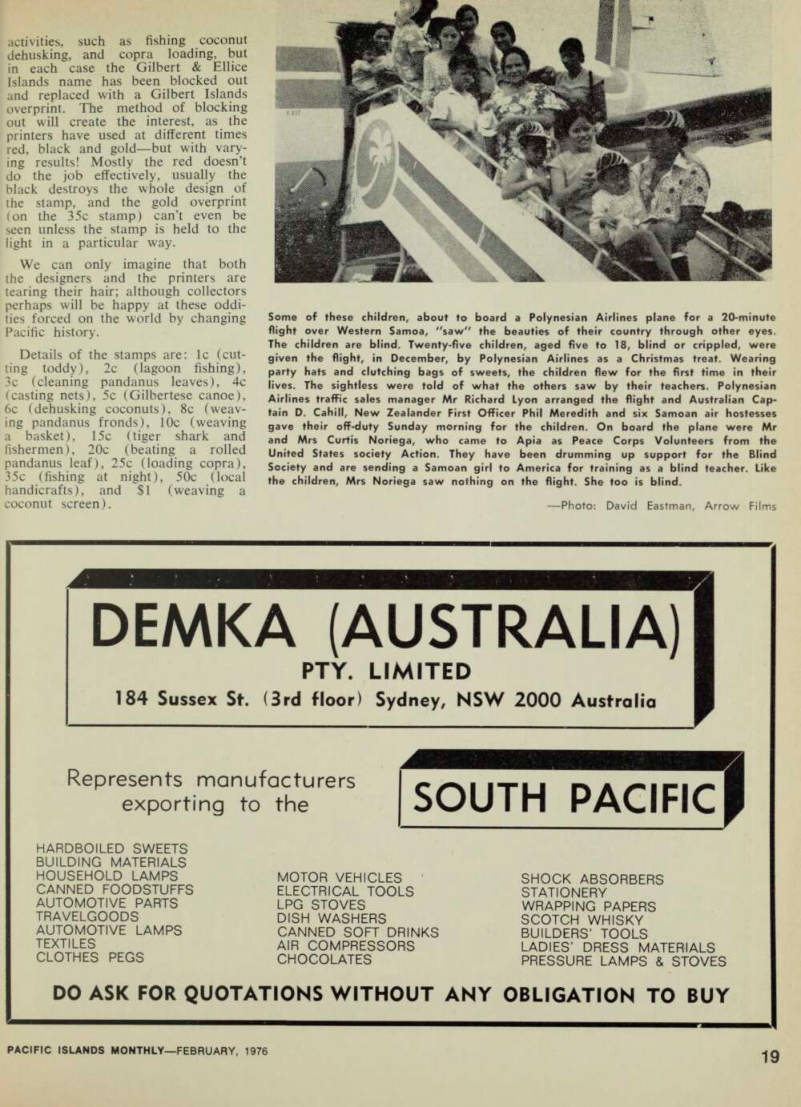
Some of these children, about to board a Polynesian Airlines plane for a 20-minute flight over Western Samoa, "saw" the beauties of their country through other eyes.
The children are blind. Twenty-five children, aged five to 18, blind or crippled, were given the flight, in December, by Polynesian Airlines as a Christmas treat. Wearing party hats and clutching bags of sweets, the children flew for the first time in their lives. The sightless were told of what the others saw by their teachers. Polynesian Airlines traffic sales manager Mr Richard Lyon arranged the flight and Australian Cap tain D. Cahill, New Zealander First Officer Phil Meredith and six Samoan air hostesses gave their off-duty Sunday morning for the children. On board the plane were Mr and Mrs Curtis Noriega, who came to Apia as Peace Corps Volunteers from the United States society Action. They have been drumming up support for the Blind Society and are sending a Samoan girl to America for training as a blind teacher. Like the children, Mrs Noriega saw nothing on the flight. She too is blind.
Photo: David Eastman, Arrow Films