Happy Self-Government Day
p. 16 · Read in the full issue
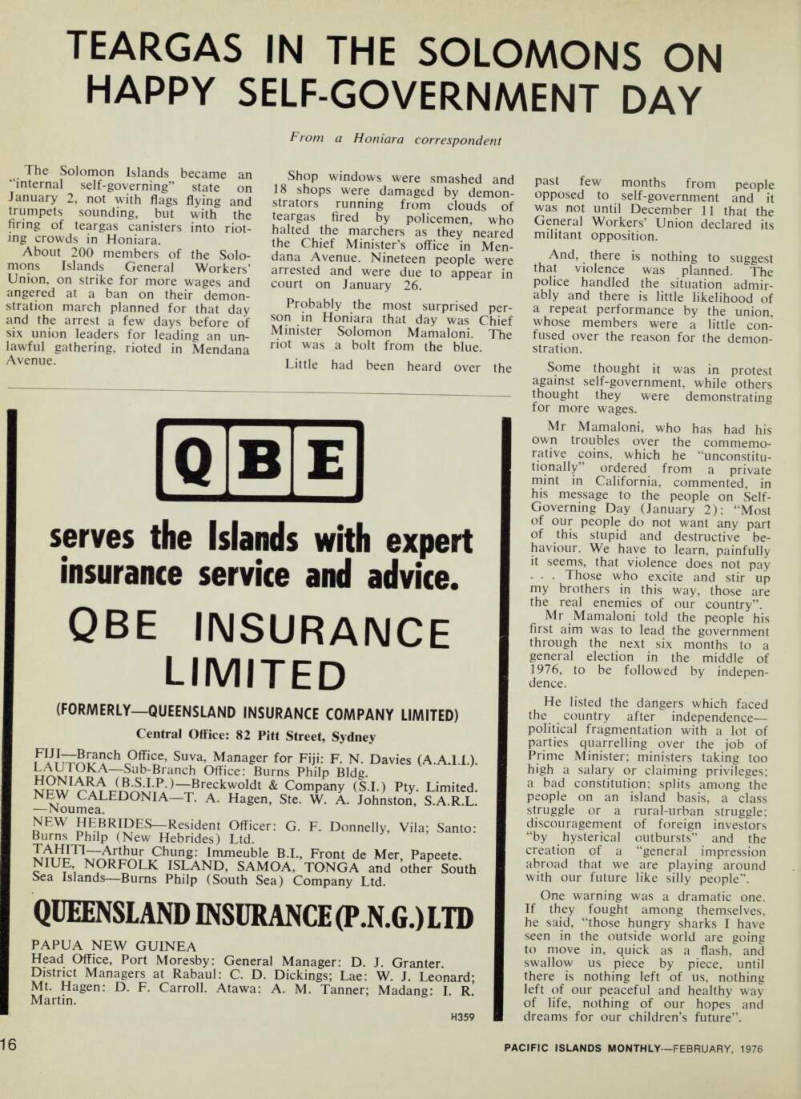
Teargas In The Solomons On
From a Honiara correspondent
The Solomon Islands became an “internal self-governing” state on January 2, not with flags flying and trumpets sounding, but with the firing of teargas canisters into riot ing crowds in Honiara.
About 200 members of the Solo mons Islands General Workers’
Union, on strike for more wages and angered at a ban on their demon stration march planned for that day and the arrest a few days before of six union leaders for leading an un lawful gathering, rioted in Mendana Avenue.
Shop windows were smashed and 18 shops were damaged by demon strators running from clouds of teargas fired by policemen, who halted the marchers as they neared the Chief Minister’s office in Men dana Avenue. Nineteen people were arrested and were due to appear in court on January 26.
Probably the most surprised per son in Honiara that day was Chief Minister Solomon Mamaloni. The riot was a bolt from the blue.
Little had been heard over the
past few months from people opposed to self-government and it was not until December 11 that the General Workers’ Union declared its militant opposition.
And, there is nothing to suggest that violence was planned. The police handled the situation admir ably and there is little likelihood of a repeat performance by the union, whose members were a little con fused over the reason for the demon stration.
Some thought it was in protest against self-government, while others thought they were demonstrating for more wages.
Mr Mamaloni, who has had his own troubles over the commemo rative coins, which he “unconstitu tionally” ordered from a private mint in California, commented, in his message to the people on Self- Governing Day (January 2): “Most of our people do not want any part of this stupid and destructive be haviour. We have to learn, painfully it seems, that violence does not pay . . . Those who excite and stir up my brothers in this way, those are the real enemies of our country”.
Mr Mamaloni told the people his first aim was to lead the government through the next six months to a general election in the middle of 1976, to be followed by indepen dence.
He listed the dangers which faced the country after independence— political fragmentation with a lot of parties quarrelling over the job of Prime Minister; ministers taking too high a salary or claiming privileges; a bad constitution; splits among the people on an island basis, a class struggle or a rural-urban struggle; discouragement of foreign investors “by hysterical outbursts” and the creation of a “general impression abroad that we are playing around with our future like silly people”.
One warning was a dramatic one.
If they fought among themselves, he said, “those hungry sharks I have seen in the outside world are going to move in, quick as a flash, and swallow us piece by piece, until there is nothing left of us, nothing left of our peaceful and healthy way of life, nothing of our hopes and dreams for our children’s future”.