Micronesia,
pp. 10-11 · Read in the full issue
bastion of US strategy
From Pamela G. Hollie
in Saipan The United State’s experience i south-east Asia has made it increas ingly apparent that Micronesia’ strategic position is of utmost im portance to the American military.
Should the US be threatened i: the western Pacific, “the Trust Terri tory would become important over night”, says Rear Admiral Ken Carroll, commander of Naval Forces Marianas. “The buildup would b tremendous”.
It appears that Micronesia, th Trust Territory of the Pacific Islands is the best possible position fron which the US could operate wit) relative freedom in the Pacific. Tb US has held the 2,100 islands as ; “strategic trust” under a Unite* Nations Trusteeship Agreement sine 1947.
Still, large military bases—nov in the planning stages—are new t< Micronesia. For 28 years, militar buildup has only been a possibility not a reality. Except for isolate* testing on some islands in the Mar shalls and a Central Intelligenc* Agency headquarters on Saipan it the Marianas, the US has concen trated its military might on Guam its “bastion of power in the Pacific”
Guam, an American possessioi since 1898, is a huge military installa tion. The military now makes ui one-fourth of the island’s 115,00 C population and contributes ovei SUSI7S million to the island’: economy.
“The fall of South-east Asia, oui pullout of Thailand, the detente witl China and the subsequent weakening of ties with Taiwan, will cause Guarr to become more important with eacl passing day”, Carroll says.
In terms of military activity, he says, Guam comes first, then Tiniar (Marianas) and third Babelthuap (Palau).
The Marianas, which last June voted overwhelmingly to become a US commonwealth, based nego tiations for commonwealth status on the islands’ military potential. The US already holds about 90 per cent of the land on the 14 islands of the Marianas.
In the covenant establishing the commonwealth, the US obtained rights to nearly two-thirds of Tinian,
about 17,800 acres. The KKLyear lease will cost the US $17.5 million a year, or about $9.83 per acre for the next 100 years. Also included in the land arrangement are 177 acres at Saipan’s harbour for $2 million and 206 acres on Farallon de Medi nilla. In effect, the US got the whole island for $20,600.
The military’s plans for Tinian are to build a supply base, ammunition storage deport and a Marine amphi bious training site. Tinian would be an “interior position”—what mili tary strategists call a securely American-held island territory.
While there is a counter campaign against those who oppose the pro posed new commonwealth of the Marianas on the grounds that it will be a “military colony”, the fact re mains that without the military’s interest in the Marianas, the islands probably would not have been able to enter into separate negotiations with the United States.
With Tinian pretty well secured, the third “fallback” position in Micronesia is expected to be Palau’s largest island, Babelthuap. But, in the case of Palau, negotiations for the nearly 32,000 acres for the military have not yet begun. The military has tentative plans for an intermittent ground force training and manoeuvres installation and a submarine base.
The military also wants joint use of Palau’s airport.
Like the Marianas, Palau has asked for separate negotiations with the US, but unlike their neighbours to the north, Palau hasn’t decided what status it wants. Yet one thing
is certain; after watching the Mari anas’ problems with their covenant, Palau would be expected to drive a harder bargain for its land.
Although the US has not said yes or no to Palau’s request for separate political status talks, the district is confident that the military’s interest in Palau will put the district in a strong bargaining position.
While there is also some opposi tion in Micronesia to the military, specifically to the use of Micronesian lands to dispose of dangerous wastes or to test nuclear weapons, “there
is an appeal”, says Johnson Tori biong, a freshman legislator and floor leader of the Palau district legislature.
“A small country with undeveloped resources will always see the military base as a means of bringing money into the area”.
But, he fears that the US will slowly take over more and more of Micronesia for military purposes.
“There’s that nagging feeling that we’re (Palau) being surrounded . . . first they took Bikini, then Kwajalein, Guam, the Marianas and now we see helicopters”.
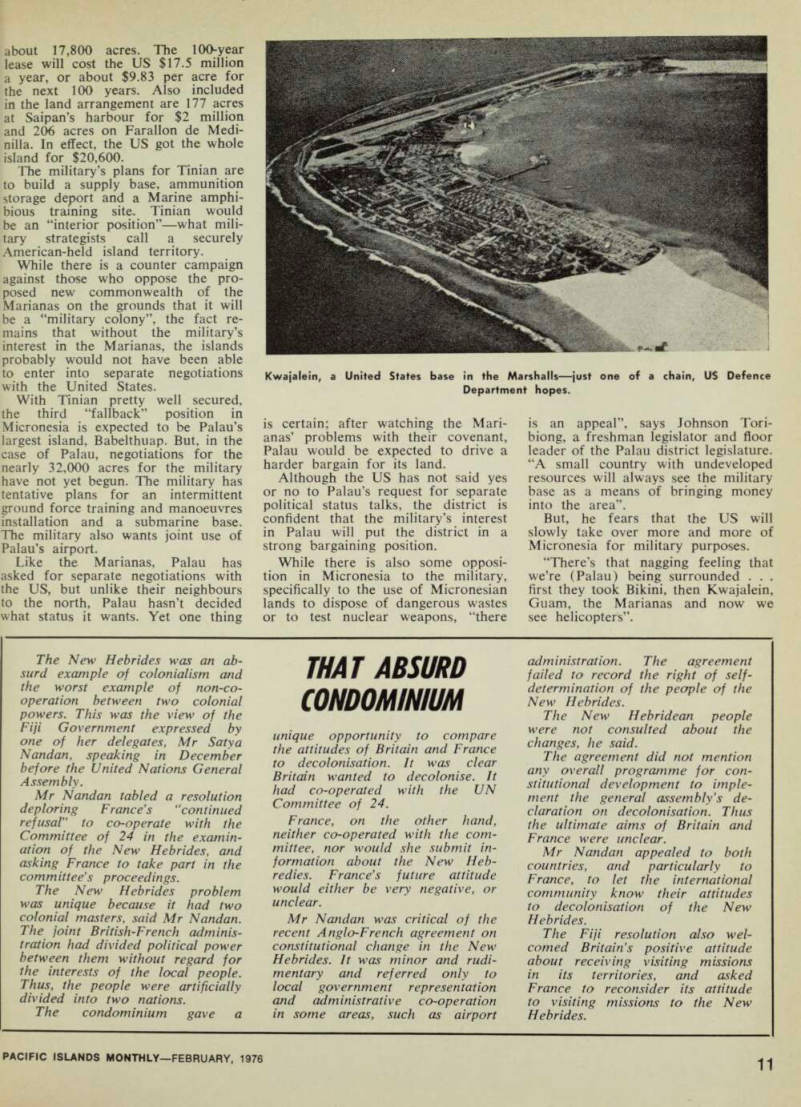
Kwajalein, a United States base in the Marshalls —just one of a chain, US Defence Department hopes.