that counts
pp. 9-10 · Read in the full issue
In PNG it's who you are that counts
From Lee Mckenzie
in Port Moresby In PNG, the UN’s 142nd member, it’s who you are that counts—lt always was in the old colonial days of strict delineation between the races. Inevitably, these historic over tones have coloured PNG’s Citizen ship Act.
At best, the firm constitutional measures could safeguard the minori ties from incurring blame in any hard times ahead in the near future.
The worst aspect is seen by some, as discriminatory legislation to en sure that only the select few gain full citizenship and share its exclusive rights.
Although Mr Somare, with the support of moderates, who share his desire for a multi-racial nation, was able to water down the so-called racist doctrines of constitutional planners. John Kaputin and John Momis, critics contend that the act is vaguely defined and ambiguous. It could be argued that a degree of equivocation resulted from the hasty drafting of PNG’s massive Con stitution. Equally there could be a degree of intentional leeway.
The radical view was to alienate all expatriates, Chinese and mixed race peoples from citizenship rights.
This would provide the means to eradicate their dominance in banking, commerce, industry and politics.
The House of Assembly accepted the legislation for a National Invest ment and Development Authority to regulate foreign business, and other trading laws in the making, as ade quate means of giving indigenous entrepreneurs a headstart. There have been murmurings of dissatis faction (from the conservative poli ticians) with NIDA of late as “frightening” away overseas interests.
The idea of dual citizenship for foreigners was discarded as a foot in-both-camps evasion. An amend ment to the act allowing for auto matic citizens only to stand for elec tion was defeated in the House, on the grounds that the ballot box and not politicians should choose the people’s representatives. Nine MPs must relinquish their candidacies un less they have applied and been
accepted by the Citizenship Advisory Committee.
The requirements for “full” status are highly selective.
The applicant must be native-born and count two grandparents born in PNG, renounce foreign citizenship rights and make a declaration of loyalty.
“Automatic” citizens are those born in PNG, Torres Strait Islands, Irian Jaya or the Solomons who don’t hold an Australian “right to residence” or similar privilege. They are guaranteed all rights within the Constitution, can vote, stand for public office, enter the Public Service and get PNG protection when travel ling abroad. Whereas, a non-citizen is ineligible for these rights but may be permitted to remain in the coun try.
This last clause indicates that the technique of “putting ’em on the next plane South”, favoured by the pre vious Australian administration for those who ran foul of the authorities, may remain useful.
Two recent deportations serve as a warning. After long and valued service to public health, Dr Eric Wright was ordered to leave on the eve of Independence. He actively supported MHA Josephine Abaijah in her Declaration of Independence for Papua.
Straight after Independence, Mr Michael Worsley, a business consult ant employed by the government was arrested and deported. He had de fied the court order and gone into hiding for three weeks “to help a business associate”.
It is assumed that this was John Kasaipwalova, the Trobriand Islands activist. He may well ponder over such advice as he nurses his costly
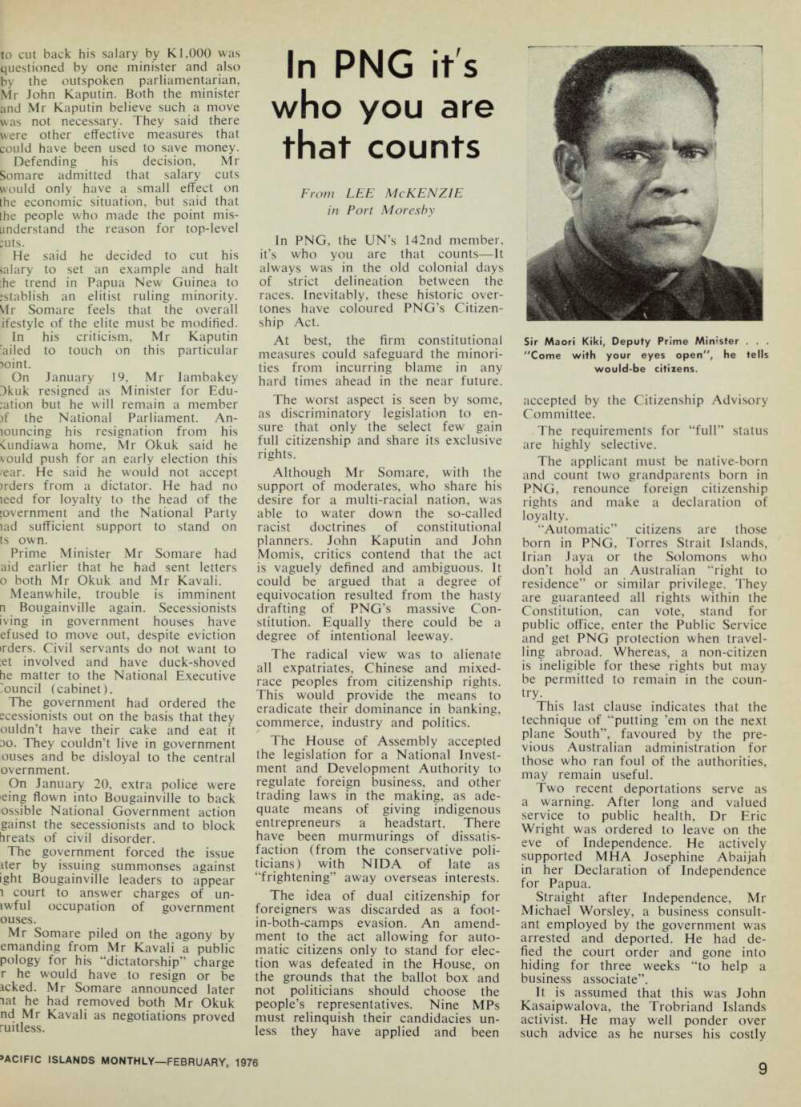
Sir Maori Kiki, Deputy Prime Minister . . .
"Come with your eyes open", he tells would-be citizens.
telex and computer, the manifest ations of his dream. He has tried to establish a PNG commodities exchange despite denials of its feasi bility by senior Treasury officials and others.
Mr Worsley’s conduct was the sub ject of a Public Service Board enquiry. Rumoured, but never re vealed were his investigations into foreign business links with national leaders.
While they won’t tolerate meddle some foreigners, ministers are sen sitive to the administrative burden and publicity of the law courts. At this stage of provincial dissidence, a deportation order attracts the mini mum of fuss.
For those remaining, there is a “halfway” person who wants to stay for life. Provided he or she won’t need “the dole”, has lived continu ously in the country for eight years without a break of less than two years, can speak the vernacular— Pidgin or Hiri Motu or possibly one of the many languages of the 20 districts AND is armed with charac ter references from nationals, shows respect for their customs and cul ture, THEN the applicant will be considered for naturalisation.
Citizenship is an individual issue.
Spouses and offspring are dealt with separately. Children may wait and choose for themselves upon reaching voting age of 18.
The label “second class” is de rived from the economic restrictions placed on this minority category.
One proviso is that, if their land is acquired by the government in the first five years of citizenship, they won’t be granted the constitutional right to just compensation. Nor will they necessarily enjoy the special benefits legally provided to “full” citizens, for the next 10 years. After these two transitional periods, they are promised equal rights, excepting membership of the Citizenship Advisory Committee. PNG’s Land Acquisition Bill overrides the Bill of Rights.
The Associated Chambers of Com merce of PNG protested.
“Very few of our members are prepared to forfeit their existing citizenship for one that does not comply with the Bill of Rights. But we hope that the government, with the wisdom it has shown in the past, will rectify the mistakes and remove the obvious inequalities”, they piously pleaded.
Sir Maori Kiki, the Deputy Prime Minister, dashed their hopes. He cited the Cocoa Industry Act, the Coffee Dealing Act and the future
Crocodile Protection Act as res tricted practices, which, in general, would be closed to foreigners and naturalised citizens, in proscribed areas of the nation. They are already barred from buying shares in over seas enterprises through the PNG Investment Corporation and addi tional laws could be enacted in the next decade to provide privileges exclusively to automatic citizens, he warned. But he stressed that suitable applicants, though warmly welcomed, should come in with their eyes open.
The 2,000 Chinese, in a population close to three million, are prominent traders. Most are Australia-oriented through education and relatives and are apprehensive. They resent having to ask for acceptance in the land of their birth as they were never colonial rulers.
Few of the 3i thousand of mixed race descent have taken steps to be naturalised. Government officers organised elucidatorv meetings in urban centres with little response. It has been said that those with Aus tralian right of residence for them selves or their children are well aware of their status and loth to part with it. They can now apply up to January in a diplomatic time extension.
The committee is processing the 500-odd potential Papua New Guineans and among the first to apply were the Sneaker of Parlia ment, Barrv Hollowav and the Transport, Works and Supply Minis ter, Bruce Jephcott.
Australian public servants who are leaving PNG do so under an earlv retirements benefit scheme funded by Canberra. Overseas recruiting, cut bv 75 per cent in the 75-76 Budget, is on wholly contract basis with varying terms.
Departure has long been a painful choice. It has been the pattern, how ever. Eventual retirement in the country of origin has been standard even for the most durable. The exceptions have been, mostly, mis sionaries and planters, committed for life to souls and soil.
At Port Moresby’s airport, a young couple and baby head stolidly throueh the wire-mesh walkway, to the southbound plane.
As thev appear, a Papuan woman thrusts herself against the barrier wailing and striking her face in grief. A tenuous immediate future has overcome the strongest ties.
The self-determination of a nation emerging from a colonial past, plus escalating airfares, may mean a mother’s final glimpse of her daughter, foreign son-in-law and half-and-half grandchild.