Books, Reviews, writers
pp. 55-57 · Read in the full issue
A Shadowy Russian In
Unknown New Guinea
On a September day in 1871 a mall corvette, half the world away rom its home base, pulled in close o the southern point of Astrolabe Jay, on the dark, New Guinea main and and landed three men, one ’olynesian and two Europeans. The *olynesian, who was soon to suc umb to the vicious malaria of this oast, fades into New Guinea history imply as Boy; one of the Europeans vas named Ohlsen, a stranded Iwedish sailor off a whaler, or a •eachcomber, picked up in Samoa.
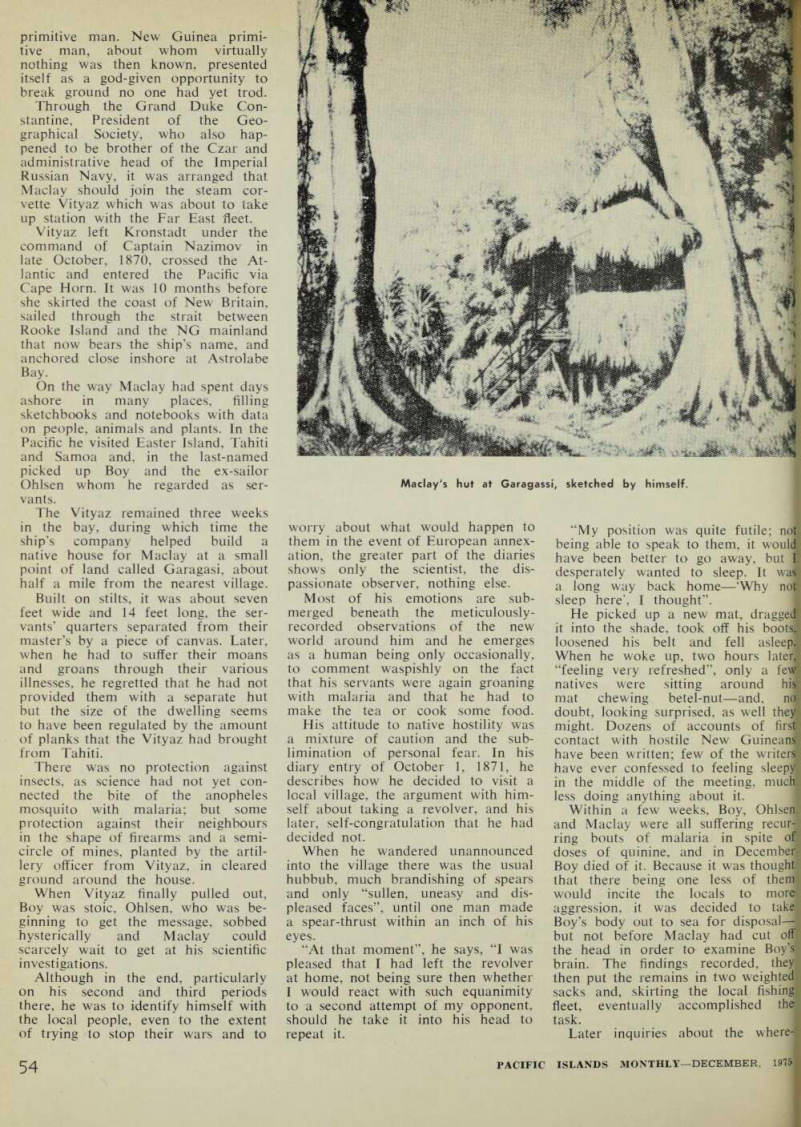
Tie third man was Nikolai Niko aevich Mikloucho-Maclay, eccentric Russian scientist who proposed to stablish himself in this unknown and in order to study the local flora nd human fauna.
Up to 70 years later he would ave been regarded as a nut and robably have been warned off by he District Officer, Madang.
But there were no DO’s in Ma ang in 1871, then little but an un sed harbour, a point on the eriphery of what was later to be otoriously known as the Rai coast, corruption of Maclay’s name. To le south-east, the land rose from astrolabe Bay in a series of 1,000 ft traces before the uplands faded ack into the cloud-draped Finisterre lt was a region peopled by erce tribesmen whose mini wars nd vendettas were interminable, who 'ent on resenting intruders even into ic late 19305, capable of giving any overnment patrol a hot reception.
In 1871, German annexation and stablishment of their first adminis ative centre at Madang was still 13 ears away; Rabaul, much more ccessible and less forbidding, on lew Britain, was still to wait half dozen years for its first traders to it up shop. So why this young Russian, who hitherto had been more oncerned with investigating the life tyle of sponges on the bottom of the :ed Sea, should choose to isolate imself on the forbidding coast of nknown New Guinea, has always een something of a mystery. At the ime time, the man himself, although
well known enough by name, has re mained a shadowy figure, obscured by time, world and Russian events of the past 100 years.
Light on the mystery and flesh on the bones of the shadowy figure of Maclay have now been supplied by the first English translation of the diaries which he kept in the three periods he spent on the Astrolabe Coast between 1871 and 1883.
The translation has been made by Mr C. L. Sentinella, of Sydney, who has also provided fore, aft and con necting chapters. As a result Mikloucho-Maclay: New Guinea Diaries, 1871-1883 becomes a book that is not only very readable but throws some new light on the inter national scrambling that went on be fore German annexation of New Guinea in 1884.
Although Maclay was a patriot to the end of his life, he spent more time out of Russia than in it and, in total, eight years of his voluntary exile in Sydney, NSW, where he married Margaret, the daughter of a former Premier of NSW, Sir John Robertson.
She accompanied him on his final return to Russia where he died, worn out at 42, in April, 1888. He left her virtually penniless, as he himself had been most of his life, but the Czarina befriended her, arranged for her to return to Australia with her two small sons and for a pension to be paid to her there. It continued until the Russian revolution of 1917.
Maclay’s direct descendants were, therefore, Australians and probably the reason why, towards the end of World War 11, when Russia and New Guinea were both news, Frank Greenop, a Sydney journalist, wrote a book about Maclay’s New Guinea experiences (Who Travels Alone).
It is likely that it was this book that stirred the Russians who had allowed the Maclay diaries to lie buried for over 50 years, and why, in the 19505, the Russian Academy of Sciences published some of Maclay’s scientific material and included the diaries with them. A copy of these publications
was later obtained by one of Mac lay’s grandsons in Sydney who ap proached Mr Sentinella to undertake the job of translation into English.
Sentinella became fascinated by the background of the story, went to Astrolabe Bay himself to look at the place where it happened, and in Madang came into contact with Kristen Press Inc, the printing/pub lishing offshoot of the Lutheran Mission which was anxious to pub lish the book.
The circle was complete—Rai Coast back to Rai Coast in the mat ter of 100 years. It is probably fitting that it is descendants of the men, whom Maclay called savages when he first saw them on the beach, wav ing him off with their spears, who have had a large hand in producing this first, full English account of his years in New Guinea.
In the late 1860 s Maclay had gone to the Russian Geographic Society with a plan to visit the Pacific. At that time he was interested in marine biology but by the time the society had given reluctant sponsorship and 1,200 roubles towards the project, Maclay’s interest had switched to
Nikolai Nikolaevich Mikloucho-Maclay
primitive man. New Guinea primi tive man, about whom virtually nothing was then known, presented itself as a god-given opportunity to break ground no one had yet trod.
Through the Grand Duke Con stantine, President of the Geo graphical Society, who also hap pened to be brother of the Czar and administrative head of the Imperial Russian Navy, it was arranged that Maclay should join the steam cor vette Vityaz which was about to take up station with the Far East fleet.
Vityaz left Kronstadt under the command of Captain Nazimov in late October, 1870, crossed the At lantic and entered the Pacific via Cape Horn. It was 10 months before she skirted the coast of New Britain, sailed through the strait between Rooke Island and the NG mainland that now bears the ship’s name, and anchored close inshore at Astrolabe Bay.
On the way Maclay had spent days ashore in many places, filling sketchbooks and notebooks with data on people, animals and plants. In the Pacific he visited Easter Island, Tahiti and Samoa and, in the last-named picked up Boy and the ex-sailor Ohlsen whom he regarded as ser vants.
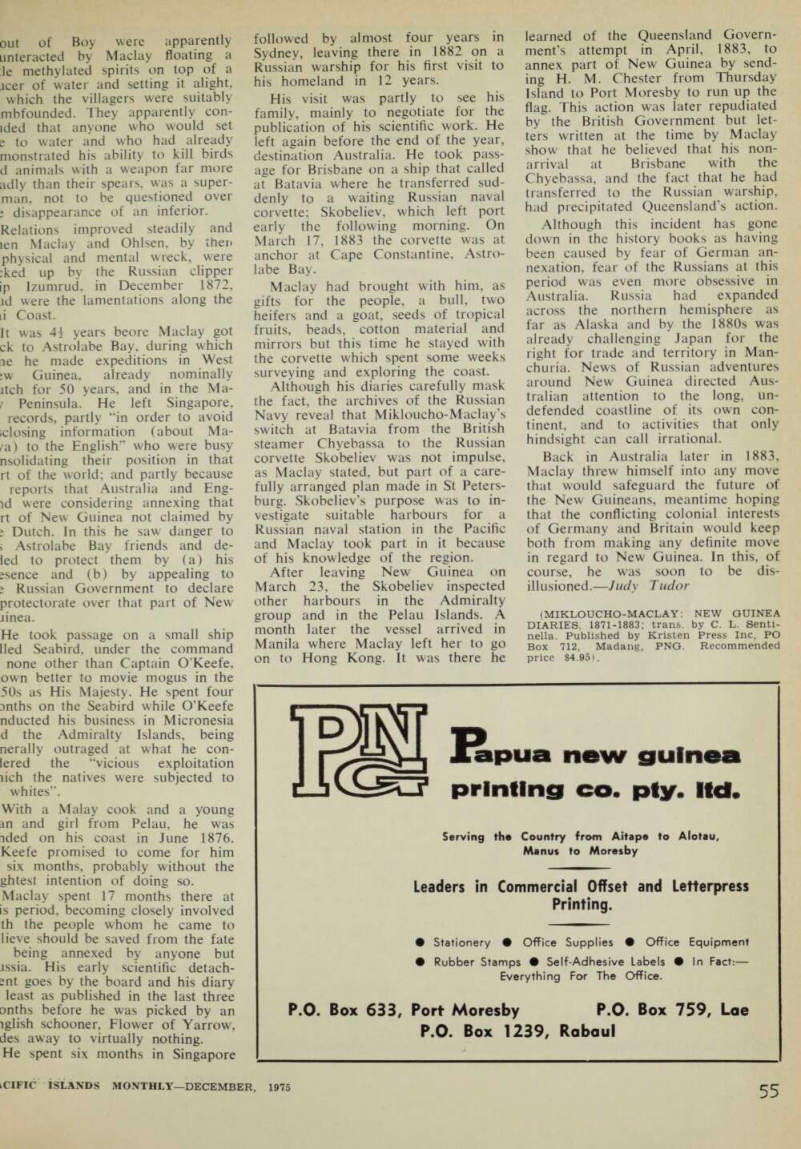
The Vityaz remained three weeks in the bay, during which time the ship’s company helped build a native house for Maclay at a small point of land called Garagasi, about half a mile from the nearest village.
Built on stilts, it was about seven feet wide and 14 feet long, the ser vants’ quarters separated from their master’s by a piece of canvas. Later, when he had to suffer their moans and groans through their various illnesses, he regretted that he had not provided them with a separate hut but the size of the dwelling seems to have been regulated by the amount of planks that the Vityaz had brought from Tahiti.
There was no protection against insects, as science had not yet con nected the bite of the anopheles mosquito with malaria; but some protection against their neighbours in the shape of firearms and a semi circle of mines, planted by the artil lery officer from Vityaz, in cleared ground around the house.
When Vityaz finally pulled out, Boy was stoic, Ohlsen, who was be ginning to get the message, sobbed hysterically and Maclay could scarcely wait to get at his scientific
investigations.
Although in the end, particularly on his second and third periods there, he was to identify himself with the local people, even to the extent of trying to stop their wars and to
worry about what would happen to them in the event of European annex ation, the greater part of the diaries shows only the scientist, the dis passionate observer, nothing else.
Most of his emotions are sub merged beneath the meticulously recorded observations of the new world around him and he emerges as a human being only occasionally, to comment waspishly on the fact that his servants were again groaning with malaria and that he had to make the tea or cook some food.
His attitude to native hostility was a mixture of caution and the sub limination of personal fear. In his diary entry of October 1, 1871, he describes how he decided to visit a local village, the argument with him self about taking a revolver, and his later, self-congratulation that he had decided not.
When he wandered unannounced into the village there was the usual hubbub, much brandishing of spears and only “sullen, uneasy and dis pleased faces”, until one man made a spear-thrust within an inch of his eyes.
“At that moment”, he says, “I was pleased that I had left the revolver at home, not being sure then whether I would react with such equanimity to a second attempt of my opponent, should he take it into his head to repeat it.
“My position was quite futile; not being able to speak to them, it would have been better to go away, but I desperately wanted to sleep. It wal a long way back home—‘Why not sleep here', I thought”.
He picked up a new mat, draggeJ it into the shade, took off his boots, loosened his belt and fell asleepl When he woke up, two hours lateil “feeling very refreshed”, only a few natives were sitting around his mat chewing betel-nut—and. no doubt, looking surprised, as well the)l might. Dozens of accounts of firsa contact with hostile New Guineans have been written; few of the writers have ever confessed to feeling sleepy in the middle of the meeting, much; less doing anything about it.
Within a few weeks, Boy, Ohlserl and Maclay were all suffering recurj ring bouts of malaria in spite of doses of quinine, and in December Boy died of it. Because it was thought; that there being one less of them would incite the locals to morel aggression, it was decided to take I Boy’s body out to sea for disposal—-! but not before Maclay had cut off the head in order to examine Boy’s! brain. The findings recorded, they,; then put the remains in two weighted sacks and, skirting the local fishing! fleet, eventually accomplished the task.
Later inquiries about the where-i
Maclay's hut at Garagassi, sketched by himself.
out of Boy were apparently (interacted by Maclay floating a le methylated spirits on top of a acer of water and setting it alight, which the villagers were suitably mbfounded. They apparently con ided that anyone who would set z to water and who had already monstrated his ability to kill birds d animals with a weapon far more adly than their spears, was a super man, not to be questioned over ; disappearance of an inferior.
Relations improved steadily and len Maclay and Ohlsen, by then physical and mental wreck, were :ked up by the Russian clipper ip Izumrud, in December 1872, id were the lamentations along the li Coast.
It was 4i years beore Maclay got ck to Astrolabe Bay, during which ne he made expeditions in West ;w Guinea, already nominally itch for 50 years, and in the Ma r Peninsula. He left Singapore, records, partly “in order to avoid (closing information (about Mato the English” who were busy nsolidating their position in that rt of the world; and partly because reports that Australia and Eng id were considering annexing that rt of New Guinea not claimed by ; Dutch. In this he saw danger to i Astrolabe Bay friends and de led to protect them by (a) his ssence and (b) by appealing to i Russian Government to declare protectorate over that part of New jinea.
He took passage on a small ship lied Seabird, under the command none other than Captain O’Keefe, own better to movie mogus in the 50s as His Majesty. He spent four Dnths on the Seabird while O’Keefe nducted his business in Micronesia d the Admiralty Islands, being nerally outraged at what he con lered the “vicious exploitation lich the natives were subjected to whites”.
With a Malay cook and a young an and girl from Pelau, he was ided on his coast in June 1876.
Keefe promised to come for him six months, probably without the ghtest intention of doing so.
Maclay spent 17 months there at is period, becoming closely involved th the people whom he came to lieve should be saved from the fate being annexed by anyone but assia. His early scientific detach snt goes by the board and his diary least as published in the last three □nths before he was picked by an iglish schooner, Flower of Yarrow, des away to virtually nothing.
He spent six months in Singapore
followed by almost four years in Sydney, leaving there in 1882 on a Russian warship for his first visit to his homeland in 12 years.
His visit was partly to see his family, mainly to negotiate for the publication of his scientific work. He left again before the end of the year, destination Australia. He took passage for Brisbane on a ship that called at Batavia where he transferred suddenly to a waiting Russian naval corvette; Skobeliev, which left port early the following morning. On March 17, 1883 the corvette was at anchor at Cape Constantine, Astrolabe Bay.
Maclay had brought with him, as gifts for the people, a bull, two heifers and a goat, seeds of tropical fruits, beads, cotton material and mirrors but this time he stayed with the corvette which spent some weeks surveying and exploring the coast.
Although his diaries carefully mask the fact, the archives of the Russian Navy reveal that Mikloucho-Maclay’s switch at Batavia from the British steamer Chyebassa to the Russian corvette Skobeliev was not impulse, as Maclay stated, but part of a carefully arranged plan made in St Petersburg. Skobeliev’s purpose was to investigate suitable harbours for a Russian naval station in the Pacific and Maclay took part in it because of his knowledge of the region.
After leaving New Guinea on March 23, the Skobeliev inspected other harbours in the Admiralty group and in the Pelau Islands. A month later the vessel arrived in monm later me vessel arrived in Manila where Maclay left her to go on to Hong Kong. It was there he
learned of the Queensland Govern ment’s attempt in April, 1883, to annex part of New Guinea by send ing H. M. Chester from Thursday Island to Port Moresby to run up the flag. This action was later repudiated by the British Government but let ters written at the time by Maclay show that he believed that his non arrival at Brisbane with the Chyebassa, and the fact that he had transferred to the Russian warship,
had precipitated Queensland’s action.
Although this incident has gone down in the history books as having been caused by fear of German an nexation, fear of the Russians at this period was even more obsessive in Australia. Russia had expanded across the northern hemisphere as far as Alaska and by the 1880 s was already challenging Japan for the right for trade and territory in Man churia. News of Russian adventures around New Guinea directed Aus tralian attention to the long, un defended coastline of its own con tinent, and to activities that only hindsight can call irrational.
Back in Australia later in 1883, Maclay threw himself into any move that would safeguard the future of the New Guineans, meantime hoping that the conflicting colonial interests of Germany and Britain would keep both from making any definite move in regard to New Guinea. In this, of course, he was soon to be dis
illusioned.
Judy Tudor
(Mikloucho-maclay: new guinea DIARIES. 1871-1883; trans. by C. L. Senti nella Published by Kristen Press me. po box 712, Madang, png. Recommended price $4,951.