Yesterday
p. 53 · Read in the full issue
wenty years ago, Western Samoa was n the road to independence and the Kperts were sure she could handle her iture political status —but there as a cloud on the horizon. According > PIM, Professor K. B. Cumberland, rho led an Auckland University eographical survey of Western Samoa, lid, on his return to Auckland, he had •w misgivings about Western Samoa's bility to accept early self-government om a social and political point of lew, but there were dangers from i economic viewpoint. Heading lose dangers was the possibility of ipanese economic penetration. He oted Japanese fishing fleets were perating in Western Samoan waters id elsewhere in the South Pacific. The iggest problem as he saw it was the ipidly increasing population, which lould double in 18 years. There 'as urgent need for increased food reduction to cope with it. The suntry also needed leadership to evelop its agriculture.
he commission of inquiry into alleged ribery in the Fiji Police Force heard om an Indian bus proprietor that, i) he had not heard of bribes being aid; (b) had no complaints to make gainst the Transport Board; (c) he ad never given a bribe to anybody, hen he added, after reflection, lat he had once bribed a constable. was in 1926, when he had been ooked for not having a rear light on a ehicle. A constable had said that would e worth $6 in court, but that he 'ould accept $2. Further inquiries ad disclosed that the constable ;tired many years ago, and was robably dead. The commission left it t that. he price for copra in British-controlled irritories in the South Pacific was xpected to be lower in 1956. The free larket price in 1955 showed an overall all. The British Ministry of Food and opra producing countries were soon a meet to negotiate a new price, nder the MOF agreement the price ould not rise or fall by more than 0 per cent in any one year. nport restrictions began in Papua lew Guinea on December 1 in line with lie Australian Government's policy of ringing external payments into full
balance by June, 1956. PNG imports from non-Australian sources had increased by about 300 per cent since 1953, and in the last financial year cost about $19.2 million.
The first public announcement was made of the impending merger (takeover) by W.R. Carpenter and Co Ltd, Sydney, and Morris Hedstrom Ltd, Fiji. Carpenters made an offer for 75 per cent of the Morris Hedstrom shares. The intervening years have seen a rationalisation of the affairs of the two companies.
Five Easter Islanders arrived at Atiu in the Cock Islands at the end of November after a 54-day voyage in an open boat. They said they had been without food for 24 days during the 2500-mile journey. The men said they were aiming at Tahiti, where they had relatives.
The 8000-ton former Japanese tanker, Naruta, lying half-submerged in Rabaul Harbour, was again offered for sale by her owners, Anderson's (Pacific) Trading Co Ltd. Offered in May, 1953, the Naruta failed to attract bids above the reserve. She was later allowed to sink, but was recently partly salvaged and rose higher out of the water than ever before. She was damaged aft by bombs in the engine room during World War 11.
After many years of suggestions and speculation, a practical start was made planting cocoa in Fiji 20 years ago.
About 300 acres were planted, mainly by Fijians. The fruiting of young
cocoa at agricultural stations was said to be encouraging. The Governor, Sir Ronald Garvey, said at the Legislative Council in November that he looked forward to the day when the cocoa crop would make a major contribution to Fiji's economy. He's still waiting, and he will be waiting a long time yet. Fiji still does not have a commercial cocoa industry.
A further 33 deaths occurred on Tikopia, the Polynesian outlying island of the Solomons. The killer disease, thought to be either malaria or influenza, turned out to be the latter. More than 120 had died up to the end of September.
The BSIP Government sent an assistant medical practitioner to help the islanders, and followed up with an additional dresser. It was believed that the last 33 to die refused medical treatment. Now 20 years later, 'flu is back again in the area. By this September 30, 59 had died in Papua New Guinea.
Junkers aircraft, which put New Guinea on the air-freighting map before World War 11, returned to the country.
Gibbes Sepik Airways had flown one in from Sweden, and had another two on order. The JUS2, like its predecessors, was a low-wing monoplane with a high payload. It was capable of landing and taking off in 350 yards.
The Germans used the JUS2 in World War II to ferry their parachute army.
A dog problem in Rabaul was developing into a battle of wits. It was not the ordinary run-of-the-mill dog causing the problem, but the "cunning ones".
Superintendent A. Rackerman told the Town Advisory Council that some of the dogs were taking refuge on private premises when they sighted the dog patrol. All possible police action was being taken, but it was becoming difficult to trap "cunning" offenders.
PIM reported that Rabaul had a quite unique dog patrol, consisting of a bevy of native policemen, plus some assistants who trundled a sort of wire cage on wheels. The posse was equipped with large contrivances like butterfly nets to make the job of dog-catching easier.
A Vila correspondent reported that with copra at $86.30 a ton, a general business slump had set in in the New Hebrides. The slump was most evident in bars, where customers were few.
Planters were not spending much time in town. There was also a very slow turnover in all kinds of consumer goods. Seeking trade, Chinese storekeepers were selling rice at $4.40 for 56 pounds, which was 40c below cost. American cigarettes were down to 75c for a carton of 200.
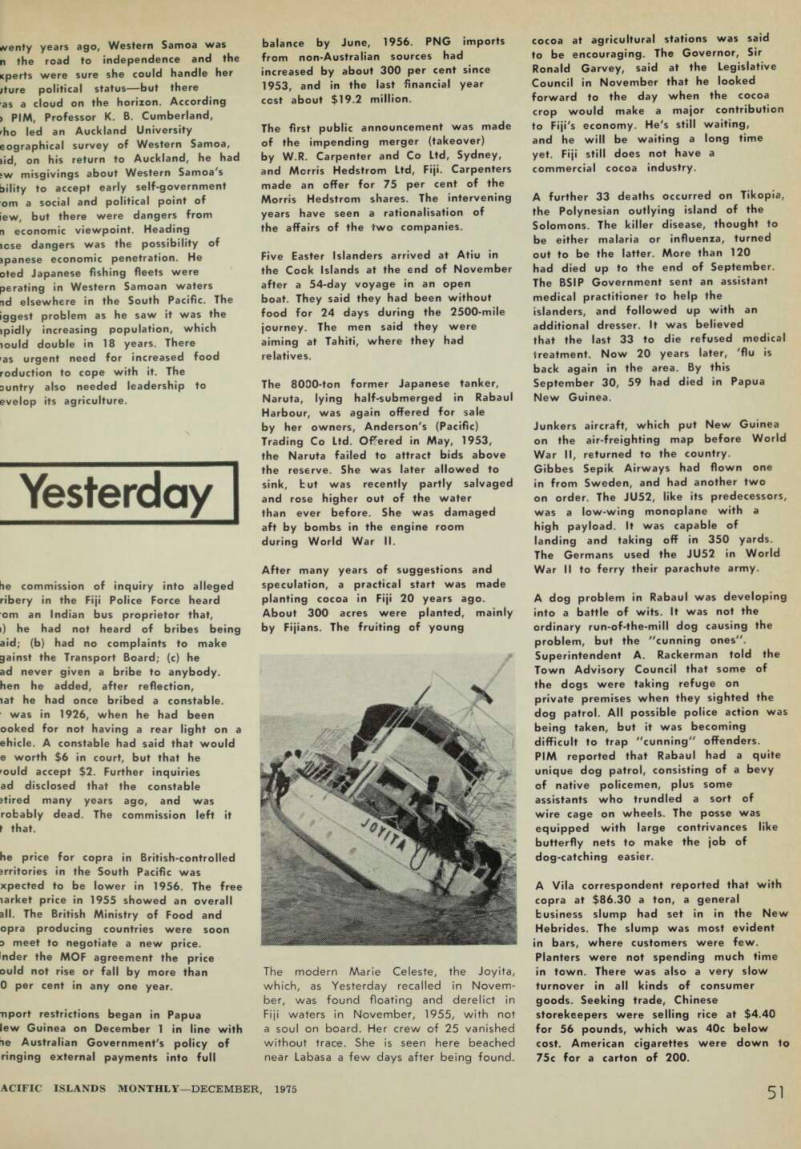
The modern Marie Celeste, the Joyita, which, as Yesterday recalled in Ndvem ber, was found floating and derelict in Fiji waters in November, 1955, with not a soul on board. Her crew of 25 vanished without trace. She is seen here beached near Labasa a few days after being found.