One Saturday
pp. 48-51 · Read in the full issue
Morning
By Vanessa Griffen
TERESA woke up to the sound of
her grandfather’s coughing. The
old man was from Lami village and he had come to stay with his part- European daughter-in-law while he was sick. It was early in the morning and the sun was not yet up, so the room was still cool. Her mother had already got up and was bending over the old man.
“Sit up”, she was saying. “Sit up and drink some tea”. Her voice was soft but slightly tired. Her hair was still untidy from sleep.
The old man could not lift him self, so she bent over, placed her hands under his arms and lifted him up. Teresa watched them a minute.
The old man was very thin and weak, and his skin hung about his chest. He sneezed and coughed into an old hanky. Teresa’s mother patted him on the back gently. She turned and looked back at the girl.
“Teresa, you get up now”, she said.
Teresa sat up and gathered her sulu about her. She climbed over the children, who were still sleeping bundles close together. Before she went into the kitchen, she glanced at her grandfather and smiled at him.
He didn’t look at her, but his thin hand on the sheet flapped feebly in silent acknowledgment of her look.
As she was leaving her mother said, “Make him some pancakes. The kids can have some too”, The flour, water and sugar stuck to the spoon as she stirred. It was sticky and Teresa turned the mixture up and down with the spoon, slowly, “He is worse today. He is worse . . .” went round in her head. Her hand kept stirring the dough, and as it swept thickly round the bowl, a fearful almost unformed question kept recurring. “What are we going to do?”
The children woke up crying. Her mother called out softly: “Come and see to them. I’ll cook the pancakes”, and she quickly left the old man’s side.
Teresa came in and picked up the youngest.
“Shoo, shoo, don’t cry. See, grand father is still sleeping”, When Teresa looked at him, the old man was staring back at her. She smiled at him again, and this time he smiled back faintly in return, Teresa bent over the children and began dressing them. The smell of cooking pancakes crept into the room. The room was getting hotter.
Grandfather was becoming restless, “Teresa, Teresa”, he called weakly, “Come here”. She went over.
“Do you want something?” she sked.
His frail hand reached over and ripped her arm.
“Teresa, tell your mother that I ant to eat crab today”. —Crab, she thought, how are we aing to get him crab?
But she said to him. “All right.
II tell her”.
He closed his eyes and lay back a the pillow, smiling a little.
Teresa stood hesitating next to the >od cupboard. “He wants to eat ab today”. It came out finally, irected at her mother’s profile dish ig out pancakes. “He asked me to ik you”. lER mother turned and looked at her for a minute. Her big strong ice had a dull, sad look about the res. They both didn’t say anything, eresa glanced away. Her mother d not take long to decide.
“Well, we’ll get him some”, she id, turning back to the pancakes. 3et the money out of my purse”.
Teresa took the two children down the flat below, to ask a friend to ok after them. Going down the airs which always smelt faintly of ine and dust, she was relieved in way to be leaving the small, hot ►om with its heavy feeling in the r.
She waited at the bus-stop to get e bus into Suva market. Some of tr girl friends were there. They ere going to town to roam around e shops. Everyone did that in Suva i Saturdays.
“Hello, Teresa”, a cheerful voice illed behind her.
“Oh, hello”. It was Ruci, a good iend of hers.
“Hey, where you going today”. A iendly hand pulled at her arm, Mctures?”
Swinging her shoulder bag casually, uci tapped impatiently on the pave ent with her sandals. Her dress was Tie green and short. She talked, and ;r nose tilted cheekily in the (Brec on the bus should come, her eyes [uinting as if to keep out the dust.
“No, I’m going to the market”, eresa said. “I have to get some ab”.
“Oh?” Ruci looked at her a minute, /ebrow raised eloquently. “Too bad” te said casually. “Anyway, here’s e bus”.
The green and yellow bus pulled ? and they climbed in. Ruci arched jauntily down the aisle, and it down in an empty seat. The bus as fairly full; people looked at uci. She was so bouncy bright, eresa followed and sat in front of ;r.
Normally, she would have been excited to be going into town on a Saturday. But today, the bus seemed to go very slowly. Teresa was afraid of being away for too long, of leav ing her mother to care for the old man, —I hope I can hurry back, she thought uneasily. She was afraid of going back too.
“Teresa”, Ruci was leaning forward and tapping her on the back. “Why don’t you come to the picture this afternoon? We’re all going together”.
Her open face was flushed with excitement, and the heat. Teresa smiled and shook her head.
“No, sorry, true’s up I can’t come”, she said. “The old man’s sick at home and I got to mind the child ren .
“You sure?” The persuading tone persisted. “You can’t come for sure?”
“Yes, I really got to go home”.
Ruci gave up, and sank back into her seat. Then she swung round to talk to the other girls.
The laughter and voices were loud and jumbled oddly together. The Saturday shopping crowd filled the bus. The aisle was packed with people who swayed clumsily from side to side as the bus sped round the cor ners. The bus jolted to a halt. People toppled precariously over each other, clutching at seats, or the hand rail, or whoever was available. The people who wanted to get off were slowly eased out of the bus. Then on they went. It was a slow process.
Chin on hand, Teresa stared un seeingly out the window. The sun shine seemed too bright and the crowded streets went by unnoticed.
There was only the cool of the small dark room in the morning, and her grandfather’s slight figure propped up by the window.
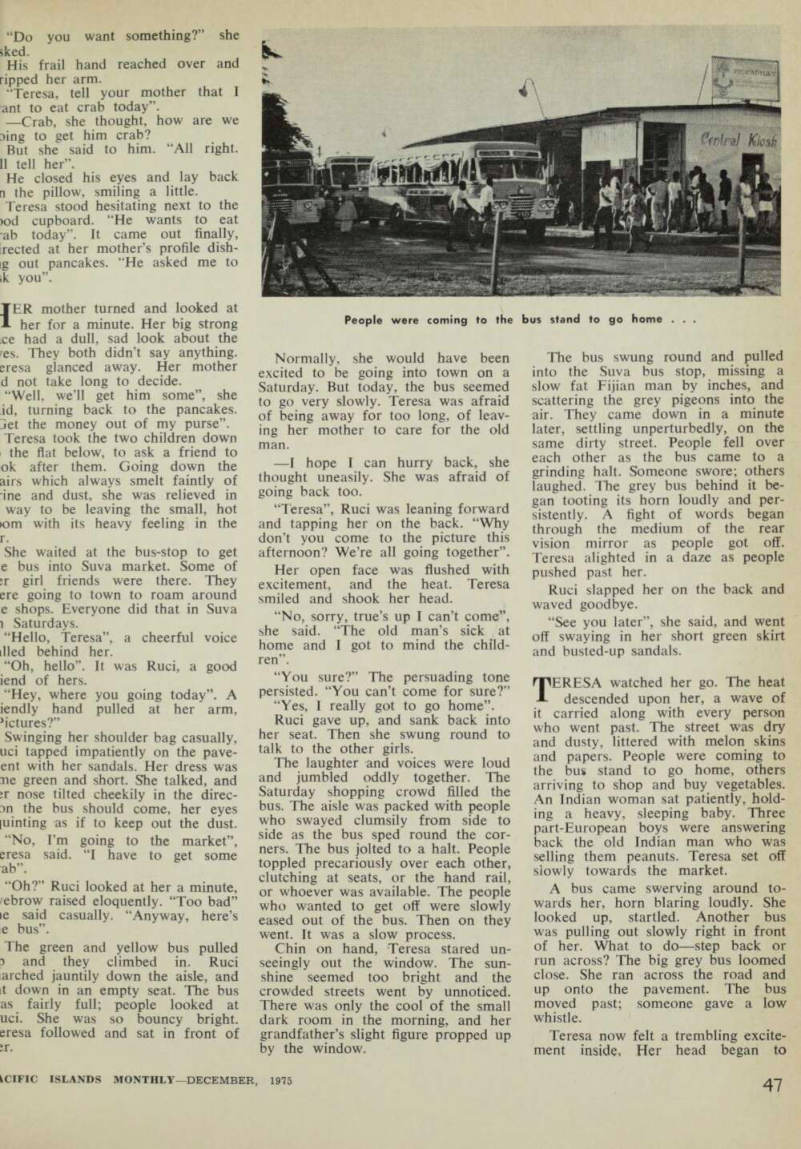
The bus swung round and pulled into the Suva bus stop, missing a slow fat Fijian man by inches, and scattering the grey pigeons into the air. They came down in a minute later, settling unperturbedly, on the same dirty street. People fell over each other as the bus came to a grinding halt. Someone swore; others laughed. The grey bus behind it be gan tooting its horn loudly and per sistently. A fight of words began through the medium of the rear vision mirror as people got off.
Teresa alighted in a daze as people pushed past her.
Ruci slapped her on the back and waved goodbye.
“See you later”, she said, and went off swaying in her short green skirt and busted-up sandals.
TERESA watched her go. The heat descended upon her, a wave of it carried along with every person who went past. The street was dry and dusty, littered with melon skins and papers. People were coming to the bus stand to go home, others arriving to shop and buy vegetables.
An Indian woman sat patiently, hold ing a heavy, sleeping baby. Three part-European boys were answering back the old Indian man who was selling them peanuts. Teresa set off slowly towards the market.
A bus came swerving around to wards her, horn blaring loudly. She looked up, startled. Another bus was pulling out slowly right in front of her. What to do—step back or run across? The big grey bus loomed close. She ran across the road and up onto the pavement. The bus moved past; someone gave a low whistle.
Teresa now felt a trembling excite ment inside, Her head began to
People were coming to the bus stand to go home . . .
throb with the heat, and with the shock the bus had given her. She walked across the taxi stand, and through the stalls of dalo, tied in bundles, and bunches of green bana nas. Chillis formed bright red piles; there were the odd lemons and com.
She stepped over a puddle towards the cold, wet fish market.
Women were sitting outside with coconut-leaf baskets resting in front of them on rough brown sacks.
Maybe they will have crab here, Teresa thought. It may be cheaper too.
She walked past slowly, looking at the baskets. Most of them had black closed kai shells. No crabs.
The women sat fanning themselves and didn’t take much notice of her.
Coming to the end of the row without success, Teresa stepped over a pool of fish-smelling water, and into the fish market.
The cold concrete counter was pressing against the customers, two rows deep, who leaned over the coun ter, pointing at the fish.
“How much for that one?”
“Two dollar”.
“Whoa! Too much! And that one, the small ones?”
Teresa could not find any room for herself. She wandered along, careful not to slip on the wet floor, peering over the heads of the shorter women there.
At first she could not see any crabs. She felt heavy-hearted. —lf there are no crabs, what will I do?
Just as she was beginning to worry, an old man pulled away with his short bundle of silver fish, and Teresa quickly slipped into his place.
The fish counter felt cold under her elbows as she leaned against it. Once more she glanced along the wet grey slab of concrete that the fish were thrown upon. Almost directly in front of her was a bundle of crabs.
The crabs were very big dark green things with thick nippers. Teresa leaned forward to look at them, frowning at their size. —They are too big, I won’t have enough money, she thought.
Teresa felt someone’s basket poke into her side. She looked at the woman next to her. She was point ing at the crabs and saying “sst-sst” to the young man behind the counter, so that he would come up to her.
Teresa moved a little out of her way.
The woman had a loud voice.
“Hey”, she called down the coun ter, “How much these crabs?”
The young man came up in a dirty white robe. He looked indifferently back to where she was pointing.
“Four dollar!” he said.
Teresa’s breath caught in shock and disappointment.—Four dollars!
SHE barely heard the woman ask ing to see the crabs, or poking at them with a crooked finger, hagg ling further, then opening up her dirty hanky and getting out the money.
The cold concrete seeped up into Teresa’s arms. They still rested on the counter. She was looking blankly at the cold empty slab. The young man noticed her there.
“Yes”, he asked, his head to one side, “What do you want?”
Teresa started, then found her tongue. On the counter her fist clutched the money her mother had given her.
“Have you got any more crabs?” she dared to ask.
She watched the man turn his head and slowly look down the long row.
His head was coming back.
“No, no more”, he said, looking at her.
Her face crumpled, her eyes be came very bright. The young man glanced keenly at her, then he broke into an unexpected smile.
“Wait. I’ll look for you”, he said.
He went through the door on the side, then came back, still looking around. He spoke to the other man
serving. Teresa watched them in tently. She saw the other man point.
The young man stooped down some where, and came up with a bundle of small crabs. He held it out in front of him and walked up to Teresa.
“Last ones!” It was a kind sales man’s smile. “For you I’ll give it for three dollars”.
Relief made Teresa almost light headed.
“Here”, she said, handing him the money.
She reached out and took the string of crabs in her hand. The string was slippery, and the crabs dripped froth over her, but she didn’t notice. She lifted them carefully over the counter and squeezed herself out of the wet concrete room. Outside, the bustle and noise came as a hot steamy breath across her face.
Teresa sat perspiring in the bus, holding the crabs carefully by the window. It was about eleven o’clock.
The streets were full of people. The sun beat down relentlessly on the crowd that strolled amongst the stalls and along the hot pavements. The bus stand was relatively shady but people jostled and pushed to get on buses. In the heat, everything seemed to move very slowly and heavily.
The crabs moved their legs up and down, and the sharp nippers made fractional movements in and out. They were dark olive green, with rough brown spikes running along the ends of their legs. Their eyes were small yellow knobs that stuck out expressionlessly. Teresa watched the crabs as they moved in slow motion, frothing white bubbles.
A small hand reached down to wards them. Teresa looked up to see a little Indian girl leaning over the seat in front of her. Her wide black eyes, kohl-painted, stared down at the crabs. Teresa held them up for the child to see. The crabs wriggled frantically. A big smile wreathed the child’s face, and she stooped down to touch them. Teresa started to laugh.
“No, if you do that they will bite you”, she said, smiling. She pulled away the crabs just in time.
THE mother turned her dark head to see what her baby was doing.
She looked at the crabs and at her baby’s intent face. She smiled, and laughing a little, she scolded the child, putting out a hand to draw her back. The black eyes shone with interest as they looked backwards over her shoulder at the crabs.
“Eh you”, Teresa said and pinched the girl’s fat cheeks.
The baby turned her head away.
The bus felt hot and close again. was full, there was the smell of arket goods, fish; peanuts were fisily cracked open, shells scattered erywhere. Teresa thought of home. —They must be waiting for me. le wished the bus driver would irry up instead of drinking his orning tea.
The bus stopped close to her place. le grey block of flats baked slowly the sun. Doors were open black •les all along the floors. Washing pped listlessly along the verandahs. lildren ran around the yard, a few ouched over an intense game of arbles being carried on in the dust. stinctively, Teresa glanced up at sir flat. It would be hot now, dark en though the door was open. The imus roaring furiously, emanating 2 smell of kerosene throughout the o rooms. The air always seemed ipped inside. The old man would by the window, trying to fan
IlSe , -
Teresas feet moved slowly up the rty stairs. Two little boys came ampering down as she made her ly up. They looked at her, dropped -ir eyes, and swerved past. They In’t make a sound.—What are they to now, she thought.
She came up to the top floor and used. There was a crowd of people Dcking the way, mostly women. resa saw that they were all gath- ?d outside their flat. Something Id ran quickly through her body, d suddenly the crabs seemed very avy in her hand. Teresa let them
hang foolishly by her side.
“Hey, dear . . .” someone had noticed her, Mrs Smith the part- European woman from the other flat.
She was turning towards Teresa, her arms held out and a soft strained expression coming over her face.
Teresa pushed past them and made her way to the door. Over the heads of the people, her mother saw her.
Her eyes filled with tears, and she silently beckoned Teresa in. People made way for her without a word.
“The old man’s gone”, her mother said, “Just after you left”.
CJHE felt her eyes sting, but that was all. There was no time to think about it She put the crabs in the sink and went j£ t 0 the room t 0 get t^e children. Grandfather was gone. The children had been forgotten, and were cowering in the corner, wide-eyed. Teresa reached down, took both the small hands, and led them out.
Mrs Smith said, “Come dear, give them to me Marv can i onk after y The children drifted into the woman’s warm embrace without protest.
Teresa went back into the kitchen.
Most of the women were going back to their flats, after saying comforting words to her mother. Teresa stood waiting, not knowing what to do.
Her Aunt Rosie stayed with them.
Her mother stopped crying and got up to cook the crabs. Teresa had forgotten all about them.
Lying in bed between the two
children, Teresa found it hard to sleep. Night had not cooled the air.
A black heat hung over the room, After a while, she got up quietly, und went out the door onto the verandah.
The pale moth-covered lights burned on. Three floors down, the yard was lit in patches by the street lights near the road, and the veran dah lights of the flats on both sides, Only at the far end there was a deep patch of shadow. The clotheslines llke . ® tark de-frocked umbrellas m tne middle - It was slightly cooler outside, Teresa leaned on the low concrete wa U> anci l°°ked down into the yard, anc * at the A ats opposite. Most lights were out; some glowed through bright curtains. It was quiet and still, Gradually, Teresa started to feel and think again. The events of the day oozed out from where they had been smothered. Her grandfather was dead. She dwelt on that for a while. She felt sad, but she had accepted it. He was old, and ill. Her thoughts wavered there—there was nothing more to be said—then moved on - They came upon the dark bright eyes °f the little Indian baby on the hus, and the expression on her face as s he stretched towards the crabs nippers.
“Eh, what a funny baby”, Teresa smiled as she remembered. “So silly”, It did not feel so hot any more, so Teresa left the verandah and went quietly inside. She crept into bed next to the sleeping children and fell asleep quite peacefully.