Magazine Section
pp. 41-47 · Read in the full issue

Frederick Joseph Moss, So Well
Qualified An Individual'
By A. M. Quanchi
In 1859, when Frederick Joseph vloss arrived at Lyttleton in New Zealand, he was 30 years of age and lad been married for six years. He lad decided to try his fortune in the lew colony after migrating from his lirthplacc of St Helena.
He had previously settled in Natal vhere he had served in the Kaffir Vars, but as Natal was suffering from plague Moss decided to move on 0 New Zealand.
He opened a mercantile business n Lyttleton but soon shifted to Dune lin and engaged in commercial and mancial interests on the newly proclaimed gold fields. He started newspaper and then entered local politics as a member of the Pro incial Council. In May, 1868, he noved again. This time he left v New 'ealand and migrated to Fiji where e hoped to establish himself as a andowner and cotton planter.
This was the beginning of a 46-year elationship with the Islands which aw him become a respected authority n Island affairs and an imperialist f the same school as Vogel, Grey nd Whittaker, all men who promoted Jew Zealand’s destiny in the Islands 3 the north. Moss was at various mes until his death, a planter in iji, an educationist and politician in Jew Zealand, the appointed British Resident in the Cook Islands Protecto ate and throughout these years a rolific writer on the Islands, the laoris of New Zealand and above 11, New Zealand politics.
In 1864 he founded the Otago )aily Mail and four years later his rst writings on the Islands appeared 1 its columns. They were a series f letters sent back from Fiji.
Moss had retired from the Pro incial Council and quit New Zealand nd was in Fiji seeking a suitable rea to establish himself. Fiji had ccome the New Eldorado for olonists, from Melbourne and Auck md in particular, and while Island otton maintained its high prices on ie European market the stories of leal soils and climate and readily vailable land and labour were an icentive to many men like Moss.
Moss, however, was more alert to the problems than most of his counterparts, and although ill-health forced him to return to New Zealand he had a discerning eye for Fiji’s potential.
His letters in the Otago Daily Mail were widely read and in October, 1868, they were published in book form in Melbourne under the title, A Month in Fiji.
Financial backing had come from the Polynesia Company, a Melbourne based attempt to speculate in land in Fiji. The company had intentions of monopolising land sales and economic development in the group. The fore word to the book stated the letters were, “printed in the present form with the view of offering the public a lucid and evidently impartial account of a new settlement which is attracting considerable attention here and elsewhere”.
Moss had landed in Levuka but
found reliable information on where to settle hard to obtain. He set off to visit the plantation areas and found the Rewa River to be the most pros perous. He purchased land there and, when forced to return to New Zealand, left an overseer in charge.
In his letters he foresaw the short term profits to be made from cotton (the boom had collapsed by 1870) and predicted that greater successes would be had with coffee, tobacco and sugar. He reported that for 25 miles the banks of the Rewa were in a state of “uninterrupted settle ment” and wrote enthusiastically of the success of the planters there.
In May, 1870, Moss returned again to Fiji to tidy up his holdings and to gather more material for a book, A Planter’s Experience in Fiji, which was published later that year. By then his opinions had changed re garding European settlement and the resulting effects on native peoples.
His interests in Fiji were now as much political as pioneering. He voiced the opinion that New Zealand, “if she chose to put forth her hand” could soon become the natural centre of the Island trade.
He continued to speak favourably of the potential awaiting development in Fiji, and in November, 1870, he was called as a witness before a parliamentary committee investigating a proposed Auckland-Fiji steamer service. With the link up in 1869, the trans-continental railway had reached the west coast of America, and with a Sydney-West Coast service already planned, Moss correctly fore cast that New South Wales would easily dominate the Islands trade unless New Zealand acted to link up with this now important group of islands.
The New Zealand press began to talk of Auckland as the “great com mercial entrepot of the South Pacific”, but New South Wales did take the lead and it was not until the late 1880 s that New Zealand was able to make any impression on Sydney’s trade dominance.
Politically, New Zealand was also to come second. It was to Melbourne
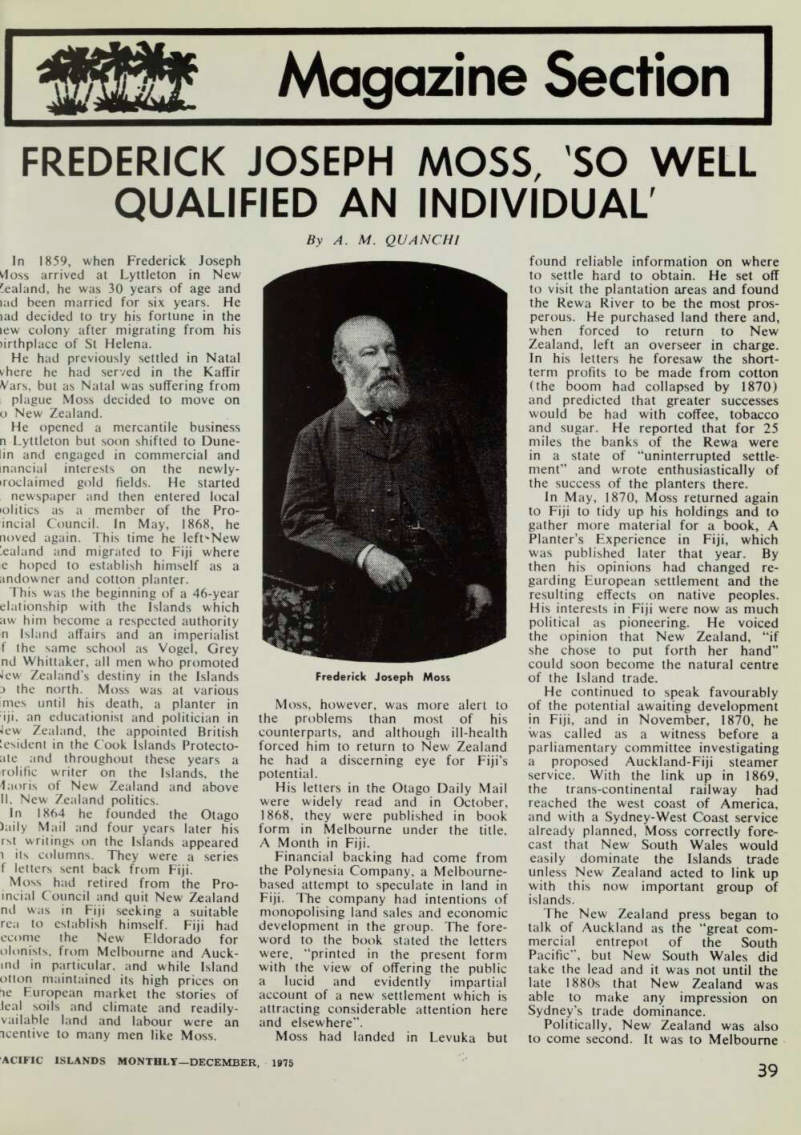
Frederick Joseph Moss
that the predominantly Victorian settler community in Fiji looked when internal troubles threatened their prosperity.
New Zealand’s name was linked with Fiji in several proposals before the eventual British annexation in 1874 and, after annexation, in 1885 and 1901 there were further attempts to cement a political link between the two. Moss served on investigating committees in both cases, neither of which became anything more than pipe-dreams for disgruntled settlers in Fiji and visionary imperialists in New Zealand.
After resettling at Parnell on the North Island, Moss worked on the local Board of Education until 1876 when he was elected to the House of Representatives. He served there for 14 years until he left New Zealand again to take up his appoint ment in the Cook Islands.
In his years in parliament he spoke often on Island matters and became a staunch supporter of Sir George Grey. In 1879, he was the centre of a controversy when Grey suggested him as the new Attorney-General to replace Stout, another New Zealander with a keen eye towards expansion in the Islands.
Moss served on most committees dealing with Island affairs, and in 1885 he spoke of the “unbearable political tyranny” which the European community in Fiji suffered under. He was then on a committee investigat ing a petition from Fiji offering annexation to New Zealand.
As a colony herself New Zealand could not annex, and even if Great Britain had been willing to allow New Zealand some participation in Fiji’s government, such a proposal was overshadowed by a stronger in terest in the, as yet, unclaimed Samoan Islands.
In 1886, Moss visited Fiji and met the two administrators, William Mac- Gregor and John Bates Thurston.
Moss had met Thurston on his pre vious visit to Fiji and they had cor responded regularly. Indeed there is a certain similarity in many of their ideas on European behaviour and the fate of the Pacific Islanders. However, they did not agree on this occasion and the proposed trade reciprocity agreement between Tahiti, Tonga and New Zealand fell through.
In 1888, Moss served on the Royal Commission investigating Julius Vogel’s grandiose confederation and annexation scheme. This was a plan to ensure New Zealand’s paramountcy over the political hegemony of the unclaimed Islands to the north. Both political and commercial circles saw gains to be made from an empire in the Islands controlled from Auck land, but there were internal and im-
perial obstacles to overcome. Vogel’s plan sought to overcome these. Although it was never put into practice expansion did occur three years later, and Moss and Vogel could rightly claim that New Zealand’s destiny in the Islands was at last being fulfilled. * During this time Moss wrote Through Atolls and Islands in the Great South Seas, a School History of New Zealand and a study of the Maori titled Native Lands and their Incidents. He also travelled to the Islands in the trading vessels of his acquaintances Henderson and Mac- Farlane, of island trading fame; 1888 was also to see the two threads of Moss’s life come together.
His active political life in New Zealand and his experiences in the Islands were linked with his interests in expansion in the South Pacific. In September, 1888', Great Britain announced a protectorate over the Cook Islands and after a lengthy debate the colonial Office agreed that New Zealand could administer the new protectorate provided she paid the costs of the appointed Administrator, Moss was nominated for the position and in April, 1891, he commenced at his new post.
In recommending him, the Covernor of New Zealand had written, “1 consider the Government of New Zealand have been fortunate in securing the services of so well qualified an individual for a post the emoluments of which are but small”.
Moss had the responsibility of establishing firm government in a dis-
persed group of islands where there was already a small community of traders and planters and a background of strong missionary control, Moss set about immediately to secure native participation in a cen tralised administration but there were several problems. Moss was restricted by the non-interference assurances given to the traditional High Chiefs when the protectorate was announced, They imposed restraint on his actions where they might disturb existing customs and laws. He was also to guarantee that both Europeans and Islanders obeyed the laws. It was a difficult position to be in. The High Chiefs were rightly jealous of their position and they frequently reminded Moss of the earlier assurances they had been given.
Moss planned a federal system based on a single administration which still allowed the districts to retain local authority. He gradually overcame old inter-island and inter tribal jealousies, and an executive composed of the ariki, and a legisla ture with both ariki and nominated representatives were established. He, as Resident, exercised the veto over their decisions but Moss preferred to act as an adviser to both bodies.
There was a serious liquor problem on Rarotonga and both medical and education services needed to be established. Moss set about his tasks with the belief that Island people lost the will to survive and became dis couraged as they lost their former prestige and status. He started the teaching of English so they could
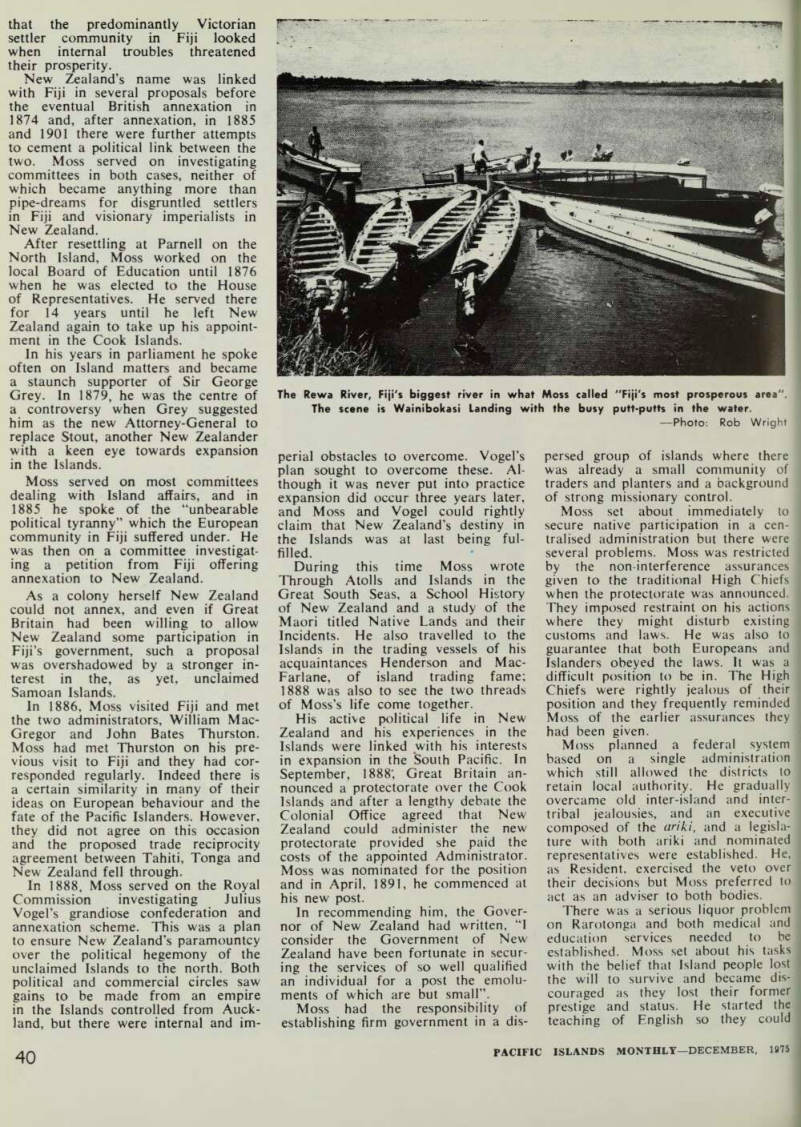
The Rewa River, Fiji's biggest river in what Moss called "Fiji's most prosperous area".
The scene is Wainibokasi Landing with the busy putt-putts in the water. —Photo: Rob Wright
mrticipate effectively in their own ;overnment and he localised all spects of the administration by per onally training Islanders for positions n the administrative and judicial ser ices.
There were also problems over land temming from the ill-defined tra litional rights of tenure and the dif culty of establishing legality in the irevious land transactions between slanders and Europeans.
Moss’s own ideas on land were to reate an agricultural economy based n individual native ownership on a amily farming basis, free from what e saw as burdensome obligations to in groups and chiefs. These ideas /ere not shared by the European ommunity or the ariki-dominated jgislature.
It was a disagreement with the riki which finally led to Moss’s dis lissal as Resident in 1898. He had 3und the judicial system inadequate ?r dealings over land and for legal isputes involving Islanders and uropeans.
He planned a High Court which 'ould act as Court of Appeal for the
lower Native Courts, and as a final court in matters involving both races.
Under this scheme the Resident would have had the final effective say.
The European community, hostile to most of Moss’s commonsense, though often idealistic ideas, stirred up opposition among the ariki and agitated for the rejection of Moss’s High Court Bill. New Zealand was forced to make an official investiga tion and it was decided to recall Moss as his health had deteriorated during the recent troubles, and because, “he had lost the confidence of the natives”.
Moss returned to New Zealand and, although not entering politics again, he continued his active interests in both Island affairs and internal prob lems of government in New Zealand.
He continued to write and two articles he had published on the Cook Islanders remained as standard references on the Cook Islands many years after his death in 1904.
Frederick Joseph Moss was a re spected and influential figure and his successes as the first Administrator in the Cooks are evidence of his under
standing of the complexity involved in balancing European settlement against native interests, Above all. Moss was an advocate of New Zealand’s expansion and it was fitting that he served in New Zealand’s long-awaited and first ex pansionary move into the Islands, Moss had written in 1891 to the Governor of New Zealand that his appointment in the Cooks, “might fairly be regarded as the first step towards the extension of New Zealand influence and to her becoming the commercial and ultimately the political centre of an island federation that would form a fitting companion to federated Australia’’.
With his ideas on colonial govern ment, European expansion and native policy, Moss was typical of several other notable Europeans active in the Islands in the late 19th century. His 46 years in the Islands and New Zealand had given him the oppor tunity to express in words and actions the ideas he held, beginning with his first visit to Levuka in 1868, through his service in the Cooks and up until his death in 1904.