Lae City is going broke
p. 11 · Read in the full issue
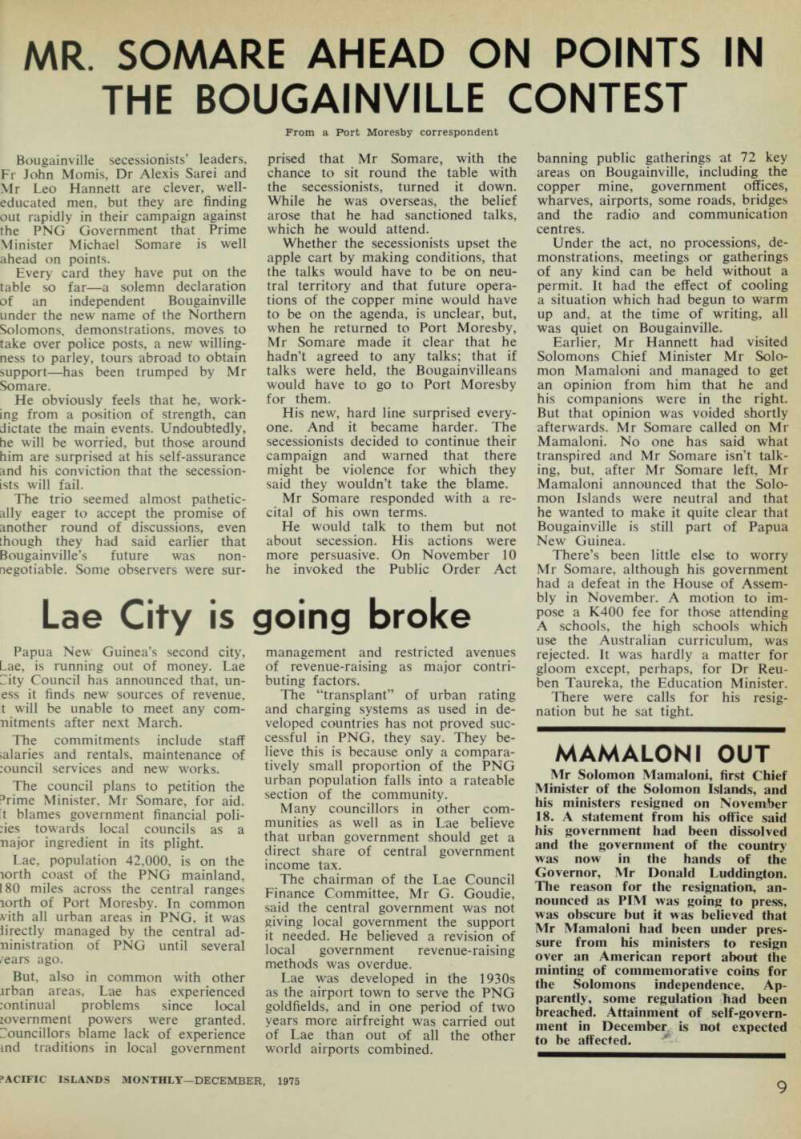
Papua New Guinea’s second city, Lae, is running out of money. Lae ITity Council has announced that, un ess it finds new sources of revenue, t will be unable to meet any com nitments after next March.
The commitments include staff salaries and rentals, maintenance of :ouncil services and new works.
The council plans to petition the 3 rime Minister. Mr Somare, for aid. t blames government financial poli ces towards local councils as a najor ingredient in its plight.
Lae, population 42,000, is on the lorth coast of the PNG mainland, ISO miles across the central ranges lorth of Port Moresby. In common vith all urban areas in PNG, it was Erectly managed by the central ad ninistration of PNG until several ago.
But, also in common with other irban areas, Lae has experienced continual problems since local joverament powers were granted.
Councillors blame lack of experience md traditions in local government
management and restricted avenues of revenue-raising as major contri buting factors.
The “transplant” of urban rating and charging systems as used in de veloped countries has not proved suc cessful in PNG, they say. They be lieve this is because only a compara tively small proportion of the PNG urban population falls into a rateable section of the community.
Many councillors in other com munities as well as in Lae believe that urban government should get a direct share of central government income tax.
The chairman of the Lae Council Finance Committee, Mr G. Goudie, said the central government was not giving local government the support it needed. He believed a revision of local government revenue-raising methods was overdue.
Lae was developed in the 1930 s as the airport town to serve the PNG goldfields, and in one period of two years more airfreight was carried out of Lae than out of all the other world airports combined.