Mr. Somare Ahead On Points In
p. 11 · Read in the full issue
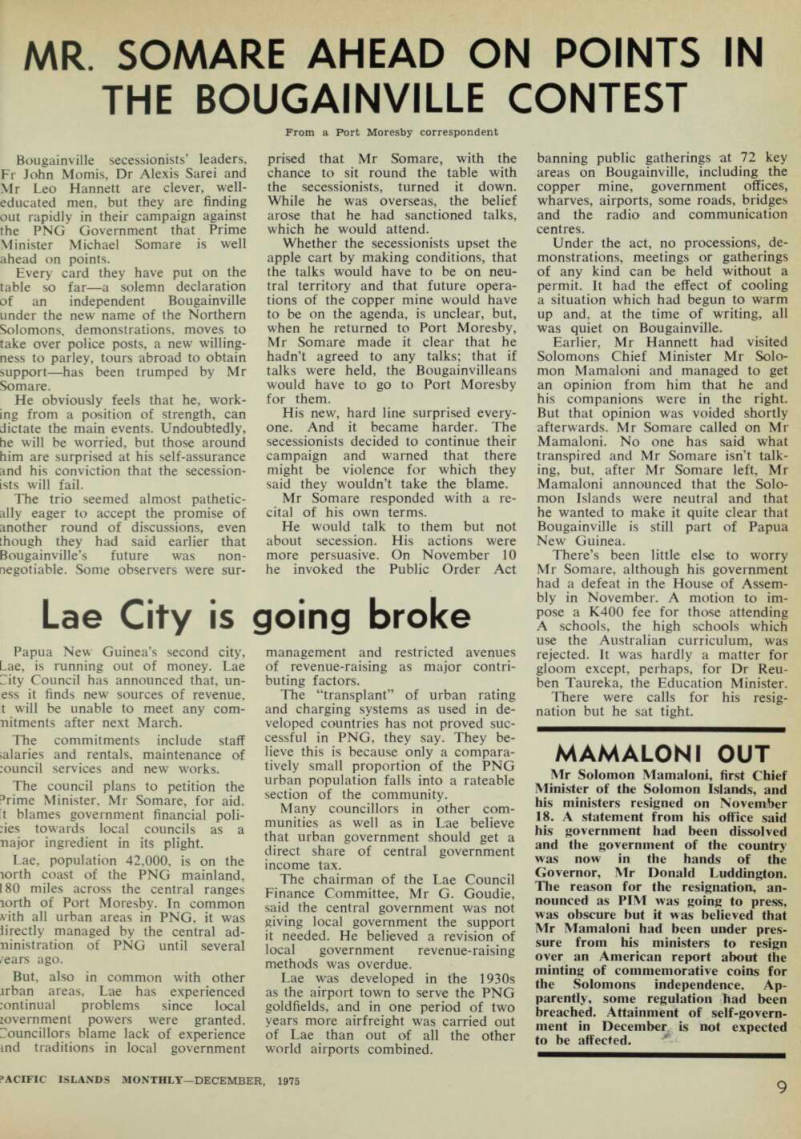
The Bougainville Contest
From a Port Moresby correspondent
Bougainville secessionists’ leaders, Fr John Momis, Dr Alexis Sarei and Mr Leo Hannett are clever, well educated men. but they are finding out rapidly in their campaign against the PNG Government that Prime Minister Michael Somare is well ahead on points.
Every card they have put on the table so far—a solemn declaration of an independent Bougainville under the new name of the Northern Solomons, demonstrations, moves to take over police posts, a new willing ness to parley, tours abroad to obtain support—has been trumped by Mr Somare.
He obviously feels that he, work ing from a position of strength, can dictate the main events. Undoubtedly, he will be worried, but those around him are surprised at his self-assurance and his conviction that the secession ists will fail.
The trio seemed almost pathetic ally eager to accept the promise of another round of discussions, even though they had said earlier that Bougainville’s future was non negotiable. Some observers were sur
prised that Mr Somare, with the chance to sit round the table with the secessionists, turned it down.
While he was overseas, the belief arose that he had sanctioned talks, which he would attend.
Whether the secessionists upset the apple cart by making conditions, that the talks would have to be on neu tral territory and that future opera tions of the copper mine would have to be on the agenda, is unclear, but, when he returned to Port Moresby, Mr Somare made it clear that he hadn’t agreed to any talks; that if talks were held, the Bougainvilleans would have to go to Port Moresby for them.
His new, hard line surprised every one. And it became harder. The secessionists decided to continue their campaign and warned that there might be violence for which they said they wouldn’t take the blame.
Mr Somare responded with a re cital of his own terms.
He would talk to them but not about secession. His actions were more persuasive. On November 10 he invoked the Public Order Act
banning public gatherings at 72 key areas on Bougainville, including the copper mine, government offices, wharves, airports, some roads, bridges and the radio and communication centres.
Under the act, no processions, de monstrations, meetings or gatherings of any kind can be held without a permit. It had the effect of cooling a situation which had begun to warm up and, at the time of writing, all was quiet on Bougainville.
Earlier, Mr Hannett had visited Solomons Chief Minister Mr Solo mon Mamaloni and managed to get an opinion from him that he and his companions were in the right.
But that opinion was voided shortly afterwards. Mr Somare called on Mr Mamaloni. No one has said what transpired and Mr Somare isn’t talk ing, but, after Mr Somare left, Mr Mamaloni announced that the Solo mon Islands were neutral and that he wanted to make it quite clear that Bougainville is still part of Papua New Guinea.
There’s been little else to worry Mr Somare, although his government had a defeat in the House of Assem bly in November. A motion to im pose a K4OO fee for those attending A schools, the high schools which use the Australian curriculum, was rejected. It was hardly a matter for gloom except, perhaps, for Dr Reu ben Taureka, the Education Minister.
There were calls for his resig nation but he sat tight.