How Papua New Guinea Sees
p. 19 · Read in the full issue
Her Role In World Affairs
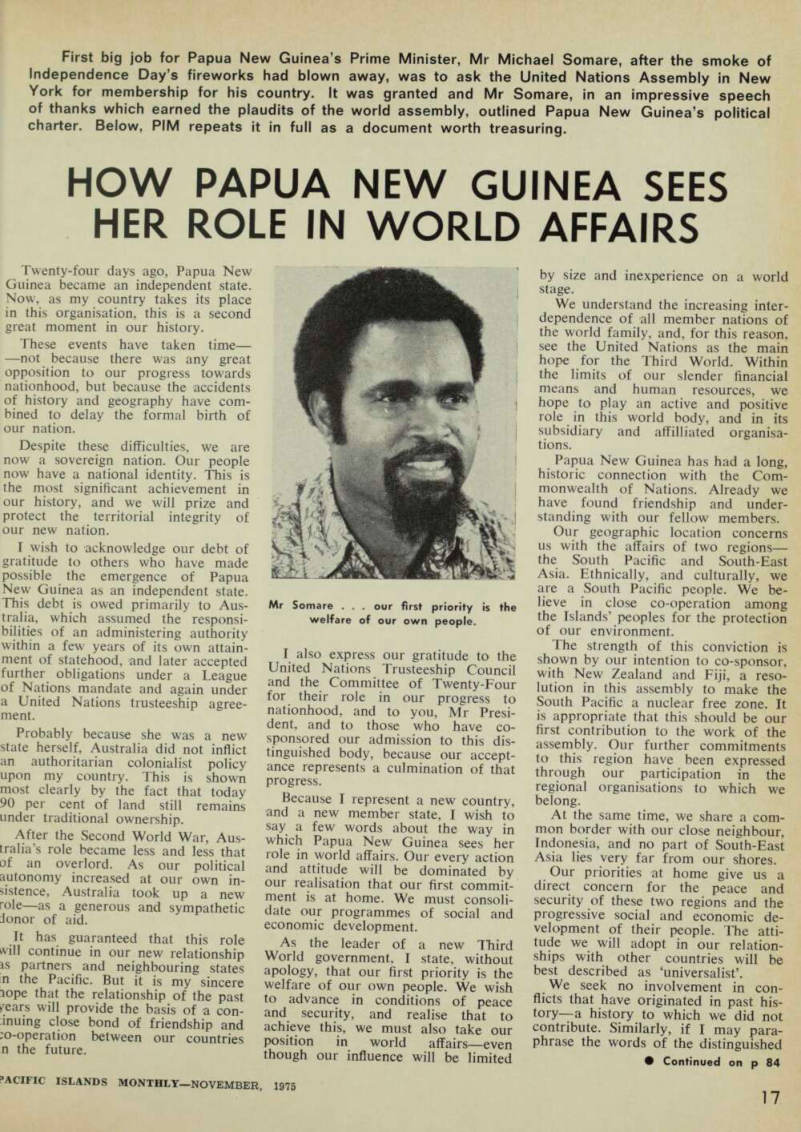
First big job for Papua New Guinea’s Prime Minister, Mr Michael Somare, after the smoke of Independence Day’s fireworks had blown away, was to ask the United Nations Assembly in New York for membership for his country. It was granted and Mr Somare, in an impressive speech of thanks which earned the plaudits of the world assembly, outlined Papua New Guinea’s political charter. Below, PIM repeats it in full as a document worth treasuring.
Twenty-four days ago, Papua New Guinea became an independent state.
Now, as my country takes its place in this organisation, this is a second great moment in our history.
These events have taken time— —not because there was any great opposition to our progress towards nationhood, but because the accidents of history and geography have com bined to delay the formal birth of our nation.
Despite these difficulties, we are now a sovereign nation. Our people now have a national identity. This is the most significant achievement in our history, and we will prize and protect the territorial integrity of our new nation.
I wish to acknowledge our debt of gratitude to others who have made possible the emergence of Papua New Guinea as an independent state.
This debt is owed primarily to Aus tralia, which assumed the responsi bilities of an administering authority within a few years of its own attain ment of statehood, and later accepted further obligations under a League of Nations mandate and again under a United Nations trusteeship agree ment.
Probably because she was a new state herself, Australia did not inflict an authoritarian colonialist policy upon my country. This is shown most clearly by the fact that today 90 per cent of land still remains under traditional ownership.
After the Second World War, Aus tralia’s role became less and less that of an overlord. As our political autonomy increased at our own in sistence, Australia took up a new role —as a generous and sympathetic donor of aid.
It has guaranteed that this role will continue in our new relationship is partners and neighbouring states n the Pacific. But it is my sincere aope that the relationship of the past (ears will provide the basis of a con inuing close bond of friendship and :o-operation between our countries n the future.
I also express our gratitude to the United Nations Trusteeship Council and the Committee of Twenty-Four for their role in our progress to nationhood, and to you, Mr Presi dent, and to those who have co sponsored our admission to this dis tinguished body, because our accept ance represents a culmination of that progress.
Because I represent a new country, and a new member state, I wish to say a few words about the way in which Papua New Guinea sees her role in world affairs. Our every action and attitude will be dominated by our realisation that our first commit ment is at home. We must consoli date our programmes of social and economic development.
As the leader of a new Third World government, I state, without apology, that our first priority is the welfare of our own people. We wish to advance in conditions of peace and security, and realise that to achieve this, we must also take our position in world affairs—even though our influence will be limited
by size and inexperience on a world stage.
We understand the increasing inter dependence of all member nations of the world family, and, for this reason, see the United Nations as the main hope for the Third World. Within the limits of our slender financial means and human resources, we hope to play an active and positive role in this world body, and in its subsidiary and affilliated organisa tions.
Papua New Guinea has had a long, historic connection with the Com monwealth of Nations. Already we have found friendship and under standing with our fellow members.
Our geographic location concerns us with the affairs of two regions— the South Pacific and South-East Asia. Ethnically, and culturally, we are a South Pacific people. We be lieve in close co-operation among the Islands’ peoples for the protection of our environment.
The strength of this conviction is shown by our intention to co-sponsor, with New Zealand and Fiji, a reso lution in this assembly to make the South Pacific a nuclear free zone. It is appropriate that this should be our first contribution to the work of the assembly. Our further commitments to this region have been expressed through our participation in the regional organisations to which we belong.
At the same time, we share a com mon border with our close neighbour, Indonesia, and no part of South-East Asia lies very far from our shores.
Our priorities at home give us a direct concern for the peace and security of these two regions and the progressive social and economic de velopment of their people. The atti tude we will adopt in our relation ships with other countries will be best described as ‘universalist’.
We seek no involvement in con flicts that have originated in past his tory—a history to which we did not contribute. Similarly, if I may para phrase the words of the distinguished
Continued on p 84
Mr Somare . . . our first priority is the welfare of our own people.