under Fiji's political pot
pp. 17-18 · Read in the full issue
Party strife and racial parades light a fire under Fiji's political pot
From ROBERT KEITH-REID in Suva Balmy days of unchallenged power look like being over for Fiji politicians who have been cock of the roost for longer than most voters can remember.
The months of August, September and October saw more excitement generated than at any time since the general election of April, 1972.
A new political party made a stealthy appearance as a breakaway group from the largely Indian-backed National Federation Party, holder of all but one of the seats on the Opposition side of the House of Representatives. And an Alliance Party rebel, Mr Sakiasi Butadroka, dismayed and alarmed the vast majority of Fiji’s 550,000 inhabitants by leading supporters of his Fijian Nationalist Party in a procession through Suva in which placards tell ing Indians to get out of Fiji were displayed.
August saw the tour through the country of a Royal Commission of three British lawyers, who, at the end of this year, will issue a report recommending what changes, if any, should be made in Fiji’s complex voting arrangements.
The new party is the Fiji Social Democratic Party. Despite its name it’s not a left-wing organisation. A month after making its presence known there was still not much re vealed about its true leadership and objectives.
But rumours—and the Nadi areas of western Viti Levu, where it was formed, was seething with them—in dicated it was the baby of some Hindu businessmen and farmers who declare they are fed up with the NFP's leader, Muslim lawyer Siddiq Koya.
The party was inaugurated at a private meeting at Nadi attended, it is said, by about 30 people.
Afterwards, pamphlets were scat tered about Nadi Town saying the party had been formed by followers 3f the late A. D. Patel and wanted to “clean up” Fiji’s politics.
Mr Patel was an India-born lawyer who founded the NFP and died in 1969, a year before the arrival of Independence.
The pamphlet’s invocation of his lame heightened speculation that the SDP’s mystery president might be
brother, Raojibhai Patel, Speaker of the House of Representatives and holder of the Ba Indian communal seat on an NFP ticket.
But Raojibhai Patel, who a few days earlier had created a stir by issuing another pamphlet, would not say yea or nay when asked point-blank if he was involved with the new party.
Like his dead brother, he is a lawyer who has often acted for sugar-cane growers in contractual disputes.
Just before the appearance of the SDP he openly affronted the NFP by putting out a pamphlet urging far mers to accept a plan under which they would contribute to a sugar cane price stabilisation fund as in surance against low sugar prices.
The NFP had been loudly backing the farmers, who were dead against contributing to the fund at up to $2.50 a ton for each ton of cane sold to the government-controlled Fiji Sugar Corporation.
In deciding to support the cane price insurance scheme, Patel went along with Swami Rudrananda, an elderly Hindu monk who, for years, has held much sway among Fiji’s mainly Indian canefarmers.
Despite his oft-proclaimed non involvement in local politics, the saffron-robed swami, as a close con fidante of A. D. Patel, was a signifi cant force in events which led to the formation of the Federation, later National Federation Party.
Both he and Raojibhai Patel are known to have become thoroughly annoyed with A. D.’s successor as NFP leader, Siddiq Koya.
But in plumping to support the cane price scheme both the swami and Raojibhai Patel came a cropper.
A few days after the publication of Patel’s pamphlet the acting Inde pendent Chairman of the Fiji Sugar Industry, Mr Faiz Sherani, said that because of overwhelming opposition of farmers expressed at meetings in the cane districts attended by him, he would advise the government to defer the insurance idea indefinitely.
Mr Sherani’s decision was greeted with glee by NFP officials, one of them describing it, and indeed it was, as a “big slap in the face” for Patel.
While leaders of the SDP con tinued to lie very low, and excitement over the prospect of a NFP split was stirred by yet more rumours and newspaper speculation, Raojibhai Patel continued to stave off queries with displays of characteristic affable vagueness.
When he had read newspaper re ports of his alleged association with the new party, he said, “I gave a hearty laugh”.
A session of parliament opened in Suva on October 2 and as the morn ing newspaper. The Fiji Times, put it on its front page: “A question mark will hang over the Speaker’s chair when its occupant, Mr Raoji bhai Patel, takes it at the opening of the House of Representatives meet ing at 10 am today. The question is whether Mr Patel will still be Speaker when the House ends its meeting in two weeks”.
The answer to the question came much more quickly and dramatically than any newspaperman or poli tician had expected.
After prayers and the moving of the minutes, Mr Patel, sitting in his long wig and red gown, said he wanted to make an important an nouncement.
He had, he admitted, been in the news in the last couple of weeks and it was only right to take the House into his confidence as to what he had been doing.
To a rising chorus of protests from NFP members the Speaker pro ceeded to read into Hansard a trans lation of the pamphlet in Hindi he had put out to sugar farmers.
“I refuse to listen to you, sir” bawled the acting Opposition leader, Mr Chirag Ali Shah, a canefarmer himself, and stamped out of the Par
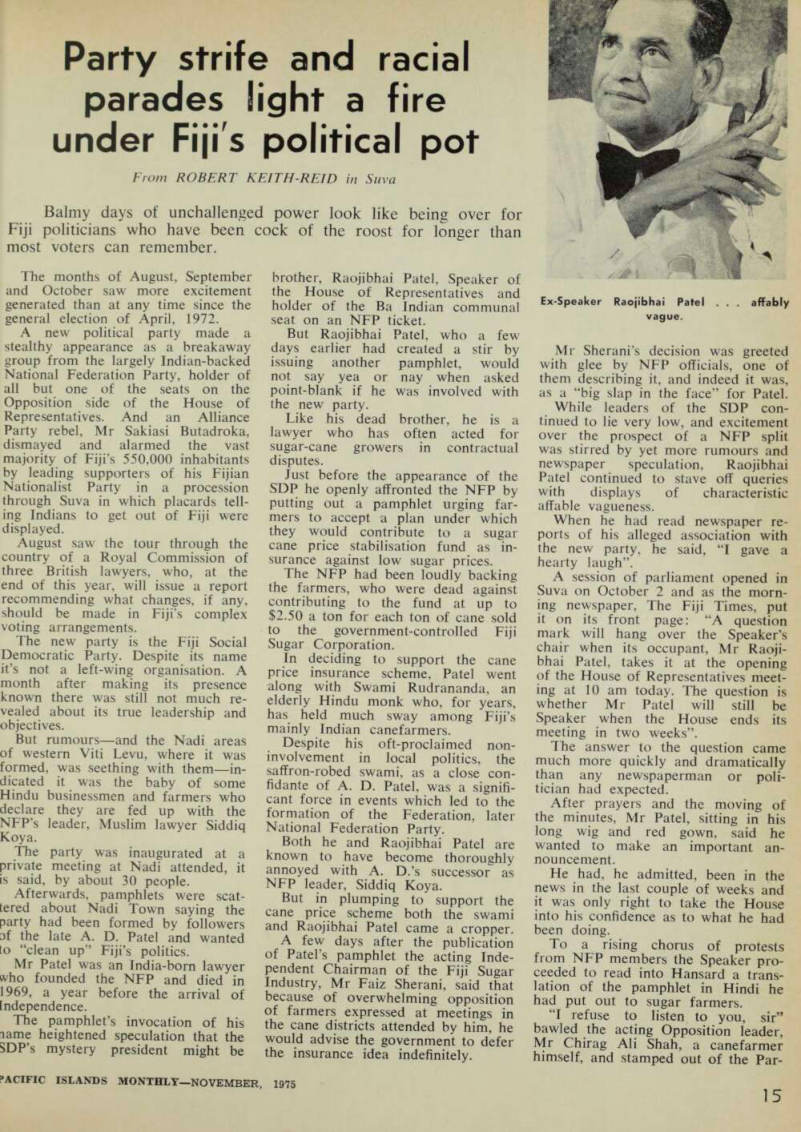
Ex-Speaker Raojibhai Patel . . . affably vague.
liament Chamber, after angrily thumping his desk.
His pamphlet safely in the parlia mentary record, Mr Patel continued: “I am now going to tell you that I solemnly and seriously declare that from today I am out of the National Federation Party”.
And since he had quit the party that had got him into parliament, he added, he felt impelled to also resign from Parliament also.
Mr Patel took his final bow as Speaker on the brink of tears. In fact so overcome was he that he had to be brought back after what should have been his last exit from the Chamber because he had forgotten to make the formal adjournment.
Later in the day, the ex-Speaker was his chirpy self again as he spoke to reporters. But he was still skating round the question of: “Are you with the SDP?”
“You’re assuming that I am play ing a role in the new party”, is all that he would say.
Back to his lawyer’s practice in Ba he went, and a couple of days later the first SDP official to pub licly admit to being such, Mr Ram Sami Pillay, denied that Mr Patel had anything to do with his party whatsoever.
So ended, at least for the present, Mr Patel’s career in the House. It has had its purple patches, notably when, during a stormy debate in May, 1973, on trade unions, he locked all the MPs out of the House.
Prime Minister Ratu Sir Kamisese Mara, who missed the resignation as he was at the South Pacific confer ence in Nauru, said in commenting on the affair, that as a statesman he didn’t like the idea of the Fiji Opposi tion being fragmented by the arrival of a new party.
But as a politician—well, an op ponent was an opponent.
News-making as Patel’s resig nation was, even more space in Fiji’s dailies was being won at the time of it by Mr Sakeasi Butadroka, an avowed nationalist who has set up the Fijian Nationalist Party with the slogan of “Fiji for the Fijians”.
Formerly an Assistant Minister for Co-operatives, he was dismissed by the Prime Minister and then slung out of the Alliance for open de fiance of the party and its leader.
He became an embarrassment to the party as his speeches in the House of Representatives became more openly racist, and anti-Indian in particular.
Mr Butadroka’s bitterness appears to lie in the failure of a public com pany, Rewa Provincial Development Ltd, which he formed as a vehicle
for getting Fijians into business.
Based in the Rewa area, which is also his communal constituency, the company has a disastrous financial record.
Its efforts at running a bus service have been unhappy and Mr Buta droka has decided that the cause has not been Fijian, and his own, business inexperience, but “unfair” competition from Indian bus com panies and the alleged refusal of the government, and particularly the Prime Minister, to give a Fijian enterprise special help.
Despite claims by him that the party is a growing one, support is probably restricted to a small area of the Rewa district and its followers probably amount to little more than the ailing company’s shareholders.
But Mr Butadroka is a man who knows the value of publicity and how to go about getting it. He's organised a couple of processions through Suva, the most recent being in September when he decided to present a petition to Ratu Sir Kami sese one Saturday morning.
The petition cited a number of “grievances” ranging from the prob lems Fijians have in getting loans from the Fiji Development Bank, to a protest against a recent government decision to permit doctors, who have qualified at certain universities in India, to go into medical practice in Fiji.
Mr Butadroka got permission to hold a march through Suva and fore cast that about 5000 people would take part in it. Less than 200 did so, but this was quite enough to send a chill running through the country when the “Indians —quit Fiji” pla cards appeared.
The day before, Ratu Sir Kamisese had announced that neither he nor any officials of his department would be at Government Buildings to re
ceive the petition on Saturday morn ing as requested by Mr Butadroka.
The reasons: The Prime Minister’s office was not normally open on Saturday; Mr Butadroka’s request had been received only the day be fore the march; and the PM and his staff, in any case, were already tied up with other matters.
Butadroka got very angry when he got to the glass door of Government Buildings and found that some police officers were the only people waiting there. So he smashed the door with a kick and, as he told Suva Magis- Court later, he was prepared to kick his way up four floors to the PM’s office.
He was arrested and the court fined him $3OO and said, for an MP. his behaviour had been atrocious.
A few days later he was in court again, this time on 14 traffic charges for which he was fined over $125 and disqualified from driving for a year.
Three days later he was in the news again when he led a party of Fijian landowners to a small farm at Raralevu, near Nausori, whose Indian tenants, he claimed, were be hind with the rent.
Unless the money was forthcoming at once, he warned, the house and the family in it would be fenced in.
The Fijians he had taken to the farm sat round it while, inside, a terrified housewife telephoned her husband at Nausori to get the money.
Police were called in but did not intervene directly, and finally the Fijians left after money was paid.
But, said Mr Butadroka, at least another 100 tenants in the same dis trict were in arrears also because the Native Land Trust Board could not, or would not do its job properly.
These would get the fence-in treat ment also unless they paid up promptly.
Both the NLTB, which controls the leasing of all Fijian land and collects rents for the Fijian owners, and the NFP were quick to condemn Buta droka’s latest ploy.
Blasting Butadroka for usurping the NLTB’s functions, the board’s general manager, Josefata Kami kamica, said: “What Mr Butadroka and his followers have done to the board’s tenant is more dangerous to the Fijian people and the country than the verbal attack by some other politicians to dismantle the NLTB.
“To destroy this trust as Butadroka has done is to introduce the seeds of chaos into this country”.
TTie NFP leader, Siddiq Koya, de manded immediate government action to curb Butadroka’s rent collecting campaign.
Unless this was done, he said,
Continued on p 84
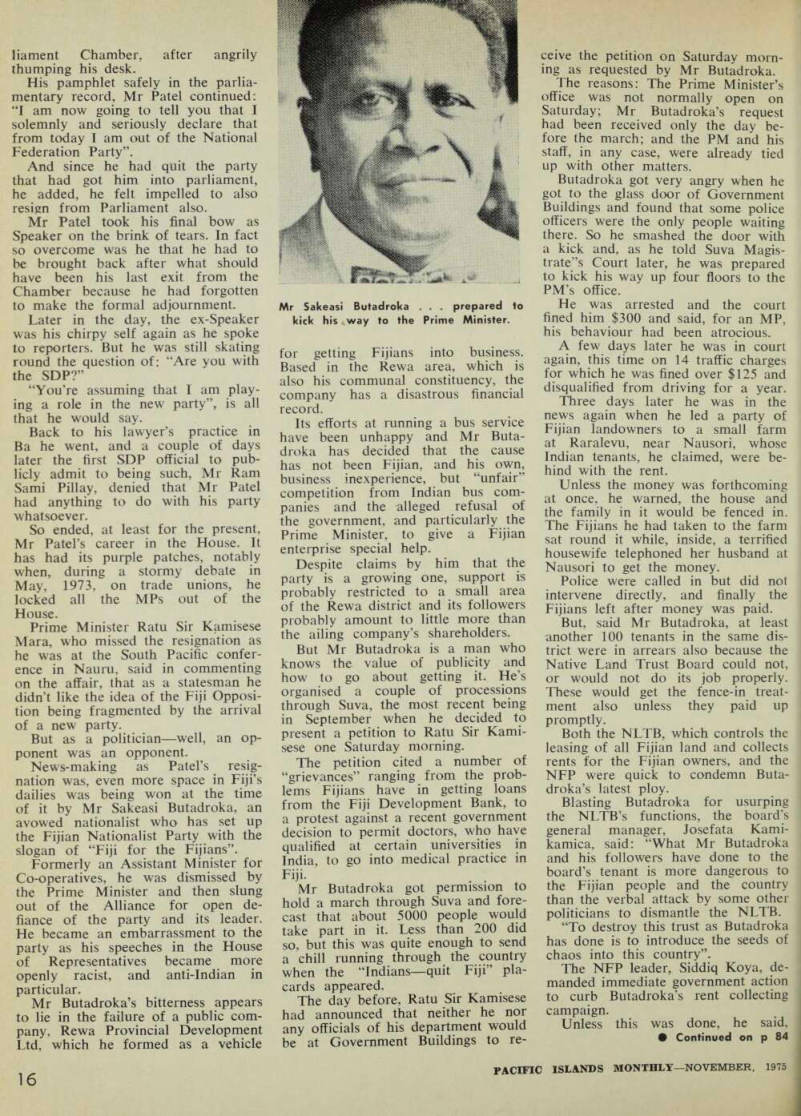
Mr Sakeasi Butadroka . . . prepared to kick his way to the Prime Minister.