Papua New Guinea Finds Gold
pp. 47-48 · Read in the full issue
In Its Cultural Heritage
It was the biggest artifact raid in Papua New Guinea's history. In simultaneous swoops at Madang, Wewak and Angoram police seized more than K 150,000-worth of cultural pieces destined for the United States and Australian markets. In the following days of mid-June 1972 police and museum experts extended the crackdown on artifact profiteers to Rabaui.
The police action, authorised by PNG Prime Minister Michael Somare, was the first brake applied to illegal trade in cultural property which had netted millions of kina (dollars) for overseas dealers.
Investigations that followed confirmed that most pieces seized were important cultural property. They are now held by the Papua New Guinea Museum and Art Gallery and one conservative estimate puts their value at more than K 250,000. These artifacts will be on public display at the Creative Arts Centre, Waigani, Port Moresby during Independence celebrations until October 10.
From a Port Moresby correspondent
That raid was the most publicised incident in illegal artifact dealing in PNG and signalled the end of lucrative fly-by-night operations. The raids served to inform the public of the astronomical profits in artifacts which ran as high as 3,000 per cent in some cases.
Since then the PNG Government has imposed increasingly tough mea sures to protect the country’s cul tural heritage which has been the target of foreign dealers and mis sionaries.
While foreign dealers exploited the country’s culture for profit some missionaries looked on the ‘primitive’ art as the work of heathens and set about destroying traditional culture.
Today at the heart of PNG’s arti fact trade in the East Sepik District, the government has laid the guide lines for localising the industry to give the district’s 100,000 craftsmen a better return for their work. What they produce is not, of course, rare cultural property—but they are genuine and valuable nevertheless.
Through the National Cultural Council, the Sepik Art and Tourist Development Corporation has been formed with initial working capital of K 300,000. Subsidiary companies at Maprik, Angoram, Ambunti and Pagwi will supply artifacts to the holding company for re-sale to over seas museums, universities and other bodies or organisations with a cul tural interest in Papua New Guinea.
The board of directors of the hold ing company hopes to inject K 100,000 into the district in the next eight months.
Each subsidiary will receive an equal share of a K 100,000 govern ment grant, and a Development Bank loan of K 200,000 will be used as purchasing capital for the holding company. Sepik Art and Tourist Development Corporation will issue
500,000 K 1 shares and the sub sidiaries will each issue 100,000 shares.
Profits from artifacts sales will earn a dividend for shareholders and the bulk of the remaining capital will be put back into the district.
This will ensure a continuous flow of money into artifact-producing areas which on the Sepik River alone involve more than 80,000 people with no other income.
Board of directors of the holding company comprises PNG Museum director Geoffrey Musawadoga, Dis trict Commissioner Tony Bais, and representatives from Angoram, Map rik, Ambunti and Pagwi.
Wewak Cultural Centre director,
Mr Ricky Wyatt, first proposed the scheme about 12 months ago as the best way of guaranteeing a regular flow of capital into East Sepik in land centres.
In the last 18 months only K 60,000 has been spent in the dis trict on artifacts, compared with an average annual turnover of K 250,000.
The marked drop in income has caused hardships for craftsmen, par ticularly on the Sepik river.
"By involving Papua New Gui neans in the machinery of artifact dealing we hope to increase their returns by about 200 per cent”, Mr Wyatt said.
“Once villagers know we will be buying regularly—and at a fair price —the dealers who slip in the back door will soon find their kina does not have the buying power it used to. It will also encourage craftsmen to do better work because they know we will give them a better price for better work”, said Mr Wyatt.
Buyers working on commission for the subsidiary companies will be responsible for ensuring artifacts pur chased are representative of the dis trict. They will travel to the most isolated villagers as well as the main centres so that funds are distributed evenly.
Mr Wyatt is anxious to see Papua New Guineans getting the lion’s share of profits from artifacts. He attacked “unscrupulous foreigners” who in the past were responsible for “the rape of PNG’s cultural heri tage”.
“We've had dealers through here who have robbed the people blind.
They would buy in bulk at ridicul ously low prices and then sell over seas at between 300 and 3,000 per cent profit”, said Mr Wyatt.
“There was one operator who used to give his buyers K 1,000 in cash to buy no less than 500 masks.
“Well, if you go into a village
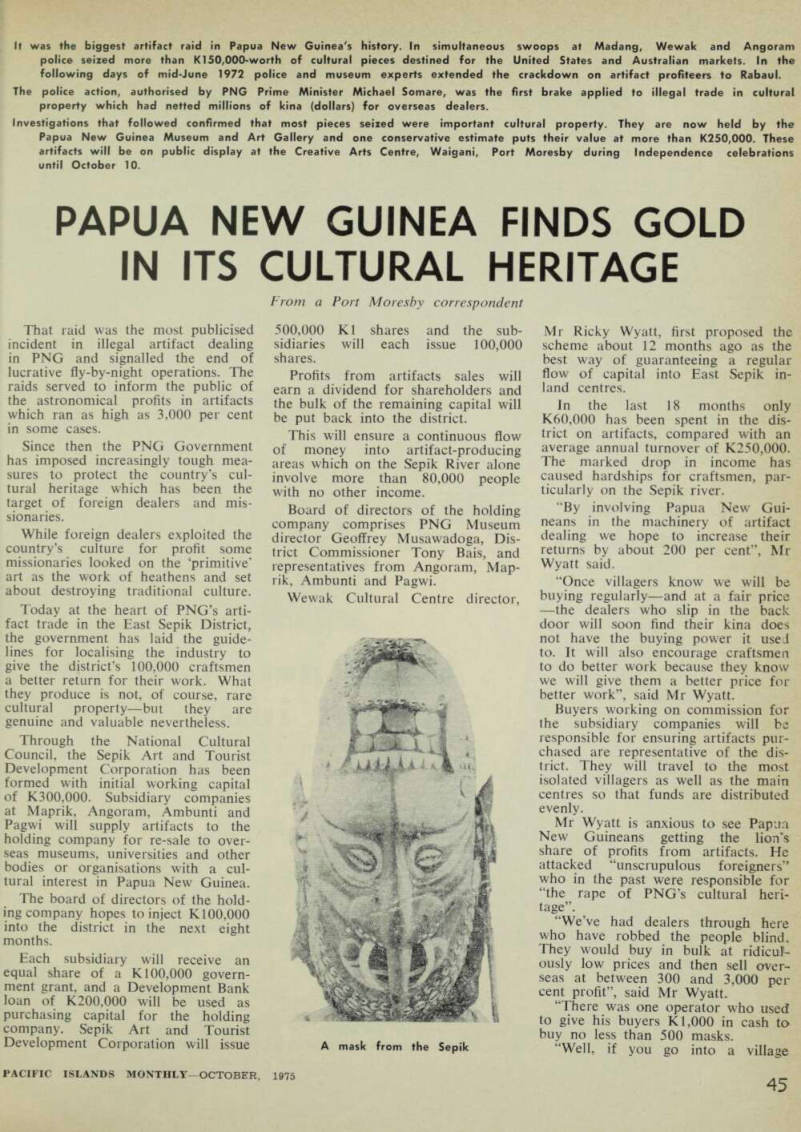
A mask from the Sepik
where there hasn’t been anyone buy ing for a long time, people who need the money will sell masks worth K4O for K 2.
“That’s just one case where the people have been exploited.
“It’s the sort of thing we are try ing to stamp out”, said Mr Wyatt.
“Our best weapon is to make villag ers a much better offer than anything the dealers can come up with. This is what we will be doing and it will work”.
The Angoram Art and Tourist Company is the scheme’s pilot pro ject and will set a ‘track record’.
Once it is established, the holding company will begin distributing funds to other subsidiaries for artifact buying.
The scheme has been received enthusiastically by villagers in the East Sepik and Mr Wyatt is investi gating establishing a subsidiary at Vanimo in the West Sepik.
Mr Wyatt thinks eventually the scheme could be the forerunner for complete nationalisation of the arti fact trade in Papua New Guinea.
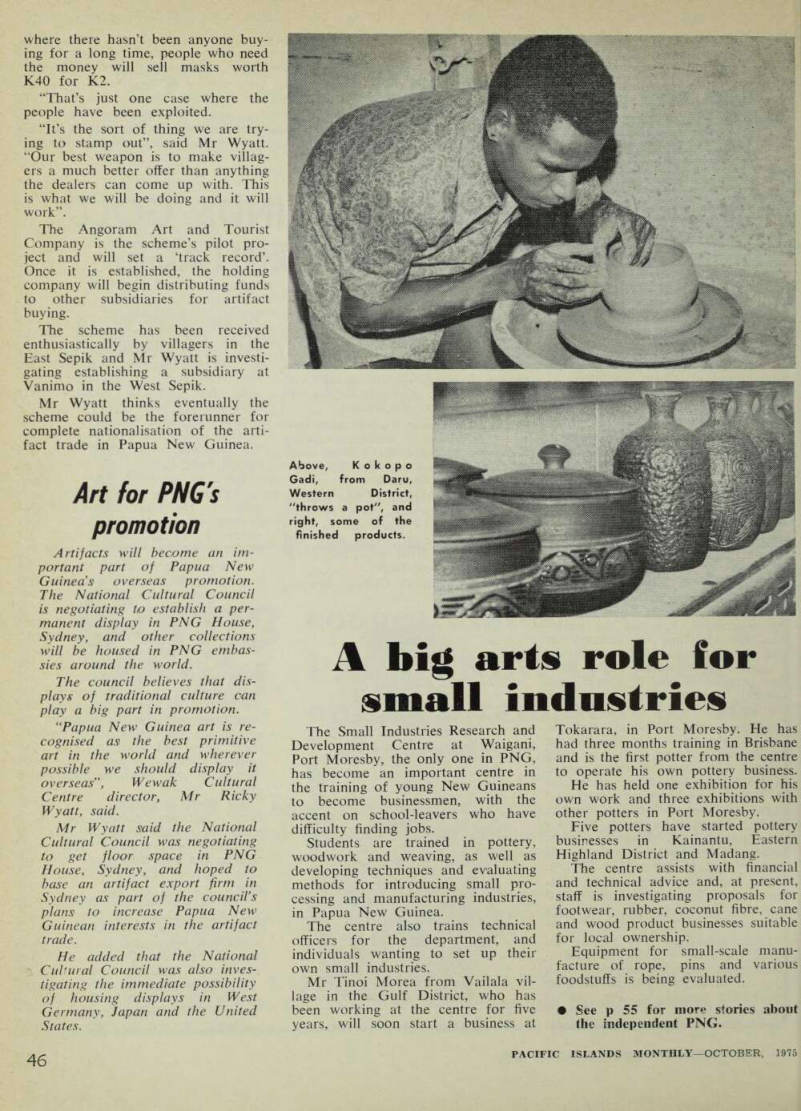
Above, Kokopo Gadi, from Daru, Western District, "throws a pot", and right, some of the finished products.