“That's Papua new guinea all over!
pp. 45-46 · Read in the full issue
The man who steals the show
PIM ON THE FOLLOWING PAGES LOOKS AT THE MANY FACETS OF A NEW NATION.
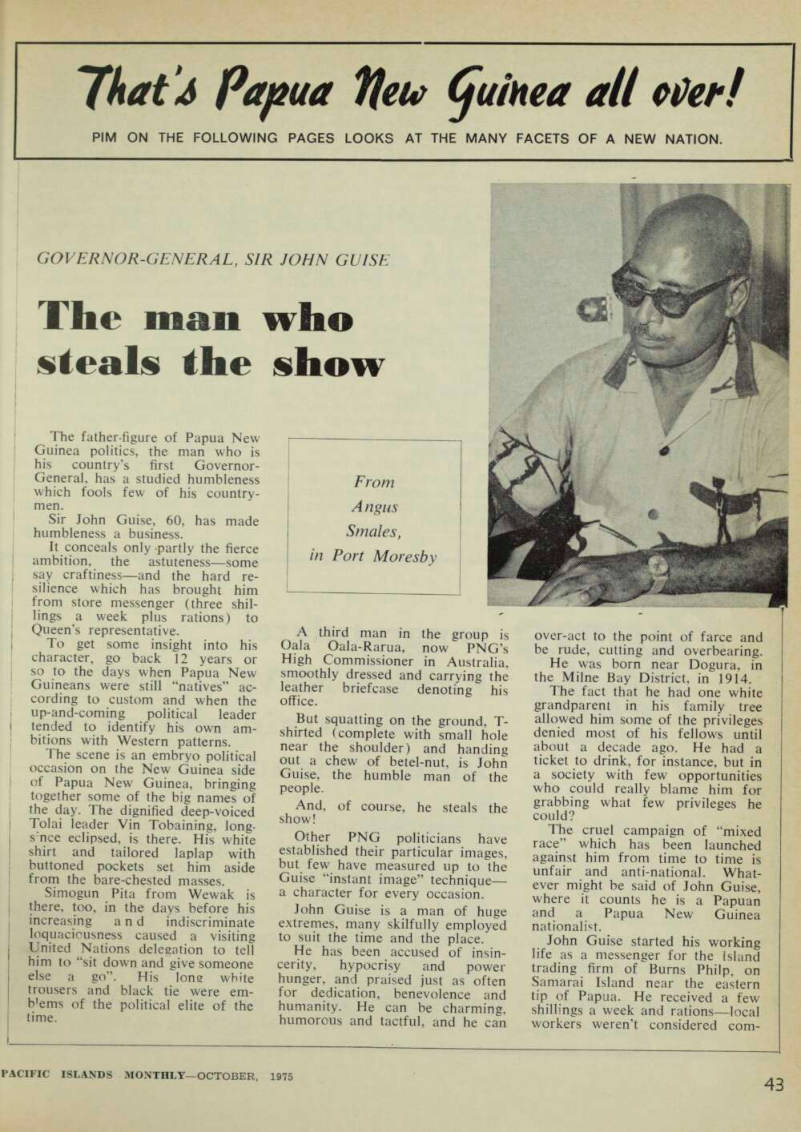
Governor-General, Sir John Guise
'Hie father-figure of Papua New Guinea politics, the man who is his country’s first Governor- General, has a studied humbleness which fools few of his country men.
Sir John Guise, 60, has made humbleness a business.
It conceals only partly the fierce ambition, the astuteness —some say craftiness—and the hard re silience which has brought him from store messenger (three shil lings a week plus rations) to Queen’s representative.
To get some insight into his character, go back 12 years or so to the days when Papua New Guineans were still “natives” ac cording to custom and when the up-and-coming political leader tended to identify his own am bitions with Western patterns.
The scene is an embryo political occasion on the New Guinea side of Papua New Guinea, bringing together some of the big names of the day. The dignified deep-voiced Tolai leader Yin Tobaining, long s nee eclipsed, is there. His white shirt and tailored laplap with buttoned pockets set him aside from the bare-chested masses.
Simogun Pita from Wewak is there, too, in the days before his increasing and indiscriminate loquaciousness caused a visiting United Nations delegation to tell him to “sit down and give someone else a go”. His lone white trousers and black tie were em b’ems of the political elite of the time.
From Angus Smales, in Port Moresby
A third man in the group is Uala Oala-Rarua, now PNG’s Commissioner in Australia, smoothly dressed and carrying the leather briefcase denoting his offlce - But squatting on the ground, Tshirted (complete with small hole near the shoulder) and handing out a chew of betel-nut, is John Guise, the humble man of the people.
And, of course, he steals the show!
Othpr PM n U
ffgfSSr particular images*
a character for every occasion.
John Guise is a man of huge extremes, many skilfully employed to suit the time and the place.
He has been accused of insincenty, hypocrisy and power hunger, and praised just as often tor dedication, benevolence and humanity. He can be charming, humorous and tactful, and he can
over-act to the point of farce and be rude, cutting and overbearing.
He was born near Dogura, in the Milne Bay District, in 1914.
The fact that he had one white grandparent in his family tree allowed him some of the privileges denied most of his fellows until about a decade ago. He had a ticket to drink, for instance, but in a society with few opportunities who could really blame him for grabbing what few privileges he could?
The cruel campaign of “mixed where it COU nts he is a Papuan and a Papua New Guinea nationalist.
John Guise started his working life as a messenger for the Island trading firm of Bums Philp, on Samarai Island near the eastern tip of Papua. He received a few shillings a week and rations—local workers weren’t considered com-
The man who steals the show
• etent to handle their own food
buying arrangements.
During the Pacific War he was a signals clerk with the Australian New Guinea Administrative Unit, and he later became a policeman and a welfare worker.
He was a well above average cricketer who has always retained an interest in the game.
He entered national politics in 1961 when he became a member of the then Legislative Council, and he has been a member of all parliaments since. He was Speaker of the Second House of Assembly, received an honorary Doctorate of Laws from the PNG University for his services to the people, and became a knight in this year’s Queen’s Birthday List.
He’s been known to issue edicts on how his name should be used in different connotations—just plain “Guise” or “Dr John”.
“I think it’s more fitting for the nation if you just continue to call me ‘Doctor’ rather than ‘Sir’,” he said after his knighthood was an nounced.
There’s been a tendency, par ticularly among whites, to see John Guise as a man out for power at any price. Although he has been Deputy Chief Minister through the life of the present parliament, for instance, he re mained an independent and seized the reins strongly when his much younger Chief Minister, Michael Somare, was absent.
But this would seem to be nothing more serious than yet another facet of his image-building techniques. After all, he has lived twice as long as many of his col leagues, and was in politics when some of them were still at school, travelling a long, long road of political and personal develop ment.
Small wonder now that he sits on a sort of pinnacle from which he feels free to say all sorts of things, merely to get a kick out of the reaction.
And it would not be surprising if this attitude carries over into his office of Governor-General, be cause he wouldn’t be John Guise if it didn’t.
Sir John Guise, who had been a member of PNG Par liament for a longer period than any other member, de feated two other candidates in a one-hour secret ballot held behind locked doors at the National Constituent Assembly in Port Moresby in July for the post of Governor-General. The Constituent Assembly was the House of Assembly meeting under a separate identity to make constitutional arrange ments for nationhood.
The two other candidates were the Opposition leader, Mr Tei Abel, and the Country Party leader, Mr Sinake Gire gire. Dr Guise was nominated by the Government in the House.
Mr Abel privately asked to withdraw before the Assembly sat, but the chairman, Mr Barry Holloway, asked him to con tinue in fairness to his nomi nators.
On the first ballot Mr Abel was eliminated when the voting was Sir John 45, Mr Giregire 25, and Mr Abel 21. The second vote resulted in Sir John 53, and Mr Giregire 38.