It's now Independence Hill
p. 10 · Read in the full issue
A church leader used pidgin English to bless the national flag at the Port Moresby ceremony which set the seal on independence.
“Mak bilong bung wantaim long mipela” (The mark of unity of you and me) said Bishop Herman Topaivu of the Roman Catholic Church, one of two chaplains who bowed their heads to bless the bril liant bird of paradise flag.
Then the flag was raised above the tree-studded hill where PNG will one day build its national parliament.
Independence Hill will be the official name of the area where the formal flag-raising ceremony was held.
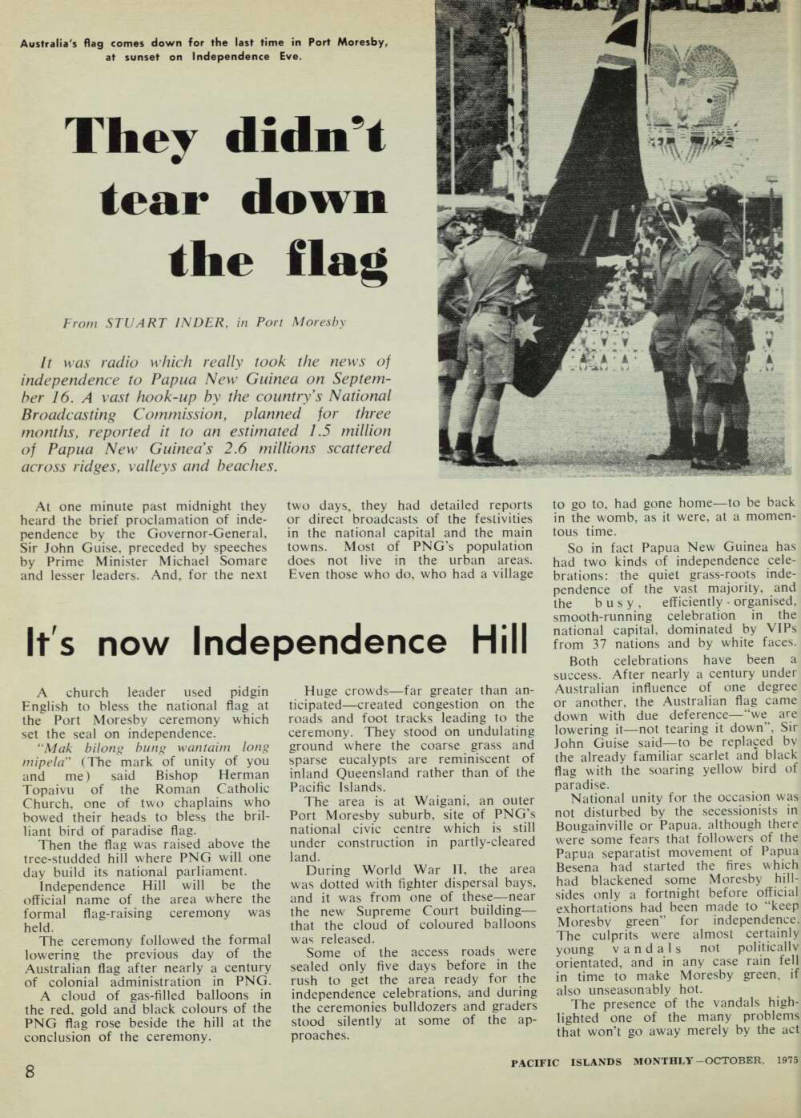
The ceremony followed the formal lowering the previous day of the Australian flag after nearly a century of colonial administration in PNG.
A cloud of gas-filled balloons in the red, gold and black colours of the PNG flag rose beside the hill at the conclusion of the ceremony.
Huge crowds—far greater than an ticipated—created congestion on the roads and foot tracks leading to the ceremony. They stood on undulating ground where the coarse grass and sparse eucalypts are reminiscent of inland Queensland rather than of the Pacific Islands.
The area is at Waigani, an outer Port Moresby suburb, site of PNG’s national civic centre which is still under construction in partly-cleared land.
During World War 11, the area was dotted with fighter dispersal bays, and it was from one of these—near the new Supreme Court building— that the cloud of coloured balloons was released.
Some of the access roads were sealed only five days before in the rush to get the area ready for the independence celebrations, and during the ceremonies bulldozers and graders stood silently at some of the ap proaches.