the flag
pp. 10-12 · Read in the full issue
They didn’t tear down the flag
From STUART INDER, in Port Moresby
It was radio which really took the news of independence to Papua New Guinea on Septem ber 16. A vast hook-up by the country's National Broadcasting Commission, planned for three months, reported it to an estimated 1.5 million of Papua New Guinea's 2.6 millions scattered across ridges, valleys and beaches.
At one minute past midnight they heard the brief proclamation of inde pendence by the Governor-General, Sir John Guise, preceded by speeches by Prime Minister Michael Somare and lesser leaders. And, for the next
two days, they had detailed reports or direct broadcasts of the festivities in the national capital and the main towns. Most of PNG’s population does not live in the urban areas.
Even those who do, who had a village
to go to, had gone home—to be back in the womb, as it were, at a momen tous time.
So in fact Papua New Guinea has had two kinds of independence cele brations: the quiet grass-roots inde pendence of the vast majority, and the busy, efficiently - organised, smooth-running celebration in the national capital, dominated by VIPs from 37 nations and by white faces.
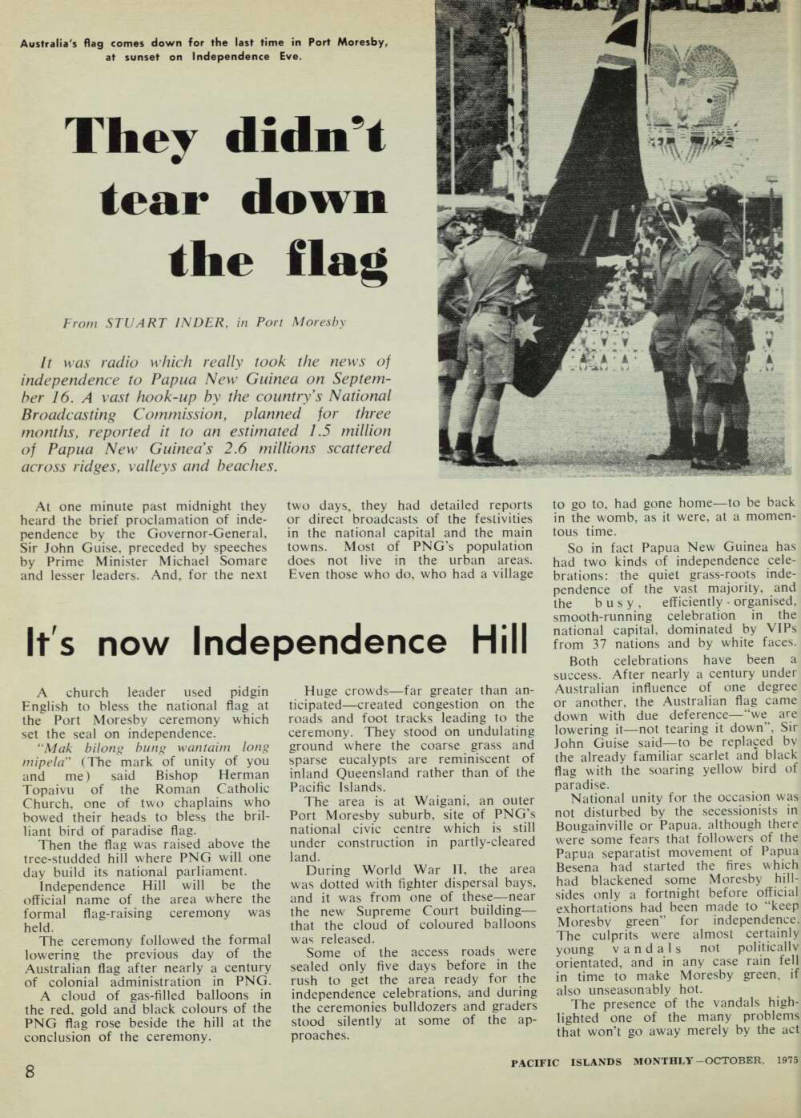
Both celebrations have been a success. After nearly a century under Australian influence of one degree or another, the Australian flag came down with due deference —“we are lowering it —not tearing it down”, Sir John Guise said —to be replaced by the already familiar scarlet and black flag with the soaring yellow bird of paradise.
National unity for the occasion was not disturbed by the secessionists in Bougainville or Papua, although there were some fears that followers of the Papua separatist movement of Papua Besena had started the fires which had blackened some Moresby hill sides only a fortnight before official exhortations had been made to “keep Moresby green” for independence.
The culprits were almost certainly young vandals not politicallv orientated, and in any case rain fell in time to make Moresby green, if also unseasonably hot.
The presence of the vandals high lighted one of the many problems that won’t go away merely by the act
Australia's flag comes down for the last time in Port Moresby, at sunset on Independence Eve.
of independence—that is, the shortage of work in the towns for school dropouts, with resultant crime, par ticularly theft. Another problem was highlighted by the presence of World Bank officials among the hundreds of VIP guests, mixing in this case business with pleasure. The World Bank admits PNG has great potential, but doesn t want to give the new nation borrower status, insisting on an Australian guarantee, and even in the midst of the celebrations there was undercover resentment among many PNG government officers at this lack of faith in a new nation (see report on p 77).
The visitors poured in on all kinds af aircraft. The Islands delegates vere a roll-call of the South Pacific Commission.
They included President Hammer 3eßoburt of Nauru, Sir George Cakobau, Governor-General of Fiji, ■Tench Governor in the Pacific Mr .-C. Eriau, Prime Ministers Ratu >ir Kamisese Mara, Fiji, Sir Albert denry, Cooks, Prince Tui’pelehake, fonga, Tupua Tamasese Leolofi of Vestern Samoa, Chief Minister iolomon Mamaloni, of the Solomons, ogether with the Governor, Mr D. C. -uddington; and Naboua Ratieta, of he Gilbert and Ellice.
Mr Fred Bettham, secretary-general if the SPC, was there, together with i huge delegation from Australia, ed by Governor-General Sir John Cerr, Prime Minister Gough Whitlam, nd politicians of all persuasions. Old *NG hands included the surviving administrators from Colonel J. K.
Jurray, former university vice hancellor, Sir John Gunther, and ex iaps such as Sir Home Niall, J. K.
IcCarthy and Ivan Champion.
Sir Paul Hasluck didn’t make it, nd former Australian Territories linister Andrew Peacock actually isited Moresby, but left for Iran two ays before Independence, to the hagrin of some of his local sup □rters who thought he could have rganised himself better.
Principal guest, Prince Charles, to the British throne, seemed a ttle bit more correct and formal in üblic than the Pacific has known im, although he unbent during a iree-day tour of PNG after the main debrations.
There was a sparkling exhibition scene-stealing on Independence ly itself when Imelda Marcos, first dy of the Philippines, managing to ok light and beautiful despite a lickening waistline, arrived on the ggest aircraft of them all, a stretch CB, with the biggest entourage of em all, about 40, most of them curity men who surrounded her in flying wedge wherever she moved.
She arrived late and from the
wrong direction for the flag-raising ceremony, unpardonably late for the State opening of the National Parlia ment by Prince Charles, thus inter rupting the proceedings, and at a formal presentation by foreign diplo mats of their credentials to Sir John Guise later that day she so outraged one of the diplomats by attempting to take precedence that he walked out, and returned on his own later.
Fortunately her visit was brief.
Not even the wife of the President of the Philippines could overshadow the obvious fact that PNG’s inde pendence was an Islands occasion.
There has been a widely-held view ' that Papua New Guinea is not of the South Pacific, but is oriented towards the politics and economics of the Philippines, Indonesia and Japan.
That view was shattered by the special warmth of the welcome for Islanders by Prime Minister Michael Somare, together with the Islands style of the festivities, and clear political expressions of where PNG stands in relation to the South Pacific, made in various speeches over the three days of celebrations.
For most of the formal occasions, colour was added by 400 students from Sogeri Senior High School, representing groups from each PNG district, some of each group wearing traditional dress, others in specially designed outfits displaying hand (Continued next page)
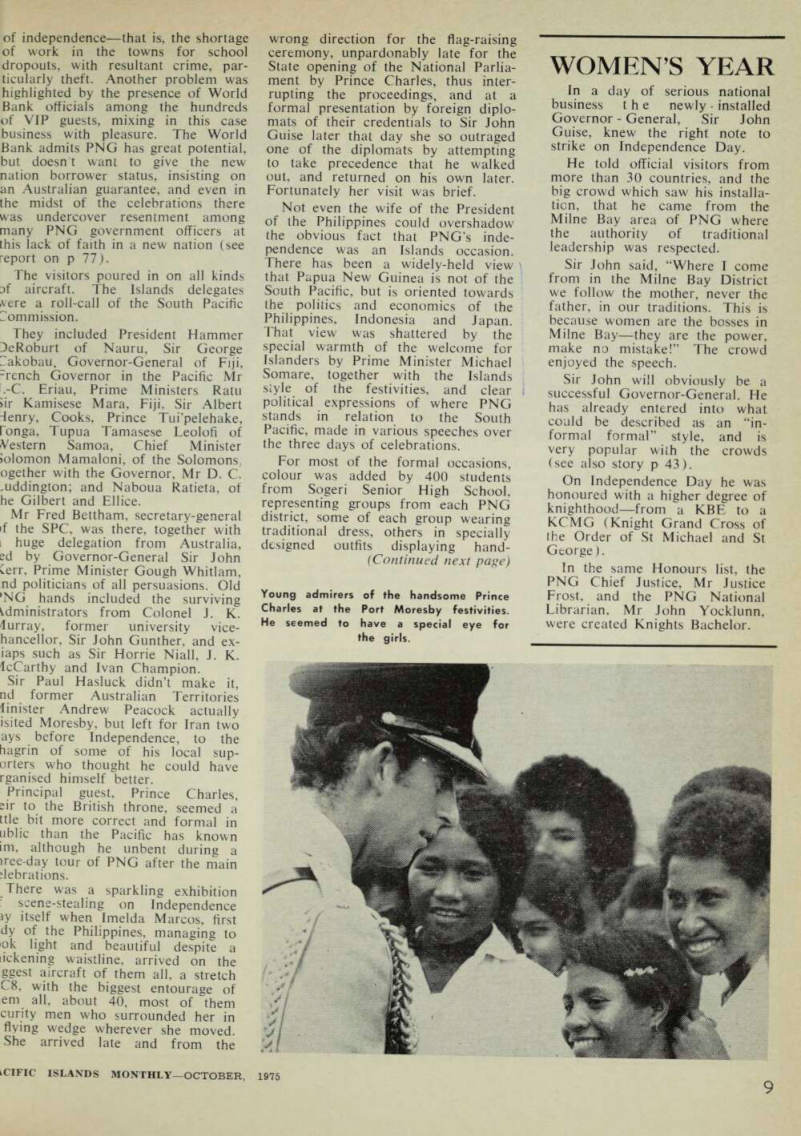
Young admirers of the handsome Prince Charles at the Port Moresby festivities.
He seemed to have a special eye for the girls.
printed designs typical of the districts.
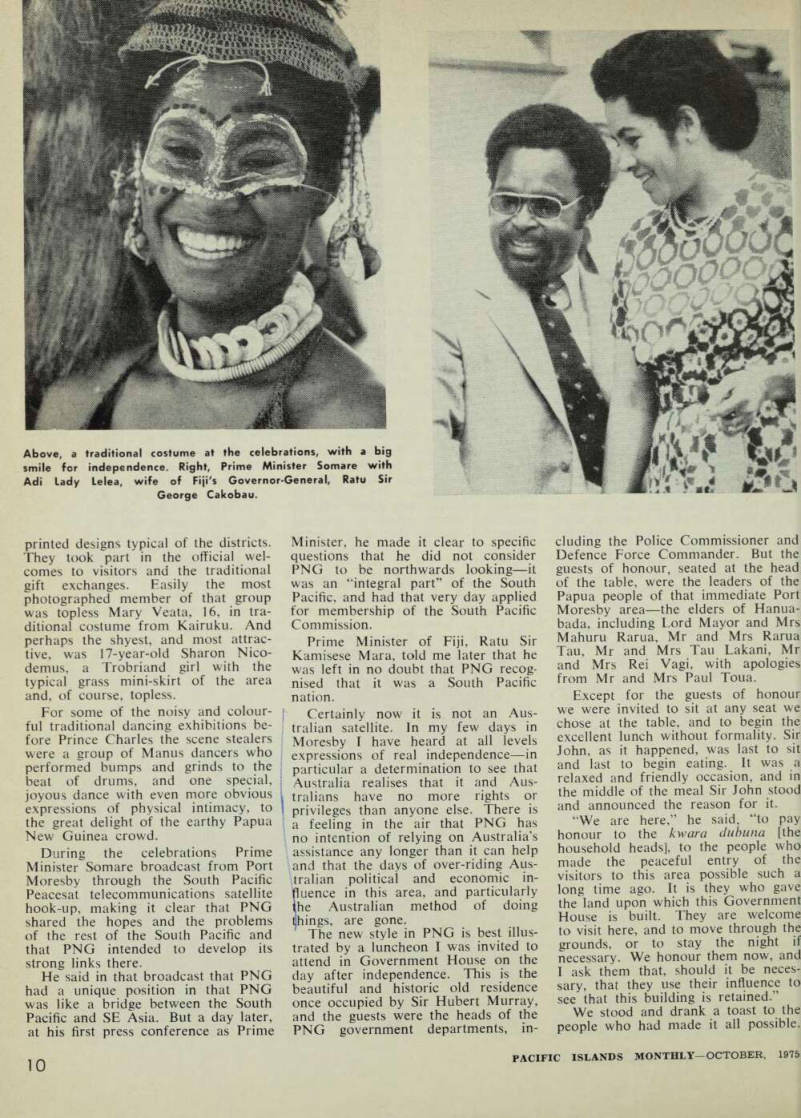
They took part in the official wel comes to visitors and the traditional gift exchanges. Easily the most photographed member of that group was topless Mary Veata, 16, in tra ditional costume from Kairuku. And perhaps the shyest, and most attrac tive, was 17-year-old Sharon Nico demus, a Trobriand girl with the typical grass mini-skirt of the area and, of course, topless.
For some of the noisy and colour ful traditional dancing exhibitions be fore Prince Charles the scene stealers were a group of Manus dancers who performed bumps and grinds to the beat of drums, and one special, joyous dance with even more obvious expressions of physical intimacy, to the great delight of the earthy Papua New Guinea crowd.
During the celebrations Prime Minister Somare broadcast from Port Moresby through the South Pacific Peacesat telecommunications satellite hook-up, making it clear that PNG shared the hopes and the problems of the rest of the South Pacific and that PNG intended to develop its strong links there.
He said in that broadcast that PNG had a unique position in that PNG was like a bridge between the South Pacific and SE Asia. But a day later, at his first press conference as Prime
Minister, he made it clear to specific questions that he did not consider PNG to be northwards looking—it was an “integral part” of the South Pacific, and had that very day applied for membership of the South Pacific Commission.
Prime Minister of Fiji, Ratu Sir Kamisese Mara, told me later that he was left in no doubt that PNG recog nised that it was a South Pacific nation.
Certainly now it is not an Aus tralian satellite. In my few days in Moresby I have heard at all levels expressions of real independence—in particular a determination to see that Australia realises that it and Aus tralians have no more rights or privileges than anyone else. There is a feeling in the air that PNG has no intention of relying on Australia’s assistance any longer than it can help and that the days of over-riding Aus tralian political and economic in fluence in this area, and particularly the Australian method of doing nhings, are gone.
The new style in PNG is best illus trated by a luncheon I was invited to attend in Government House on the day after independence. This is the beautiful and historic old residence once occupied by Sir Hubert Murray, and the guests were the heads of the PNG government departments, in
eluding the Police Commissioner and Defence Force Commander. But the guests of honour, seated at the head of the table, were the leaders of the Papua people of that immediate Port Moresby area —the elders of Hanua bada, including Lord Mayor and Mrs Mahuru Rarua, Mr and Mrs Rarua Tau, Mr and Mrs Tau Lakani, Mr and Mrs Rei Vagi, with apologies from Mr and Mrs Paul Toua.
Except for the guests of honour we were invited to sit at any seat we chose at the table, and to begin the excellent lunch without formality. Sir John, as it happened, was last to sit and last to begin eating. It was a relaxed and friendly occasion, and in the middle of the meal Sir John stood and announced the reason for it.
“We are here,” he said, “to pay honour to the kwara duhuna [the household heads], to the people who made the peaceful entry of the visitors to this area possible such a long time ago. It is they who gave the land upon which this Government House is built. They are welcome to visit here, and to move through the grounds, or to stay the night if necessary. We honour them now, and I ask them that, should it be neces sary, that they use their influence to see that this building is retained.”
We stood and drank a toast to the people who had made it all possible.
Above, a traditional costume at the celebrations, with a big smile for independence. Right, Prime Minister Somare with Adi Lady Lelea, wife of Fiji's Governor-General, Ratu Sir George Cakobau.