underground bangs
p. 11 · Read in the full issue
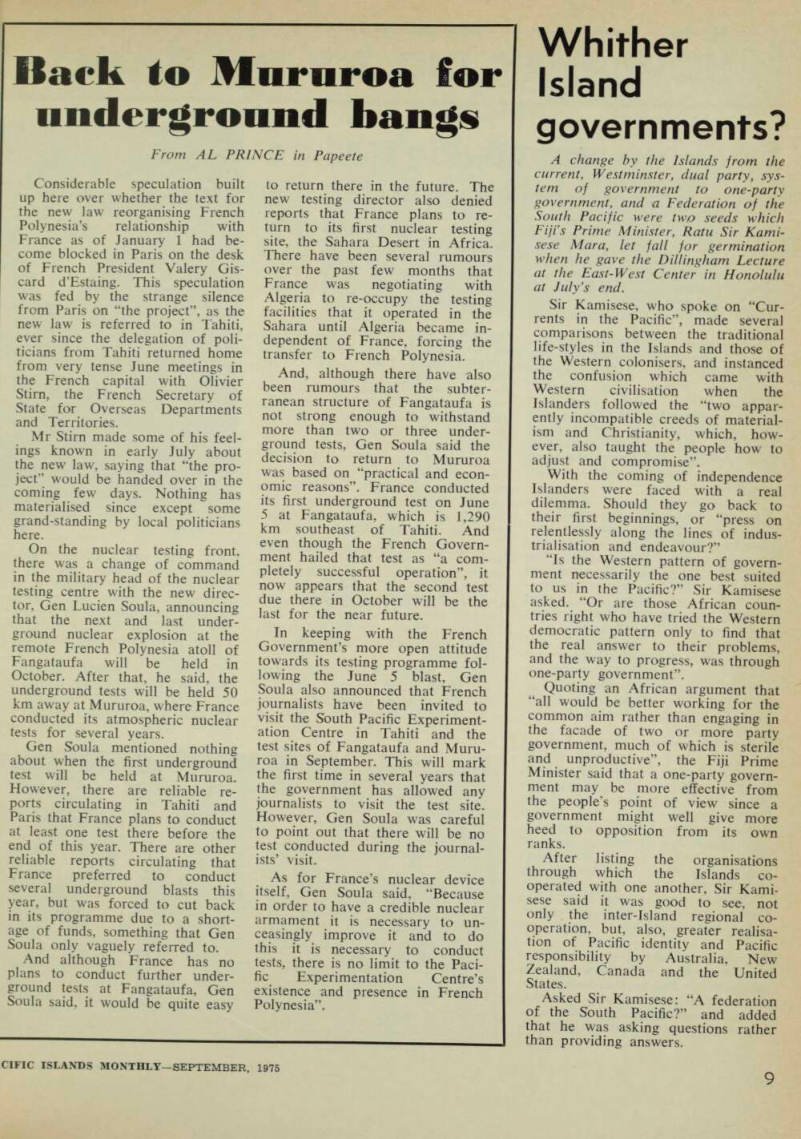
Back to Mururoa for underground bangs
From AL PRINCE in Papeete
Considerable speculation built up here over whether the text for the new law reorganising French Polynesia’s relationship with France as of January 1 had become blocked in Paris on the desk of French President Valery Giscard d’Estaing. This speculation was fed by the strange silence from Paris on “the project”, as the new law is referred to in Tahiti, ever since the delegation of politicians from Tahiti returned home frF; e „ r c y h te ca e p,t , ai ne wUh et X i lr Cfjrr, Pranoh Q. pr . fnr , 7 r
ISte for Overseas DeparZems
and Territories.
Mr Stirn made some of his feelings known in early July about the new law, saying that “the project” would be handed over in the coming few days. Nothing has materialised since except some grand-standing by local On the nuclear testing front, there was a change of command in the military head of the nuclear testing centre with the new director, Gen Lucien Soula, announcing that the next and last underground nuclear explosion at the remote French Polynesia atoll of Fangataufa will be held in October. After that, he said, the underground tests will be held 50 km away at Mururoa, where France conducted its atmospheric nuclear tests for several years.
Gen Soula mentioned nothing about when the first underground test will be held at Mururoa.
However, there are reliable reports circulating in Tahiti and Paris that France plans to conduct at least one test there before the end of this year. There are other reliable reports circulating that France preferred to conduct several underground blasts this year, but was forced to cut back in its programme due to a shortage of funds, something that Gen Soula only vaguely referred to.
And although France has no plans to conduct further underground tests at Fangataufa, Gen Soula said, it would be quite easy
to return there in the future. The new testing director also denied reports that France plans to re turn to its first nuclear testing site, the Sahara Desert in Africa, There have been several rumours over the past few months that France was negotiating with Algeria to re-occupy the testing facilities that it operated in the Sahara until Algeria became in dependent of France, forcing the transfer to French Polynesia bee A „" d ™ a ' t o h u° r U s gh t h ,h t ere ttl haVe h f° been rumours that the subter
“ronT'eno 5
"°* s, ° ng , enou S h <-> withstand tV J? or <, th , ree H nder " § •? d le t s s ’ < -j en ( u a sald ,be " ] ° I ? turn . tc J Mururoa p i act,cal and ec ° n : ° mi fl c y eas ° ns ' Franc , e > condu l cted l ts drS p und “ground test on June
L“ .Mvss
® v “ l . h °“ s , h ‘ he t f r t nch ,P overn ' ha,led that , test as a “In operation it . f pp f ars j!? at , the s “ c "? d l ® st , d a u ® “ ° clo , he ( r wdl be the last for the near fature - In keeping with the French Government’s more open attitude towards its testing programme fol lowing the June 5 blast, Gen Soula also announced that French journalists have been invited to visit the South Pacific Experiment ation Centre in Tahiti and the test sites of Fangataufa and Muru roa in September. This will mark the first time in several years that the government has allowed any journalists to visit the test site.
However, Gen Soula was careful to point out that there will be no test conducted during the journal ists* visit.
As for France’s nuclear device itself, Gen Soula said, “Because in order to have a credible nuclear armament it is necessary to un ceasingly improve it and to do this it is necessary to conduct tests, there is no limit to the Pad fic Experimentation Centre’s existence and presence in French Polynesia”.