independence nears
pp. 9-10 · Read in the full issue
Drama as Papua New Guinea independence nears
The last few weeks before PNG’s Independence Day, scheduled for September 16, have been full of drama and decision-making.
The drama has included such things as moves by Bougainville to secede, and a chronic shortage of government money.
The money shortage has resulted in some last-minute belt tightening only a month before PNG’s first Independence Budget is to be brought down in late September. Prices of beer, liquor and cigarettes have been increased overnight by almost 50 per cent, and registration charges for private vehicles have gone up 50 per cent. The new charges will bring in an extra K 5 million this financial ye *J u . x .
Chief Minister Michael Somare told the House that Papua New Guineans will have to adjust to lower living standards and fewer services because of a cut in Australia’s aid grant this year.
It is impossible for two nations to conduct their relations as if one were a department of the other”, he sard. ‘We have been treated very badly this year; to prevent random events in Australia doing this to us again it is essential we reach an agreed perspective with the Australian Government on our long-term aid
rel fj lol iship”.
Mr Somare was referring to Austraha’s promise to provide PNG with $5OO million aid (a dollar is on a par with a Kina) over three years, one year of which has already run.
Because of Australia’s own economic
plight, the Australian grant this year is less than PNG expected, This has caused havoc with PNG finances, because Mr Somare had already cut $5O million out of PNG’s budget estimates before submitting them to Australia in an honest effort to avoid asking for more than PNG needed. The PNG Budget framers thought they had acted very respons ibly. The Independence Budget is shaped to support local development such as construction projects, copper investigations on the Ok Tedi River, etc, and expenditure on health and education will be cut.
When, in August, PNG realised just how much less it would get from Australia, requiring in turn very severe additional cuts to its own very tight Budget, Mr Somare flew urgently to Australia with his top ministers to appeal to Prime Minister Whitlam.
He got nothing. At the meeting Mr Whitlam was, in fact, rude, tell ing his own Minister for Foreign Affairs, Senator Willesee, who at tempted to put the PNG view at one point, to “shut up or get out of the room”.
Mr Somare was incensed and humi- Hated at his reception. But since re turning to Port Moresby he has
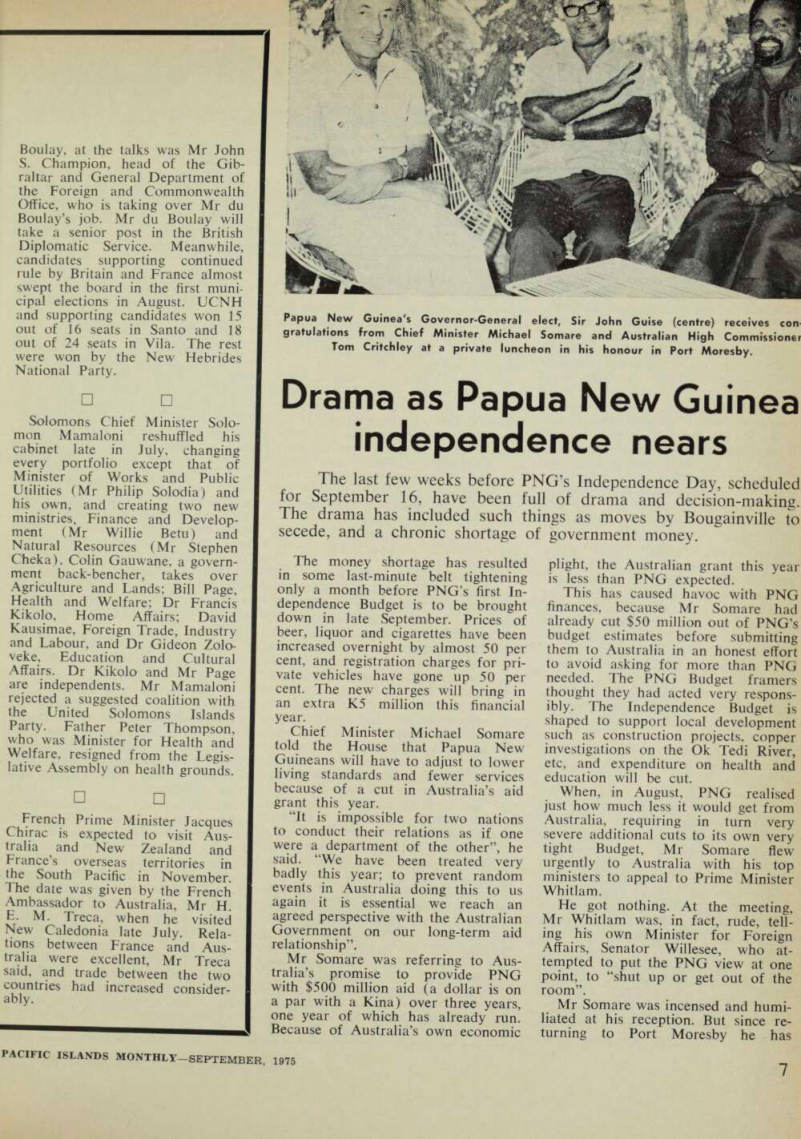
Papua New Guinea's Governor-General elect, Sir John Guise (centre) receives con gratulations from Chief Minister Michael Somare and Australian High Commissioner Tom Critchley at a private luncheon in his honour in Port Moresby.
attempted to swallow his pride, and made public announcements to the effect that it is unnecessary for Papua New Guinea and Australia to fall out so close to Independence.
But underneath, he won’t forget, and Mr Whitlam’s attitude at that meeting has permanently damaged relationships between PNG and the Australian Labour Government.
The PNG National Constituent Assembly finally ended its delibera tions on the country’s new constitu tion, and agreed to it.
But one of the sections not agreed to was section seven, which estab lishes provincial governments. In a surprise move in the assembly, Mr Somare said PNG could not afford provincial government at this stage of its development, because its esti mated cost of Kl 5 million in the next five years was out of the govern ment’s reach, and he successfully moved that the section be omitted.
The concept however, he said, was still valid.
This decision could have its reper cussions with Bougainville’s an nouncement that it would secede from PNG on September 1, and set up an independent government. By late August the PNG central govern ment had still not resolved this threat (for background, see p 23), but the Bougainvilleans were less optimistic of success.
Secessionist leader and MHA Father John Momis flew from PNG to lobby at the UN for recognition of an independent Bougainville, and another, Mr Leo Hannett, headed for the neighbouring Solomons to put Bougainville’s case for a closer re lationship with the BSIP.
Bougainville secessionists said they planned on September 1 to destroy in a bonfire K 5,000 worth of PNG independence souvenirs provided by the PNG Government —flags, badges, posters, booklets.
One of the more important sections of the constitution involved citizen ship.
The assembly agreed that people who had two PNG grandparents and who did not hold foreign citizenship would automatically become PNG citizens on September 16. Others who have lived in PNG for more than eight years are eligible for naturalis ation, but they must apply for it within two months of Independence Day or else lose all right to it except in special cases approved by the minister responsible.
The House of Assembly will not have to face new general elections until May or June 1977. Elections would normally be scheduled for 1976, but the National Constituent Assembly voted to extend the House’s
term for a year to give members some experience with independence. The move was unsuccessfully opposed by some government ministers, including Chief Minister Somare. Voting was 50 to 29; with other government ministers supporting the motion.
Sir John Guise, 61, was elected by secret ballot at the Constituent Assembly on July 29 as Papua New Guinea’s first Governor-General. Sir John, born in Papua and currently Deputy Chief Minister and Minister for Agriculture, defeated two other members for the top post—leader of the opposition United Party, Mr Tei Abal, and the leader of the Country Party, Mr Sinake Giregire.
Sir John becomes Governor- General for a six-year term on In dependence Day.
The by-election for Sir John’s seat of Alotau Open will be held after Independence Day. Meanwhile Sir John, who was the first PNG Speaker of the House of Assembly, has said that he wants no protocol as Governor-General—and he doesn’t mind being called simply “John”, as always.
He said he wouldn’t be “a stooge or rubber stamp” for government, and anything to which he put his sig nature would be carefully looked at.
The Governor-General’s official vehicle will be a Mercedes 350 SEE; Prime Minister Michael Somare’s will be a Daimler Sovereign. Mr Somare’s title of Chief Minister changes on Independence Day.
The Queen has agreed to be Head of State of independent Papua New Guinea.
Prince Charles, Prince of Wales and heir to the British Throne, will be the Queen’s representative at the Independence Day celebrations — leading a long list of VIPs from many parts of the world. Official Pacific Islands visitors will include Nauruan President Hammer Deßoburt, Fiji Governor-General Ratu Sir George Cakobau and Prime Minister Ratu Sir Kamisese Mara, and Solomon
Islands Chief Minister Solomon Mamaloni.
Independence will be heralded with a 101-gun salute fired in Port Moresby. The salute, to begin at midnight on the night of September 15 to mark the start of Independence Day, will be fired by the PNG Defence Force which will also take part in a flag-raising ceremony later in the day.
Papua New Guinea’s Head of State will hand the flag to a Defence Force marching contingent. Two chaplains will bless the flag and members of the Defence Force and the police will swear allegiance to the government of the day.
A ceremonial lowering of the Aus tralian flag will be held on the after noon of the previous day, September 15.
Other recent developments: • Organiser and a driving force behind the Papuan secessionist move ment of Papua Besena, Dr Eric Wright, in July won the distinction of being the first person ordered de ported from PNG under new immi gration laws which came into force only a week earlier. He left the country in late August. Dr Wright is a member of the Port Moresby City Council, a former private practitioner in Rabaul and former Assistant Director of Health. He has spent more than 20 years in PNG.
Miss Abaijah described the decision “as a new and desperate attack” on the Papua separatist movement. No official reason was given for the de
portation order, but privately
officials said he had “promoted dis unity”.
Miss Abaija described PNG In dependence as “a gigantic propaganda stunt to fool foreigners”. • Mr Somare commented that one day a new, “more appropriate” name might have to be found for Papua New Guinea, but he asked that in the meantime the news media refer to the people as “Papua New Guineans”, and not Papuan and New Guineans. • Among the main festivities to celebrate independence is an Australia to Port Moresby International Air Race. It’s organised by the South Pacific Aero Clubs of PNG, in two sections, and although the planning has all had to be done hurriedly be cause the actual Independence date was not known until recently, entries have been received from several parts of the world. The main race is over 1,500 miles from Brisbane via Gayn dah. Charters Towers, Cooktown, Weipa, Dam, Malalau, and Fisher men’s Island, Port Moresby, arriving on Independence Eve. Prizes are cash and a trophy.