Australia's loans battle
p. 75 · Read in the full issue
Fiji smells the smoke in Australia's loans battle
Smoke from the battle in Canberra over Australian Government ministers’ attempts to raise a loan of 4,000 million petrodollars from the Arab oil sheiks drifted over Fiji in July with the revelation that the Fiji Gov ernment had been approached by some of the actors in the drama.
The central figure was Mr Philip Cairns, stepson of the dismissed Aus tralian Deputy Prime Minister, Dr Jim Cairns, who was successively sacked from the portfolios of Treasurer and Minister for the En vironment.
The argument centred round whether Mr Cairns, who was private secretary to Dr Cairns, was acting on behalf of the Australian Government or in a private capacity. Fiji ministers said discussions and correspondence supported the view that a trip he made to Fiji in May was official.
But the Australian High Commis sion in Suva said that in his activities in Fiji he was acting in a purely private capacity. He had no authority whatsoever from the Australian Gov ernment to enter into negotiations with the Fiji Government.
Mr Cairns, on May 7 and 8, with General Galal, of Egypt and Mr lan Richardson, both representing a Mel bourne consulting firm, Rawia Inter national (Aust) Pty Ltd, met Fiji ministers and officials in Suva.
Ratu David Toganivalu, Minister for Information, said the talks were entirely exploratory, covering such matters as possible oil and sugar re fineries, and direct loan investment.
Fiji, at those talks, made no request for any particular form of industrial development or financial aid.
Dr Cairns bought into the contro versy to say that Philip Cairns was never, in any way, authorised to act on behalf of the Australian Govern ment over any loan transactions in Australia or Fiji.
This was after Ratu David said Mr Cairns sent him a letter thanking Fiji ministers for his reception in Suva.
The letter was typed on Australian Treasury letterhead, and thanked the ministers on behalf of himself “and my minister Dr Cairns”. Mr Cairns denied that he had at any time said he was in Fiji in an official capacity.
Next, there was a report from a Melbourne businessman, Mr D. Jen nings, that Mr Cairns tried to get him to back a beef cattle project in the western area of Viti Levu. Mr Cairns had said there were 48,000 acres available. His idea was to build up an export market for beef and end Fiji’s dependence on imported meat.
Commenting on Mr Jennings’ re marks, Mr Cairns said 50 per cent of the development would have been
provided by the Fiji Development
Bank. He envisaged a joint venture between the mataqali (Fijian land owning units) and Mr Jennings, with the mataqali holding 51 per cent and Mr Jennings 49 per cent.
Mr Jennings said that as far as he was concerned it was an Australian Government-backed project, but Mr Cairns replied that it was a private arrangement.
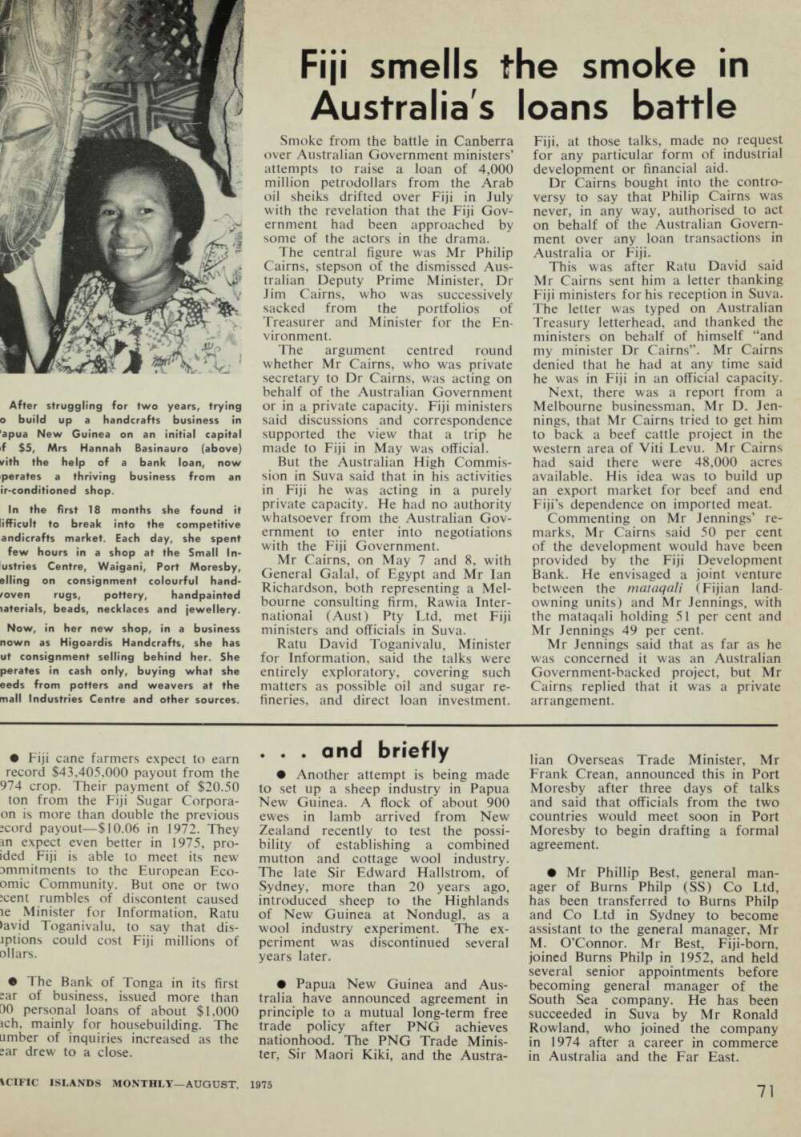
After struggling for two years, trying [?]o build up a handcrafts business in Papua New Guinea on an initial capital of $5, Mrs Hannah Basinauro (above) vith the help of a bank loan, now perates a thriving business from an
ir-conditioned shop.
In the first 18 months she found it [?]ifficult to break into the competitive andicrafts market. Each day, she spent few hours in a shop at the Small In ustries Centre, Waigani, Port Moresby, [?]elling on consignment colourful hand
roven rugs, pottery, handpainted
[?]aterials, beads, necklaces and jewellery.
Now, in her new shop, in a business nown as Higoardis Handcrafts, she has out consignment selling behind her. She perates in cash only, buying what she needs from potters and weavers at the mall Industries Centre and other sources.